Tuesday, March 13, 2007

The price of pencils

I happened to win the second prize in a writing contest organized by Helen Chen (thanks very much to her for putting it all together) and sponsored by the Rochester Public library (in Minnesota). The contest was open to the public; it was judged by some writers who live in the region. The theme was family, broadly interpreted, and the entry had to be no more than 1200 words. My submission is below; it is a memoir from my days in Ahmedabad in western India.

It was through pencils that I came to know of the financial insecurities of my parents. I was in primary school, and we were allowed to use only pencils for our daily work. I was careless and lost so many of my pencils that my mother hid them in the closet; she scolded me severely every time she lent one to me. I learned to value pencils: each one sharpened unevenly with a knife and used until it was a stub that you couldn’t grip anymore. But I learned to value them even more after my father made it clear to me one afternoon – unequivocally and in dramatic fashion – just how much their price was and what that price meant to him.

That afternoon, I rode my bicycle to the stationery store to buy a new packet of pencils. I chose the usual bonded lead ones; the red and black stripes on them smelled wonderfully of paint over wood. When I returned home, the change I thought I had brought back was missing. It was only five rupees – just more than ten cents today, but money nevertheless. My parents weren’t happy. My father and I went back to the stationery store; something in his demeanor suggested that my folly had been a serious one. We asked the cashier, a dark man with glasses, if I had left behind my change. He searched the cash register perfunctorily and shook his head.

My father took me just outside the store.

“Where is the money?” he asked me.

I was trembling; I had no answer. My father scolded me only rarely but I had always feared his silences more than I feared my mother’s frequent reprimands.

“Where is the money?” he asked again, louder this time, and slapped me.

I began to sob uncontrollably. The stationery store and the shops around were busy with people who were now beginning to look in our direction. I was conscious of their presence; it worsened my humiliation and helplessness. My father slapped me again.

The cashier, who had been watching all this and who perhaps wasn’t too enamored of publicity of this sort, called us and said that he wouldn’t mind giving us the money. My father might have taken the money – I am not sure. Strangely for such an eventful day, I do not have any memory of what followed afterwards. The incident itself stands out in my memory, but nothing immediately before or after it has stayed with me.
_

It was only later – the passage of time having put distance and perspective on things – that I began to understand the anxieties that had swirled to a focus that afternoon.

We lived at the time in Ahmedabad, in the state of Gujarat in western India. My parents had emigrated to Ahmedabad from the south Indian city of Chennai, in Tamilnadu, a few years ago. For nearly three years we had been tenants on the upper floor of house owned a joint family, but my parents had always wanted a place of their own. Veedu, or home, was at the heart of their middle class aspirations.

My parents soon bought a cheap, small flat in an area slightly away from the city-center of Ahmedabad. But almost immediately after we moved into the flat, my father had trouble at work and lost his job.

And my parents began to have doubts about their decision to buy the flat: it was unsettling to them that the owners of the other flats in the complex included a chauffeur and a maidservant. My parents were Brahmins, and their caste had given them a high sense of their worth; they felt uneasy living among people of other, traditionally underprivileged castes, who, in the decades after India’s independence, had slowly begun to assert themselves. Had my parents been in Chennai, walking its familiar streets, speaking a language they knew well, their extended families in the area always a comforting presence; in Chennai, such social changes might have been easier to absorb. But in Ahmedabad they felt they were alone.

The only Tamils who lived in close proximity to us were migrant workers who stayed in a messy slum that sprawled adjacent to our flats; they lived in huts that were a haphazard patchwork of sackcloth, wooden poles, and tarpaulin. They too had made an uncertain journey like my parents from southern India. But their poverty meant that we would always avoid them. Their Tamil, my parents said, was the Tamil of the slum: coarse, rough and loud. And we couldn’t speak our Tamil loudly for we feared that if they heard us, they would come knocking at our door, asking for money that my parents were struggling, and mostly failing, to save.

These things – the feeling that the neighborhood wasn’t nice; our forced lowering of voices, to stay incognito from the Tamil migrants who lived in the slum– these things were seemingly minor annoyances, but they weighed heavily on my father. My father was the only one who earned; he felt acutely responsible for how things had gone. He had invested savings from his previous job in the flat but he was now out of work. He pedaled twenty-five miles every day on my bicycle to an industrial town called Naroda in search of part-time jobs; he came back dejected and sweating profusely.

The incident with the packet of pencils happened around this time; and to my father, my carelessness, the easy way in which I lost my change, was an insult; it mocked the situation we were in. And it probably also mocked his efforts in a very personal way.
_

Our troubles continued in years that followed: my father found and lost jobs and we hopped through other cities in western and central India, each move necessitating difficult adjustments. All this time my father never spoke to me of that afternoon. It was only much later – more than a decade and a half later, just three years ago in fact, when our position was relatively secure – that he brought up the topic.

“Do you remember the afternoon when I hit you?” he asked, his face and his voice full of regret. His intent in asking the question partly might have been to see if I’d retained any rancor from what had happened. Since I was aware of this, I tried brush the whole issue aside, so I could convey, indirectly, that I had not carried along harsh feelings.

Our conversation, because of the awkward nature of the topic, didn’t proceed further. And so I wasn’t able to express to my father that that afternoon in Ahmedabad was important. Until then, I had been only peripherally aware of the difficulties that my parents faced; I had shut them away as only children absorbed in their own worlds can. But from then on, my parents’ situation was mine; their hopes, concerns, excitements, disappointments were mine as well. In its own inadvertent way, the incident with the packet of pencils had brought me closer to their world. And if only my father were to know of this, the guilt of that day might weigh less heavily on him.

Wednesday, March 07, 2007

The necessary vanity of a writer


Pankaj Mishra, author of An End to Suffering: The Buddha in the World, says in an interview that writers have to believe in the importance of what they are doing, though such an idea is often delusional:
"... so much of writing is fed by vanity and the feeling that what you are doing is the most important thing in the world and it has not been done before and only you can do it. Without these feelings, many writers would not be able to write anything at all. If you think that what you’re doing is not all that important in the larger scheme of things and that you’re just an insignificant creature in the whole wide world, which is full of six billion people, and that people are born and die every day and it makes no difference to future generations what you write, and that writing and reading are increasingly irrelevant activities, you’d probably never get out of bed. You need to work yourself up into some kind of a state every morning and believe that you are doing something terribly important upon which the future of literature, if not the world, depends. Buddhism tells you that this is just a foolish fantasy. So, I try not to think too much about Buddhism early in the morning. From noon on, I think about it."
The full interview, in which Mishra talks about many different things, is here. Mishra says he used to read a 350 page book in 5-6 hours - that makes me jealous. I feel good if I can finish one in two weeks. And while I am at it, let me confess that I am also jealous of how prolific this young man is.

The illustration of Mishra above is by Charles Burns.

Monday, February 26, 2007

Books this year

I've finished three great books this year. I enjoyed reading these books during nights and weekends as the temperature outside dropped to well below 0 F. The cold, unbearable at times, was a blessing in other ways: I had enough time to sit on my cushioned chair in the living room and read, or laze in the bedroom and read, occasionally looking out to see the snow, ever present and brilliantly white in the backyard.

But these are extraneous details; on to the books now.

1. In Spite of the Gods: The Rise of Modern India: Edward Luce’s insightful book on modern India, its politics, economic boom, social tensions, communal problems and lots more.

2. The Oregon Trail: Sketches of Prairie and Rocky-Mountain Life: To understand a country, one has to sometimes understand the critical periods in its history. For the United States, one such critical period was the mid nineteenth century when it expanded westward, spurred by the idea of Manifest Destiny and the gold rush in California. Francis Parkman, in his travel narrative through the great plains of the Midwest, provides an invaluable glimpse of the time.

An excerpt from the book is below. At this point of the narrative, Parkman is somewhere near the Nebraska-Wyoming border in 1845, in the vicinity of the Dakota Indians. Note especially the description in the last sentence of how a procession of Anglo American emigrants and the encamped Dakotas chance upon each other, and how Parkman uses the encounter to make a startling prediction about the Dakotas - something that almost came to pass. To be sure, Parkman's condescension and his prejudices, which the book is full of and which reflect the sensibilities of his time, were part of the problem.
“Not far from the chief stood a group of stately figures, their white buffalo robes thrown over their shoulders, gazing coldly upon us; and in the rear for several acres, the ground was covered with a temporary encampment. Warriors, women, and children swarmed like bees; hundreds of dogs of all sizes and colors ran restlessly about; and close at hand, the wide shallow stream was alive with boys and girls and young squaws, splashing, screaming and laughing in the water. At the same time a long train of emigrants with their heavy wagons was crossing the creek, and dragging on in slow procession by the encampment of the people who they and their descendents, in the space of a century, are to sweep from the face of the earth.”
3. 1491: New Revelations of the Americas before Columbus: Most of what we read, we already know: indeed, there is something reassuring in what is familiar to us. But books like Jared Diamond’s Gun Germs and Steel are unique in that they can turn things on their head and change our ideas of why history is the way it is; despite their simplifications – and Diamond is guilty of a few – they can give us new ways of looking at the world.

Charles Mann’s 1491 is such a book. Mann brings the American continent before Columbus's arrival to life as never before: summarizing new findings in archaeology and anthropology, Mann reinterprets what we know of the Incas and the other older cultures of the Andes; the Amazonians; the Mayans and the Mexicas of the Central America; the Massachusett, the Patuxet, and the Narraganssett of New England; the Cahokia cultures of the Mississippi, and many others. And along the way he also explains how disease silenced an entire content in such a way that one can only despair at what might have been. In the excerpt below, Mann writes of what this loss means to the world:
“Having grown separately for millennia, the Americas were a boundless sea of novel ideas, dreams, stories, philosophies, religions, moralities, discoveries, and all other products of the mind. Few things are more sublime or characteristically human than the cross-fertilization of cultures. The simple discovery of by Europe of the existence of the Americas caused an intellectual ferment. How much grander would have been the tumult if Indian societies had survived in full splendor!…Along with the unparalleled loss of life, this [exchange of ideas between cultures] is what vanished when smallpox came ashore.”

Tuesday, February 13, 2007

About a trip to Lothal


In Ahmedabad, when I was in my fifth standard, I went with my classmates on a day trip to Lothal. Our teachers had made an excellent choice: there could not have been a more direct way to introduce us kids to history. But I wasn’t interested; I was too busy, during the trip, in trying to get the attention of Palak, a girl who sat next to me in class. I remember playing either badminton or Frisbee with her outside the museum building in Lothal; it was the high point of my day. And on the return trip home, I remember looking through the tinted glass windows of our specially rented bus and working myself into a romantic thrall by playing in my mind, over and over again, a maudlin Bollywood song of the time - the title song from the Rishi Kapoor-Sridevi starrer Chandni.

Some vague memories of Lothal have remained: the ruins for which the site is famous; and the displays well preserved in glass cases at the museum. I am aware that even without the distraction of Palak I was quite incapable, at that age, of comprehending the significance of Lothal. But with the sort of thirst I have for history now, no excuse will do: I feel like kicking myself for not having been more attentive or exhibited some curiosity.

Lothal, of course, was one of the urban centers of what is today collectively referred to as the Indus Valley civilization, which flourished about five thousand years ago (the Wikipedia links provide excellent information on this). So I hope to do proper justice the next time I visit Lothal. And perhaps I’ll make it up also by visiting Harappa and Mohenjodaro - cities that were contemporaries of Lothal, and that are now in modern day Pakistan.

Other places I would love to visit: Takshashila (or the anglicized Taxila), also in Pakistan, where, roughly two millennia after the decline of the Indus valley civilization, the wily Chanakya and the brilliant Sanskrit grammarian Panini are supposed to have studied; and, to turn now to some cultures halfway across the world, I'd also like to visit the Mayan sites of Chichen Itza and Tikal, Machu Picchu of the Incas in Peru, and finally, closest to where I am now, the 11th century Cahokia mounds of the Mississipian Native American cultures near St. Louis.

The image above is a recreation of Lothal as envisaged by the Archaelogical Survey of India. Credit for the image also goes to this group and website.

Monday, February 05, 2007

Christopher Kremmer interview


There's an excellent interview of Christopher Kremmer, author of Inhaling the Mahatma, on Chandrahas' blog The Middle Stage. Here is an excerpt of some of Kremmer's thoughts on narrative non-fiction:

"It [narrative non-fiction] is a very post-modern form, and the writer needs to be open to the multi-faceted nature of truth. A building might look beautiful from outside, but at the back it could be a garbage heap. Look at people and things from different angles. Another thing is that you have to be prepared to reveal who you are. These are not objective books, in the traditional sense, so we need to know who is this person who is taking us through northern Afghanistan, or northern India. What’s their background? Why should be trust them? Because the books sometimes don’t have a strictly defined plot, the voice of the narrator is very important in holding it all together and making the reader turn the page. And characters. Don’t forget the absolute necessity for bringing people alive on the page. There has never been a good book that lacked humanity."

Wednesday, January 17, 2007

Zadie Smith on writers and writing


The British writer Zadie Smith, author of White Teeth and On Beauty, has an insightful article in the Guardian on writers and writing. Writing, she says, isn't merely a matter of skill:
"A skilled cabinet-maker will make good cabinets, and a skilled cobbler will mend your shoes, but skilled writers very rarely write good books and almost never write great ones. There is a rogue element somewhere - for convenience's sake we'll call it the self, although, in less metaphysically challenged times, the 'soul' would have done just as well."
In Smith's view, there's something incomprehensible involved in making a great work, and that something is linked to the writer's personality. The idea may be simple and elemental, but I haven't read anything elsewhere that expresses it in as nuanced and beautiful a way as she does in the sentences below:
"A writer's personality is his manner of being in the world: his writing style is the unavoidable trace of that manner. When you understand style in these terms, you don't think of it as merely a matter of fanciful syntax, or as the flamboyant icing atop a plain literary cake, nor as the uncontrollable result of some mysterious velocity coiled within language itself. Rather, you see style as a personal necessity, as the only possible expression of a particular human consciousness. Style is a writer's way of telling the truth. Literary success or failure, by this measure, depends not only on the refinement of words on a page, but in the refinement of a consciousness, what Aristotle called the education of the emotions."
Read the full article here. Other great articles on writing: Orhan Pamuk's Nobel lecture and Naipaul's article in the New York Review of Books.

Saturday, January 13, 2007

The founding story of Tenochtitlan

Tenochtitlan, the populous lake city of the Mexicas in the 14th and 15th centuries, has always fascinated me. And much of that fascination has to do with the story of the city's founding, memorialized in the dramatic, aggressive image of an eagle perched on a prickly pear cactus, and a serpent wriggling in the grip of its talons and beak.

In his book 1491: New Revelations of the Americas before Columbus, which reexamines Native American societies light of new scientific and archeological evidence, Charles Mann writes of this founding myth:
"The Mexicas [one of the three groups that formed the Triple Alliance in the 14th century, in the region around what is Mexico City today] fled to a swampy, uninhabited island" on Lake Texcoco. "According to an account by Hernando Alvaro Tezozomoc, grandson of the last Mexica ruler, the refugees stumbled about the island for days, looking for food and a place to settle, until one of the priests had a vision in a dream. In the dream, the Mexica's patron deity instructed his people to look in the swamp for a cactus. Standing on the cactus [the prickly pear cactus, called the tenochtli, which inspired the name of the town], the god promised, 'you shall see an eagle, warming itself in the sun.'"
A slightly different version of this is in Empires of the Word: A Language History of the World, by Nicholas Ostler. And since Ostler is an expert on languages, it is worth looking at his translation of the story from Nahuatl, the language of the Mexicas:
"It was prophesied that they [the Mexicas] must settle 'where the eagle screeches, where he spreads his wings, where the eagle feeds, where the fish fly, where the serpent is torn apart.' In the distance, on a prickly pear cactus, they saw this vision, of an eagle eating a snake. A voice cried out: 'O Mexicas, it shall be here!' But no one knew who spoke. They knew that the reedy but defensible islands in the middle of the lake should be their home, Tenochtitlan, 'place of the prickly pear'. It was the year ome calli, '2 House', 1325."
Inspired by this vision, the Mexicas went on to build an astonishing city on the islands of Lake Texcoco: Tenochtitlan was a sight to behold. One can only imagine what might have survived to the present day if disease had not wiped out the Mexicas and other Mesoamerican societies in the wake of the Spanish conquest. In 1491, Mann describes the Spaniards' reaction upon entering Tenochtitlan in 1519:
"Tenochtitlan dazzled its invaders - it was bigger than Paris, Europe's greatest metropolis. The Spaniards gaped like yokels at the wide streets, ornately carved buildings, and markets bright from goods from hundreds of miles away. Boats flitted like butterflies around the three grand causeways that linked Tenochtitlan to the mainland. Long aqueducts conveyed water from the distant mountains across the lake and into the city. Even more astounding than the great temples and the immense banners and colorful promenades were the botanical gardens - none existed in Europe. The same novelty attended the force of a thousand men that kept the crowded streets immaculate."
The Mexico City of today is built over the ruins of the lake city (the lake is now drained) of Tenochtitlan. And the image that guided the Mexicas to build the city now occupies a central place in the flag of Mexico.

Sunday, December 10, 2006

The great movement west

The westward expansion of the United States in the 19th century is one of the pivotal periods in its history. But knowledge of what "the west" meant in this context came late to me. For long I had thought that the west referred to the geographic west of present-day United States, only to the states of California and Arizona, with Texas being a permissible anomaly. But in the United States of the mid nineteenth century, the west referred to lands that lay beyond the Mississippi river.

At the Olmstead County History Center today, I got a more complete sense of how far east the expanding frontier had been. The history center is in Rochester, in southeastern Minnesota, about fifty odd miles west of the Mississippi river (the river forms the tortuous boundary that separates Wisconsin from Minnesota). The exhibits and buildings at the center inform its visitors of the pioneer heritage of the region; there is a recreation of the log cabin of William Dee, one of the region's first settlers in the mid 1850s. At the time, a settler’s journey to this part of Minnesota involved traveling by rail, then a steamship, and finally a horse-drawn wagon. But the long journey was only the beginning. For upon arrival, the settler faced great uncertainty: he was far away from what was familiar; he was in a new land and had little knowledge of how to work it; he had the difficult task of being the first to identify the skills needed to survive.

The nineteenth century movement west - and the subsequent settlement there - has been one of the epic successes of America; and the spirit of those pioneer settlers, of working against odds in a new land, is celebrated and venerated time and again.

A wrought iron marker titled "Our Pioneer Heritage", just outside the main building of the history center – with the flag of the United States on a tall pole nearby – expresses respect and awe:
"The great westward migration which took place in the nineteenth century marked more than a settlement of new land. It gave witness to the birth of a new and unique creed of men. Perhaps no Americans met the challenge of their era so well as did our pioneer fathers. Olmstead County shares in the great traditions of this pioneer heritage. From the shores of the Atlantic, from New York, Ohio, Pennsylvania and Indiana came her first citizens, and here in the valley of the Zumbro, in the land of the north star, they built their homes and raised their families. The way of life we enjoy had its beginning here in the crude log cabins that dotted the countryside.

From the days of the frontier, from the era of the ox-cart and the covered wagon, from the days of the Indian wars, come reflections which make us feel humbly grateful for their sacrifice and courage."
The only discordant note here – in what is otherwise a paean – is the mention of the Indian wars; it is a hint that the land wasn’t as empty and new as it might have seemed. But the guilt of Native American dispossession was swept aside by the perceived inevitability of the expansion. Indeed, for many Americans at the time the expansion was something ordained; it was destined to happen. The term Manifest Destiny came to define this belief.

In John Gast’s allegorical representation of the idea of Manifest Destiny (American Progress, circa 1872, shown in the picture above), Columbia, the female national personification of America (just as Uncle Sam is the male one), is shown as a white beacon of progress, an angel-like figure, leading men westward. She is stringing telegraph wires as she travels; and marching along with her are covered wagons, trains, and pioneers with cattle. At the back of the painting are boats and ships on what is possibly the Mississippi river. And ahead of her, fleeing from the advance, are Native Americans and wild animals; one of the depictions is that of a fleeing herd of buffalo to the left-centre of the painting.

Friday, December 08, 2006

Orhan Pamuk's Nobel speech


In his Nobel speech, Turkish writer Orhan Pamuk, author of the brilliant My Name is Red, muses on writers and writing, and about a suitcase his father left behind. An excerpt:

"A writer is someone who spends years patiently trying to discover the second being inside him, and the world that makes him who he is: when I speak of writing, what comes first to my mind is not a novel, a poem, or literary tradition, it is a person who shuts himself up in a room, sits down at a table, and alone, turns inward; amid its shadows, he builds a new world with words. This man – or this woman – may use a typewriter, profit from the ease of a computer, or write with a pen on paper, as I have done for 30 years. As he writes, he can drink tea or coffee, or smoke cigarettes. From time to time he may rise from his table to look out through the window at the children playing in the street, and, if he is lucky, at trees and a view, or he can gaze out at a black wall. He can write poems, plays, or novels, as I do. All these differences come after the crucial task of sitting down at the table and patiently turning inwards. To write is to turn this inward gaze into words, to study the world into which that person passes when he retires into himself, and to do so with patience, obstinacy, and joy. As I sit at my table, for days, months, years, slowly adding new words to the empty page, I feel as if I am creating a new world, as if I am bringing into being that other person inside me, in the same way someone might build a bridge or a dome, stone by stone. The stones we writers use are words. As we hold them in our hands, sensing the ways in which each of them is connected to the others, looking at them sometimes from afar, sometimes almost caressing them with our fingers and the tips of our pens, weighing them, moving them around, year in and year out, patiently and hopefully, we create new worlds."

Tuesday, November 28, 2006

Some books and links to books...

1. Democracy in America: Perhaps one of the best travel books ever written. Alexis Tocqueville, a French historian and political scientist, looks hard at the strengths, impulses, contradictions and problems of the United States in 1835.

2. The Oregon Trail: Francis Parkman's 1840s' account of his travels through Nebraska, Wyoming, Colorado and Kansas, and of his three week stay with the Oglala Sioux.

3. Chach Nama or Tarikh i Hind Wa Sindh: The story of the Arab conquest of the Hindu-Buddhist kingdom of Sind in the seventh century, analyzed superbly by Naipaul in Among the Believers.

4. The Discovery and Conquest of Mexico, 1517-1521: Bernal Diaz del Castillo's eye-witness account of a different conquest at a different time and in a different part of the world. This account tells of the fall of the Aztec and their capital city of Tenochtitlan.

Monday, October 30, 2006

Writing about Africa

I

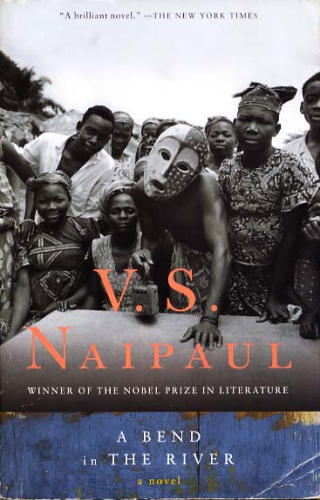
The book jacket of Half of a Yellow Sun is full of praises for its author, the young Nigerian writer Chimamanda Ngozi Adichie. There’s a quote from The Washington Post Book World heralding her as “the 21st century daughter of Chinua Achebe”. There’s an endorsement from Achebe himself: “She [Chimamanda] is endowed with the gift of ancient storytellers…She is fearless or she would not have taken on the intimidating horror of Nigeria’s civil war. Adichie came almost fully made.” But what interested me most was the writer Joyce Carol Oates’s blurb that the “novel is a worthy successor to such twentieth-century classics as Chinua Achebe’s Things Fall Apart and V.S. Naipaul’s A Bend in the River.”

At the Twin Cities book festival two weeks ago, where Chimamanda had come to read from her book, I asked her what she thought of Joyce Carol Oates’s remark; I was interested in the comparison to A Bend in the River. She smiled knowingly; she had been asked that question before.

Chimamanda said she liked some of Naipaul’s work but not A Bend in the River. And her Nigerian publisher had said to her that there was no way that Joyce Carol Oates’ remark could be on the edition of the novel that is to be released in Nigeria later this year. It showed how much Naipaul’s views are not liked in Nigeria, and perhaps, to make a bigger but not unreasonable generalization, in Africa as well.

After her reading, I was lucky to be able to talk with Chimamanda for more than an hour. At some point, I asked her about the character of Zabeth in A Bend in the River. Zabeth appears in the first chapter of the novel; she belongs to an African fishing community; she travels sixty miles, on foot and in barges towed by steamers, to buy items for her village from Salim, the narrator and protagonist of the novel (see this post for more). It was this sketch of Zabeth as a merchant woman, confident and self-assured of her trades, and the short but vivid description of the long journeys she made, that had drawn me into the novel. Zabeth’s character is perhaps the only African character in the novel that Naipaul allows to consistently maintain dignity.

My question about Zabeth did not seem to make an impression on Chimamanda. She was clear and unequivocal about how she felt: “Heart of Darkness was a long time ago, but I know the Africa of A Bend in the River. And I simply cannot consider something that denies Africa its humanity; I simply cannot consider it.”

II

Later, I realized how familiar those words were: for only a week or so ago, I had read the same sentiments in some of Achebe’s essays. In his famous analysis of the racism in Joseph Conrad’s Heart of Darkness, Achebe questions “whether a novel which celebrates this dehumanization [of Africa and Africans], which depersonalizes a portion of the human race, can be called a great work of art.”

Here is an example –a jolting one – of how Africans are thought of by Marlow, the narrator of Heart of Darkness, whose views, Achebe feels, are not different from those of Conrad’s. Marlow states in the novel: “Well you know, that was the worst of it – this suspicion of their [Africans] not being inhuman.”

Achebe writes of Marlow’s comment: “A more deadly deployment of a mere sixteen words it would be hard to imagine. I think it merits close reading. Note first the narrator’s suspicion; just suspicion, nothing more. And note that even the faint glimmer of apparent charitableness around his speculation is not, as you might have thought, a good thing, but actually the worst of it! And note, finally, the coup de grace of double negation, like a pair of prison guards, restraining that problematic being on each side.” Achebe is exceptional at insightful analysis of this sort: very carefully, he unearths the notions that lie behind words, notions that, especially when they come from someone as famous as Conrad, can go a long way in advancing and sustaining misconceptions.

And to those who dismiss such criticisms of Heart of Darkness with the excuse that racism was not yet an issue when Conrad wrote the book, Achebe has this superb rejoinder:
“In the preface of his, famous book, The Souls of Black Folk, he [W.E.B. Du Bois] wrote: ‘The problem of the Twentieth century is the problem of the color line.’ The verb he used is interesting: is instead of will be. And he wrote his words not during the 1960s Civil Rights marches in America as the tone might suggest to some, but actually in 1903 – ‘at the dawning of the Twentieth Century’, as he himself put it, and only a one year later than Conrad’s Heart of Darkness. This chronology is of utmost importance. Therefore the defence sometimes proffered: that Conrad should not be judged by the standards of later times; that racism had not become an issue in the world when he wrote his famous African novel, will have to clarify whose world it is talking about.”
Naipaul has often been compared, in a positive sense, to Conrad: the Swedish academy, announcing the 2001 Nobel Prize in literature called Naipaul “Conrad’s heir as the annalist of destinies of empires in the moral sense: what they do to human beings.” But Naipaul is also talked of in the same breath as Conrad because the criticisms of Conrad apply to him as well; in his writings Naipaul reduces Africa to a generic “bush”. In one particular passage of A Bend in the River, the protagonist and narrator Salim – whose own views are inseparable from those of Naipaul’s – writes this:
“I asked for a cup of coffee…it was a tiny old man who served me. And I thought, not for the first time, that in the colonial days the hotel boys had been chosen for their small size and the ease with which they could be manhandled. That was no doubt why the region had provided so many slaves in the old days: slave people’s are wretched, half-men in everything except their capacity to breed the next generation.”
A Bend in the River is viewed by many as a modern Heart of Darkness. Both are admired in the West, but for Africans, and critics like Achebe, they are both classic examples of superbly written books that give little consideration to Africa.

Finally, here is a scathing critique of contemporary writing on Africa in Granta 92: The View from Africa by the Kenyan writer Binyavanga Wainaina. Wainaina’s sarcasm is razor-edged and there's a hint of it even in the article's title, "How to write about Africa". Here are some excerpts:
“Always use the word ‘Africa’ or 'Darkness' or 'Safari' in your title. Subtitles may include the words 'Zanzibar', 'Masai', 'Zulu', 'Zambezi', 'Congo', 'Nile', 'Big', 'Sky', 'Shadow', 'Drum', 'Sun' or 'Bygone'. Also useful are words such as 'Guerrillas', 'Timeless', 'Primordial' and 'Tribal'…. Never have a picture of a well-adjusted African on the cover of your book, or in it, unless that African has won the Nobel Prize. An AK-47, prominent ribs, naked breasts: use these…In your text, treat Africa as if it were one country. It is hot and dusty with rolling grasslands and huge herds of animals and tall, thin people who are starving… Establish early on that your liberalism is impeccable, and mention near the beginning how much you love Africa, how you fell in love with the place and can't live without her. Africa is the only continent you can love—take advantage of this… Bad Western characters may include children of Tory cabinet ministers, Afrikaners, employees of the World Bank. When talking about exploitation by foreigners mention the Chinese and Indian traders. Blame the West for Africa's situation. But do not be too specific… Always end your book with Nelson Mandela saying something about rainbows or renaissances. Because you care.”

Tuesday, October 17, 2006

VS Naipaul’s A Bend in the River , and related thoughts

I

In Naipaul’s A Bend in the River, the protagonist and narrator, Salim, moves from the east African coast to start a new business – and with it, he hopes, a new life – in the African interior. Salim’s ancestors are from Gujarat in India but his family has lived on the African coast for many generations; they are a family of traders, with links to the Indian Ocean coasts of Arabia, Persia and India. In Salim’s words: “The coast was not truly African. It was an Arab-Indian-Persian-Portuguese place, and we who lived there were really people of the Indian Ocean. True Africa was at our back.”

Salim decides to leave his family and move by himself to a town in Central Africa at the bend of a great river; the town, the river and the country, though very obviously Kisangani at the bend of the Zaire and in what was then the Zaire (the novel is set in the 60s and 70s), are never mentioned. Naipaul, presumably, uses this technique so he can make certain abstractions that might have otherwise not been possible.

The novel is essentially an account of the tensions of being an expatriate – rootless, and with nothing to return to – in a place that is coming painfully to terms with modernity. Naipaul’s spare and contemplative prose brings these tensions sharply into focus. His capacity for historical understanding and self-assessment is remarkable; and his insightful but sometimes sweeping generalizations of civilizations and peoples are there throughout the novel.

Here is Salim, writing of his family’s lack of understanding of themselves:
“My family was Muslim. But we were a special group. We were distinct from the Arabs and other Muslims of the coast; in our customs and attitudes we were closer to the Hindus of northwestern India, from which we had originally come. When we had come no one could tell me. We were not that kind of people.” And later: “ Neither my father nor my grandfather could put dates to their stories. Not because they had forgotten or were confused; the past was simply the past.”
Whatever knowledge that came to Salim of the past achievements of his coastal community came, ironically, from the ruling Europeans:
“All that I know of our history and the history of the Indian Ocean I have got from books written by Europeans. If I say our Arabs in their time were great adventurers and writers; that our sailors gave the Mediterranean the lateen sail that made the discovery of the Americas possible; that an Indian pilot led Vasco da Gama from East Africa to Calicut; that the very word cheque was first used by our Persian merchants – if I say these things it is because I have got them from European books. They formed no part of our knowledge or pride. Without Europeans, I feel, all our past would have been washed away, like the scuff marks of fishermen on the beach outside our town.”
Of Europeans – and this is a classic example of one of Naipaul’s illuminating abstractions – Salim says:
“Europeans could do one thing and say something quite different; they could act in this way because they had an idea of what they owed to their civilization It was their great advantage over us. The Europeans wanted gold and slaves, like everybody else; but at the same time they wanted statues put up to themselves as people who had done good things for the slaves. Being an intelligent and energetic people, and at the peak of their powers, they could express both sides of their civilization; and they got both the slaves and the statues.”

II

People from many different tribal backgrounds live in the Central African town that Salim has moved into; they have come from villages around to make a living in the town. Even in periods when things are going well and business is booming there is always a feeling that collapse will come soon, that the town will go back to being a ruin just has it had at the time of the country’s independence. Salim writes, in this passage, of how different it is for the Africans of the region than it is for the expatriates in town from various countries:
“I began to understand how simple and uncomplicated the world was for me. For people like myself and Mahesh” – Salim’s friend of Indian origin – “and the uneducated Greeks and Italians in our town, the world was really a simple place. We could understand it, and if too many obstacles weren’t put in our way we could master it. It didn’t matter that we were far away from our civilization, far away from the makers and doers. It didn’t matter that we couldn’t make the things we liked to use, and as individuals were even without the technical skills of the primitive people [Africans of the region]. In fact, the less educated we were the more at peace we were, the more easily we were carried along by our civilization or civilizations.

“For Ferdinand” – an African young man that Salim knows in the town – “there was no such possibility. He could never be simple. The more he tried, the more confused he became. His mind wasn’t empty, as I had begun to think. It was a jumble, full of all kinds of junk.”
What Naipaul seems to be suggesting is that being part of a civilization or a heritage – however distant you may be from it or however peripherally you may be associated with it: just as the Indians, Greeks and Italians in town were – could somehow give you a certain dignity and a sense of your own importance. What he is also suggesting is that the backwardness of the Africans Salim is writing of is such that they have nothing to look back to. There’s a hint of condescension and snobbishness in this assessment; it is a feature of Naipaul’s writings; in other parts of the novel Naipaul’s prejudices are more directly stated (more on that in the next post). Presumably the backwardness or primitivism Naipaul is talking about refers to village ways, ancestor-worship and animist ways, ways that were mostly self-contained and had never been in any broad sense part of a larger empire or tradition. And the encounter of these backward Africans with modernity, with European achievements and colonization had left a wound; it had filled African minds like those of Ferdinand’s with “all kinds of junk”.

III

In some roundabout way, this idea of having a tradition or a heritage to fall back upon brought to my mind a documentary I had seen two years ago on PBS.

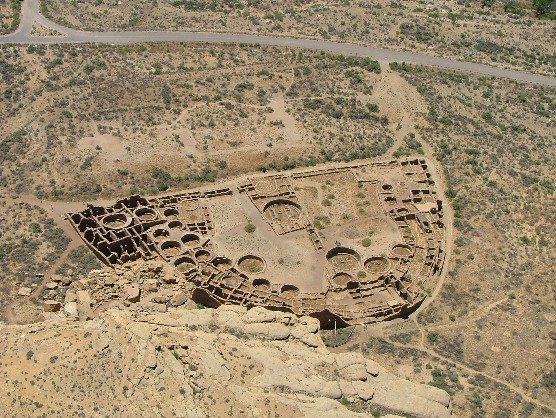
The documentary was on Chacoan society, which had flourished in the arid canyon-country of New Mexico from the eighth to tenth centuries and had then declined. The focus of the documentary was mostly on the achievements of Chacoans: their comprehensive knowledge of astronomy hinted at by the precise alignment of the roads, by the nuances in their architecture – multistoried buildings and plazas (the picture below shows an aerial view of one of these plazas) – and by the sophistication of the solstice marker on a rock of one of the buttes.


The program also featured short interviews with the team of archaeologists and researchers involved in the attempt to understand the religious and cultural sensibilities of the Chacoans. One of the team members was from a Puebloan tribe of the southwestern United States. He said that the Chacoan period with its achievements indicated something very important. “It shows,” he said, “that our people too were very intelligent.”

The Puebloans are descendents of the Chacoans, but they do not always react to their Chacoan past like this. There’s generally a lot more ambivalence: there’s a shroud of secrecy about the Chaco period, and a tendency to reject and disown it because oral histories suggest that it had ended violently. But the Puebloan man’s comment in the documentary that his people had had unique capabilities (strange that something like that had to be stated) was really a response to contemporary realities: so much today is defined by the West, and strong has been its labeling of other cultures, that claiming past accomplishments – the grandeur and ambition of which is absent today – becomes important.

I came across something similar recently in a program on the history of the Sahara; and what I heard was like an echo of what the Puebloan man had said.

A brief part of the documentary was on the kingdom of Timbuktu in Western Africa, in present day Mali. At its height during the first half of the second millennium, the kingdom had benefited immensely from the trans-Saharan trade in gold, slaves and other commodities. There had been a famous university and an extensive library. Today the town is an impoverished state. But from what was being shown in the program, it appeared that the library, or at least some of its books were still intact. There was a brief interview of a Malian man – probably a historian or scholar – dressed traditionally in a tunic and cap. He said: “This,” [the library with all its evidence of learning], “shows that we Africans have a past as well. Not all our stories were oral; we had a written tradition too.”

It was there again: the urge to talk back, redress prevalent attitudes; and the glories of the past and his knowledge of his own history had given the Malian scholar a strong sense of himself.

One of the most eloquent voices in this business of talking back, of arguing and pointing out the prejudices that lie behind Western perceptions of Africa, has been that of the Nigerian writer Chinua Achebe. Achebe, in many of his essays, systematically lays bare these perceptions that come cloaked and hidden in various forms. He does it with reasoned arguments, with wit and sarcasm.

But more of that in the next post – this post has already gotten too long and I've digressed a bit :)

Thursday, September 28, 2006

Coming up

in the next few weeks, or fortnights maybe: some thoughts on VS Naipaul’s A Bend in the River; critical reviews by Nigerian writer Chinua Achebe, famous most for his 1959 classic, Things Fall Apart, but also well-known for his taking apart of Joseph Conrad’s Heart of Darkness, which is generally regarded as one of the classics of English literature; and finally, thoughts on a couple of chapters of what I feel is a remarkable recent book of narrative historical non-fiction, Middle Passages: African American Journeys, by James T Campbell. And I hope I can also say something – though I am not sure – about this PBS documentary, especially in the context of Campbell’s book.

So I guess I’ve got my work cut out now :)

Thursday, September 21, 2006

The Lost Boys of Sudan


I

Lost Boys of Sudan is a documentary that follows the stories of two orphaned Sudanese refugee youth, Peter and Santino, from the time just before they left Sudan, to twelve months after their arrival in the United States. Both Peter and Santino, like many other young men and women, were orphaned by the protracted civil conflict in Sudan. The documentary presents selected day-to-day occurences (mostly in the United States) as they happened to Peter and Santino. The method is an effective one; it captures the refugee experience very well; and, judging from its reach and its popularity, the movie appears to have touched a chord in audiences all over the United States.

I saw the movie two years ago in Tempe, Arizona, at a local coffee shop. A refugee help group, consisting of mostly young volunteers, had organized the screening. The small room in which the movie was shown was packed. And at the end of the screening the audience could meet and talk to three Sudanese youth who had been through experiences similar to those shown in the movie, and were now refugees in the Phoenix area.

The Sudanese young men stood out in the crowd. They were thin and very black. It was one of things that Santino had talked about in the movie: his blackness and appearance set him apart from everyone, even African Americans. (In the movie, there are several pronouncements on African Americans: even before leaving Sudan, Peter and Santino are advised to avoid blacks who wear baggy pants and do “all the bad things in America”).

The Sudanese men were like celebrities that night at the coffee shop. But they took the attention very well; they seemed almost to bask in it. And for a moment – seeing their big smiles, hearing their confident answers to questions, hearing of their eagerness for education and degrees – it was easy to forget the tragedies and difficulties they had been through, and continue to go through: the loss of their parents, the break-up of their tribal communities, the uncertain political situation back home, and their solitude in America.

II

I somehow had the mistaken notion that there were different versions of the movie; I thought that each version would focus on a different set of Sudanese refugees. This was why I attended a screening of the movie at the public library, just two days ago, in Rochester, Minnesota. It was the same movie, but in other ways the experience was different.

At the screening, I met Gabriel, a Sudanese refugee - yet another of the many "lost boys", to use the movie's term, in the United States. I thought that Gabriel – and perhaps others who would shortly be there – had been invited to meet and discuss with the audience, just as at the Tempe screening. But it wasn’t so. Gabriel was the only Sudanese refugee at the library that night. He had come with a notebook; he had come because the instructor of one of the classes he was taking at the local college had asked him to attend the screening. In a way, it was ironic: Gabriel would see in the movie what he knew very well; and even without seeing it he could probably have written just as vivid an account.

Gabriel too was lean and very black. He was dressed plainly in dark pants and a striped, full-sleeve shirt that he hadn’t tucked in; he wore white sneakers. And because he was shy and reserved, he seemed to be quietly carrying the grief of his past within him.

Gabriel hadn’t seen the movie but he knew some of the refugees in the movie; he had come to the US with them at the same time, just a week before Sept 11, in 2001. At a couple of points during the screening, he turned to tell me (I was seated next to him) of the people he recognized in the movie. Some of the scenes – such as the singing of Sudanese songs and slogans of liberation; the dances of the villagers; the reunion of the lost boys at a retreat in Washington a year after their arrival, a retreat that Gabriel had been unable to attend – some of these scenes would have been powerfully nostalgic and painful to him. And I felt it was just as well that he had an assignment to finish that night and could not attend the post-screening discussion: it might have been awkward for him; all the politeness and empathy around him might have made him very conscious.

Saturday, September 02, 2006

Sacred Games, by Vikram Chandra

After Suketu Mehta’s Maximum City, a wide-ranging work of non-fiction on the city of Mumbai, Vikram Chandra’s voluminous Sacred Games traverses the same terrain differently: the 900-page book, as the review in Outlook describes it, is “a vertiginous crime thriller in the style of a Hindi potboiler”; the book “has two heroes but its true star is the impossible and impossibly seductive city of Bombay.” See the full Outlook review of the book here, and Chandrahas’s review here.

Friday, August 04, 2006

My grandfather and my name

My name causes much frustration for those who have to type or print its full snake-like length; it elicits wry smiles from those who realize that even an attempt to say it right would be futile. My long cumbersome name which recalls popular and powerful deities might have been shorter had it not been for my grandfather’s insistence.

I last met my grandparents a year ago at their rented house in a residential alley of Perambur, in Chennai. I knew my grandpa wasn’t well, but that hadn’t prepared me enough: I was shocked to see him shriveled and bed-ridden, resting uncomfortably on a water bed against a stack of ten pillows, wincing at every movement, his skin wrinkled and gray. He called me to his side, took my hand, kissed it, and with respect, touched his forehead with it. I was overwhelmed by the sentimentality of the moment, by his unexpected show of reverence, and it was only with some sustained effort that I controlled my emotions.

My earliest memory of being with grandpa is at the Menambakkam airport where through a meshed grill he showed me great winged things that, twenty odd years later, still fascinate and terrify me in equal measure. I had accompanied him then on his morning walk, a part of his unshakeable daily routine. And after all these years, segments of his routine are what I remember most. Every night, soon after the news ended at nine, my grandfather would hang the yellow tote-bag at the gate for the milkman, remove his dentures, spread his mattress on the floor, place a torchlight by his side so he wouldn’t have to grope in the pitch darkness of early morning, and go to bed. As he slept, his fingers would move intermittently of their own accord: subconscious, still-persisting rhythms of his working days when he had typed, for a meager monthly income, hundreds of documents as a clerk for India Pistons.

The precision of his routine was equaled or surpassed only by the precision with which he dealt with financial matters. He was sometimes known to be cold and calculating when it came to monetary issues. And so when I handed him an envelope with some money from my earnings, my grandma, still at her witty and sardonic best, lightened the somber ambience: "Now that he’s sniffed dollars, there's nothing stopping him from prancing around despite his fractured leg."

I left that afternoon, wondering if my grandpa would get to his 90th birthday next January, or whether I’d be able to see him again. My grandpa did make it to his 90th birthday. He died on his birthday, on Jan 14 this year, also the day on which Pongal is celebrated. His memory will live on in many ways: in the minds of those who had been close to him; in framed photographs and albums; in the Brahmanical ceremonies organized by his sons, ceremonies that will time and again commemorate his passing away. The Jagannathan in my name (often confused as a middle name) is always referred to by my parents as grandpa’s special contribution; and it will be one way I shall remember him.

Tuesday, July 11, 2006

Odds and Ends

I have nothing substantial to post and this has been the case for a while now. There’s an article I am working on but that will take a while to finish. So, to keep things going, this will be a filler post consisting of some quotes and some links from here and there – odds and ends really, with no unifying theme.

1) Pankaj Mishra recently wrote an article in The Guardian that was lambasted in the blogging world. Salil Tripathi's very civil and measured response to Mishra's article can be found here; Mishra writes to Tripathi here; and Tripathi writes back again.

2) On to Naipaul, whose books and travel writing I can’t stop reading and who continues to intrigue me. I am currently reading A House for Mr. Biswas, undoubtedly one of his masterpieces. Naipaul traces in the book the life of Mohun Biswas – the character is based on his father – in the Trinidad of early and mid twentieth century.

In 1992, Naipaul gave a lecture at the Manhattan Institute, a conservative think tank based in New York. In the opening paragraph, Naipaul is apologetic about the grand title of his lecture, "Our Universal Civilization".

"I've given this talk the title Our Universal Civilization. It is a rather big title, and I am a little embarrassed by it. I feel I should explain how it came about. I have no unifying theory of things. To me, situations and people are always specific, always of themselves. That is why one travels and writes: to find out. To work in the other way would be to know the answers before one knew the problems; that is a recognized way of working, I know, especially if one is a political or religious or racial missionary. But I would have found it hard."

Although he does not mention it directly, Naipaul is referring to western or modern civilization. The lecture is really a paean; and here are some sentences from Naipaul’s finishing paragraph:
“This idea of the pursuit of happiness is at the heart of the attractiveness of the civilization to so many outside it or on its periphery. I find it marvelous to contemplate to what an extent, after two centuries, and after the terrible history of the earlier part of this century, the idea has come to a kind of fruition. It is an elastic idea; it fits all men. It implies a certain kind of society, a certain kind of awakened spirit. I don't imagine my father's parents would have been able to understand the idea. So much is contained in it: the idea of the individual, responsibility, choice, the life of the intellect, the idea of vocation and perfectibility and achievement. It is an immense human idea. It cannot be reduced to a fixed system. It cannot generate fanaticism. But it is known to exist; and because of that, other more rigid systems in the end blow away.”
For some heavy but not scholarly or measured criticism of Naipaul, see Meena Kandasamy’s Casteist. Communalist. Racist. And Now, A Nobel Laureate.

3) Some excellent blogs I’ve come across in the last month or so: Samanth Subramanium and Chandrahas Chaudhry.

Monday, June 19, 2006

Blogging, almost a year on

In July – July 21st to be exact – it’ll be a year since I started blogging. But since July will be a busy month and I don’t expect to post much, I’ve decided to go ahead and do the looking-back-in-retrospect thing right now, more than a month early. :)

I had been skeptical about blogs and blogging and it was only after some conversations with Brewtus (thanks very much to him) that I decided to start a blog myself. Almost a year on, I’ve come to realize that blogging has sustained my writing, or whatever little there is of it, in unexpected ways.

So here's a list of my favorite posts:

1. Phoenix, Arizona: First post - a dreamy sort of tone.

2. On alcove residences and Chaco Canyon: This is one of many posts that came out of my frequent road trips to northern Arizona, Colorado, Utah and New Mexico.

3. Empires of the Word, A Language History of the World, by Nicholas Ostler: A casual review but I really enjoyed writing this, and the pleasure of reading this again and again hasn’t gone away either.

4. The Picador Book of Modern Indian Literature and Premchand’s Shatranj ke Khiladi: Casual review again, along the same lines as the previous one.

And now for the next three – the three that I especially like. The ideas for all of them came from a short trip to southern Arizona, close to the Mexico border, in December 2005.

5. Chasing a Mirage
6. The Spanish among the Pimas: Part 1. On matters spiritual and temporal
7. The Spanish among the Pimas: Part 2. The Killing of Saeta

And finally,

8. The atrium and related thoughts: This post is too recent to pass a judgement on, but that’s fine.

Thursday, June 01, 2006

Ahmadinejad's Letter

An interesting find: this is the letter that Iranian president Ahmadinejad wrote a few weeks ago to President Bush.

Thursday, May 25, 2006

The atrium and related thoughts

The atrium of the Renaissance Resort Hotel in Orlando has an imposing presence. It is the central space of the hotel building; the hallways of the ten odd stories of the hotel face the atrium. White-painted metal columns rise from its sparkling floor to the mostly glass ceiling; they end in a series of crisscrossing beams. The glass ceiling allows the sunlight to cast a bright glow on the main space of the atrium, and the conditioned air gives no hint of the humidity outside. There are decorative palms, tall and short, throughout the atrium; there is a waterfall too at one end, and the pleasing sound of water splashing on rocks can be heard from far.

At the center of the atrium is a large birdhouse with glass windows along its sides so that the birds – exotic, with long beaks and unique feathers – incarcerated within can be viewed. The birds are perched on the thin, bare branches of a dramatic-looking tree; they are mostly still but flutter occasionally. Along the circumference of the domed top of the birdhouse are small statues of bearded men, conquistadors possibly, dressed elaborately and holding spears and weapons; the statues alternate with models of ships full of unfurled sails.

The birds, the palm trees, and the waterfall: there is an irony in this attempt to create the impression of a tropical setting. Hotels like the Renaissance Resort are part of entrepreneurial initiatives driven by theme parks and the convention industry of Central Florida; they are part of the effort to recast the landscape and subjugate it to achieve economic ends. But the landscape always manages to make a comeback for we are always enamored of it; we return to it again and again, though in a superficial manner, as in the atrium; we return to it once all conveniences have been established. All that is pristine is desirable but all that is pristine also has to be sanitized.

In the suburban communities of the Phoenix, it is not uncommon to see a saguaro – the tall cactus that in the popular imagination sums up the Arizona terrain – in the front yard of a home. But the solitary saguaro is merely symbolic. For in the ever expanding 26-city Phoenix metropolitan area, where a drive from one end to the other is nearly 100 miles long, where there is talk already of combining Phoenix with the smaller city of Tucson, 90 miles to the south, into one single megapolitan area; in this ever expanding region the desert is constantly being swallowed by new development, the earthmovers are always raking up saguaros, mesquites, palo verdes, and replacing them with smooth pavements and roads, turquoise swimming pools and spacious homes, which in turn spawn their own strip malls and shopping conveniences. And in the midst of all this, the desert plants make their ornamental appearance, along with lush green, heavily watered lawns and golf courses: as incongruous a sight as any.

Monday, May 15, 2006

This Summer on PBS

A Frontline four-part series on AIDS. The preview calls it "The most important scientific and political story of our time". With 70 million infected and 22 million already dead – these are staggering numbers – there can hardly be any doubt. The series (240 minutes in all) examines all aspects of the disease: political, scientific and human.

Unrelated to this, I also found on the Frontline website a documentary, Bolivia: On the Road with Evo, that tries to understand Bolivia’s new leader Evo Morales –the country's first indigenous president – and his left-leaning policies. The 24 minute film is part of Frontline World's Stories from a Small Planet series.

Saturday, May 06, 2006

From Minneapolis to Fargo

Minnesota is known as the land of 10,000 lakes. Only today, as the plane I was in approached Minneapolis, did I actually believe it: the expanse below was wooded in parts and dotted, overwhelmingly, with lakes. It was a surprise for me, understandably, for in Phoenix lakes are either created by dams, or forcibly built in suburbs – complete with ducks, boats, and palm trees along the circumference – to maintain in a water-starved region the illusion of paradise.

On from Minneapolis to Fargo, on to the northern Great Plains region, to flatter- than-flat land apportioned, with some geometrical precision, into massive square tracts of intensively irrigated farms. And in the corner of each square, a home – the farm residence one presumes – well ensconced in a stand of trees.

But the northern Great Plains – they bring to my mind something else: the Plains Tribes, whose fierce warrior dances I had seen and enjoyed at Native American dance events that are better known as powwows.

Sunday, April 30, 2006

Thursday, April 27, 2006

Granta 93: God's Own Countries

Granta is a quarterly magazine that publishes non-fiction and fiction from writers from all over the world. The latest issue is titled God’s Own Countries. Ian Jack, the editor of Granta writes in his introduction:
“For most of the twentieth century, and not only in the West, organized belief in the supernatural was held to be in decline. All of us know the story. Science, rationalism and materialism—usually personified by the Europeans Darwin and Lyell, Marx and Freud—had given religious belief such a bashing that its explanations of how the world came to be, how we came to be in it, how we should best live in it, and what would happen to us after our death—these explanations and the strictures that went with them became, quite simply, unbelievable and disagreeable. The idea of God as creator and custodian died, and many words in the old vocabulary were robbed of their potency, even their meaning: heaven, hell, salvation, sacrilege, blasphemy.

Or so the secularists thought, forgetting the great psychologist William James’s judgement that beliefs do not work because they are true, but true because they work. Today the godly, if not God, have bounced back. As I write, I can see them at work in today’s news...”
God's Own Countries attempts to understand the role religion plays in the world today. There are short articles – titled God and Me – by many well-known writers including Pankaj Mishra and Nadeem Aslam, a writer of Pakistani origin who now lives in England (his most recent novel, Maps for Lost Lovers, received very good reviews). Also, there’s an interview with Orhan Pamuk, one of my favorite writers.

Thursday, April 20, 2006

The Tumacacori National Monument

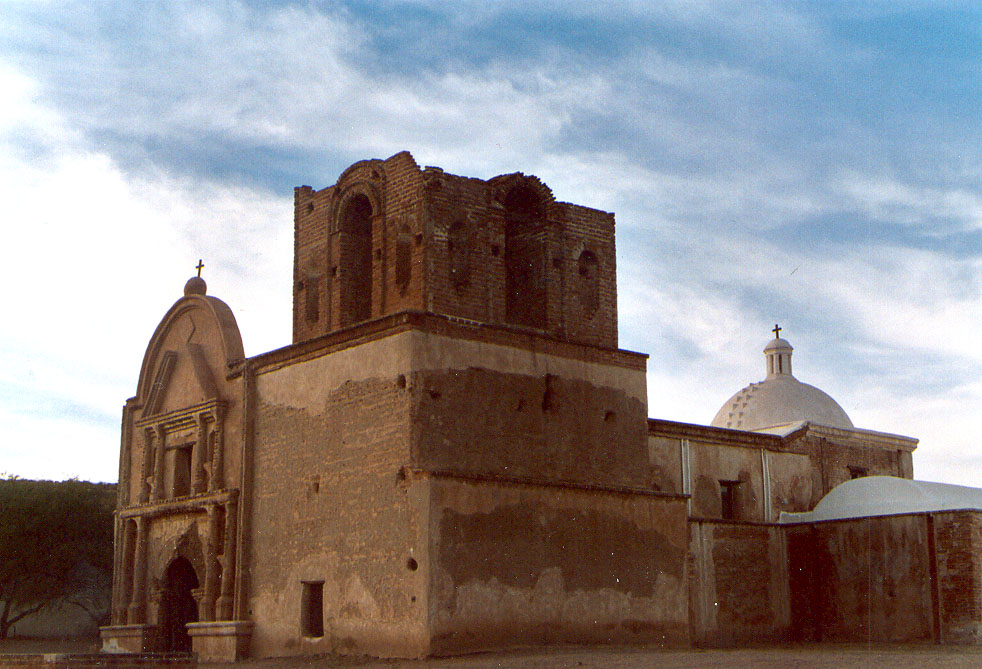
Below is a photograph of the church that is now part of Tumacacori National Monument. The monument is 20 miles north of Nogales and the Arizona-Mexico border. The church was built in the late 1700s under the supervision of the Franciscan priests of the Spanish empire, and was never fully completed (the region was steadily entering a period of lawlessness at the time). But the root of the mission at Tumacacori goes back to the foundations that Jesuit missionary Eusebio Kino (1645-1711) had laid earlier.


The Pima Indians did the actual construction, and something of their style would have surely made its way into the building of the church. The presence of the church in what was then the land of the Pima Indians brings to fore the theme of a revealed religion (specifically Islam or Christianity) ushering in new ideas, new ways of viewing things, but also attempting to erase centuries-old, perhaps millennia-old, earth religions and beliefs. The theme is a persistent one in history.

I visited the church last December; it made me think of the Spanish presence in southern Arizona, and spurred me on to research the history of the time. For more details on this, see posts 1 and 2.

Thursday, March 30, 2006

The Spanish among the Pimas: Part 2. The Killing of Saeta

Some notes before you read on:

1. This article is a continuation my post last month The Spanish Among the Pimas: Part 1. On Matters Spiritual and Temporal

2. Both Part 1 and Part 2 deal with the Spanish period in northern Mexico (the Sonora province) and southern Arizona, in the late 1600s. Two important and primary references for both articles are: Kino’s Favores Celestiales (Historical Memoir of Pimeria Alta; translation by Herbert Bolton); and Manje’s work Luz de Tierra Incognita (Unknown Arizona and Sonora; translation by Harry Karns).

3. Part 2 is mostly about the events of one specific week: March 28-April 2 in 1695. It's interesting that I've posted this article in the same week of this year, exactly 311 years later. I did not arrange this coincidence. I realized this myself only recently.

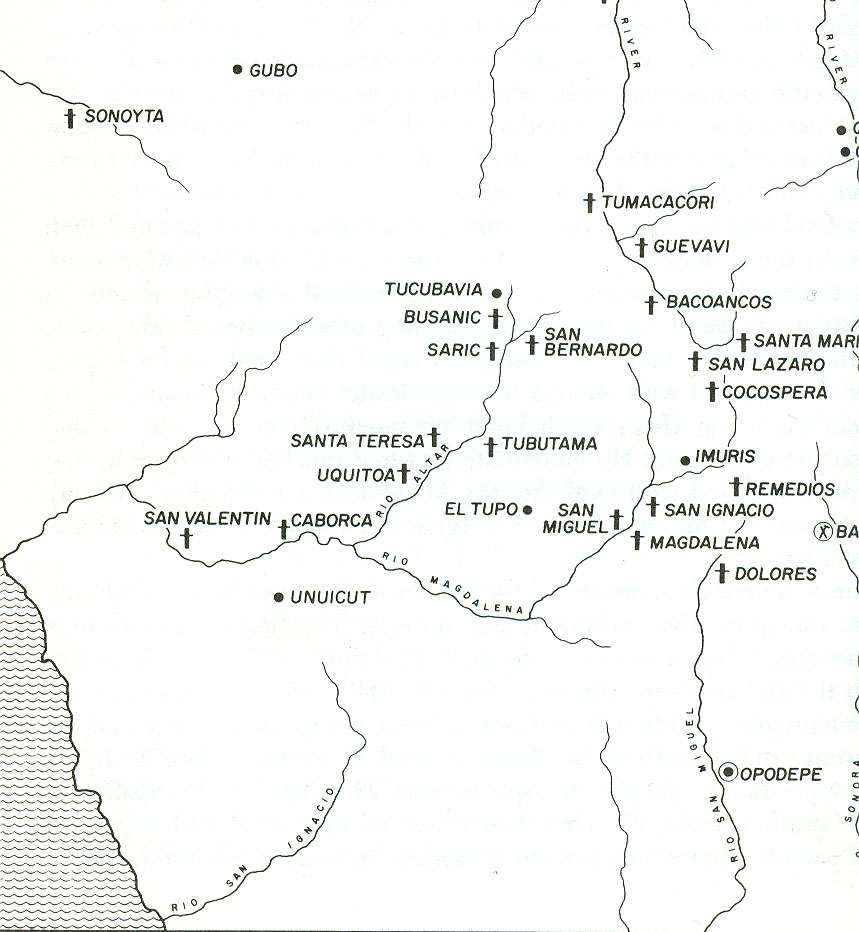
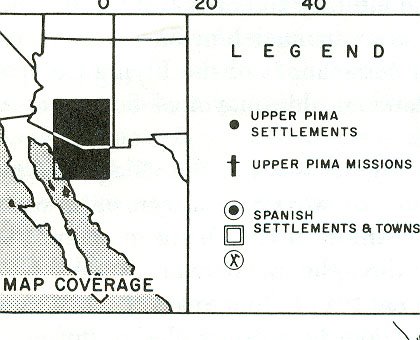
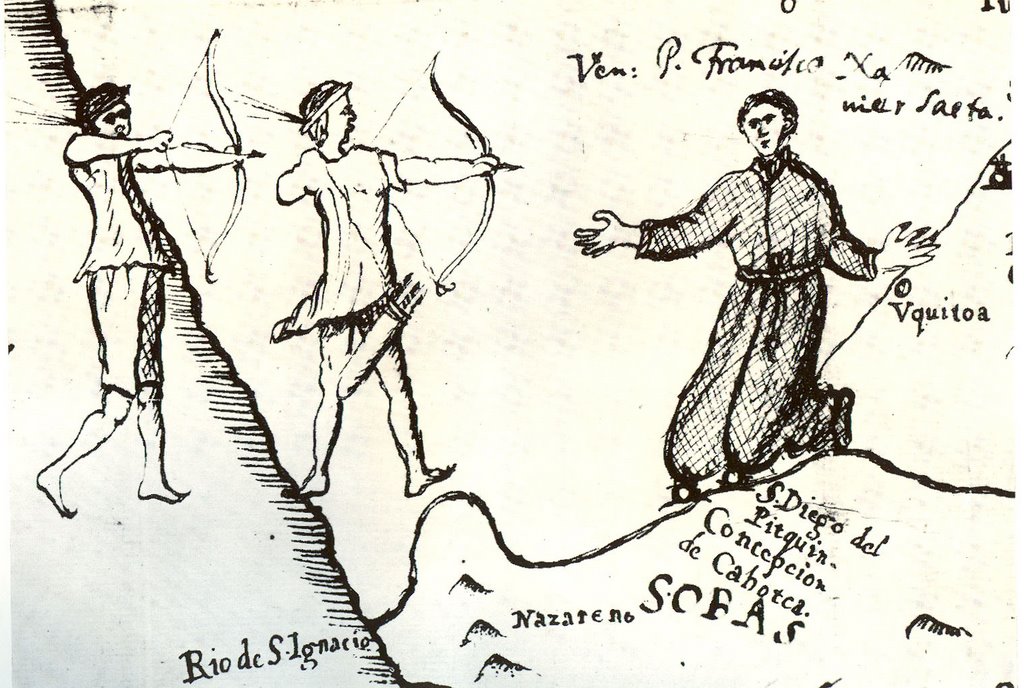
4. The maps showing the region in the late 1600s are from Edward Spicer’s Cycles of Conquest, an excellent book that examines the different ways in which the tribes of northern Mexico and the American Southwest responded to and changed after European incursions. The scanned picture of Kino’s drawing of the killing of Saeta is from Kino’s Biography of Saeta (translated by Charles W Polzer; original Spanish text edited by Ernest J Burrus).

5. There is a prevalence of usages of the type “might have”, “would have”, “in all likelihood”, “most probably” in this article. This is because I have tried to construct things based on very meager facts stated in Kino and Manje’s works.

I

It might seem from Kino’s writings that the Pimas were a docile people, easily giving in to Christianity and the needs of the Spanish. And though this is partly true, there are indications, in some of Kino’s passages, of the dissent that seethed beneath the surface. The slow northward march of the Spanish into the Sonoran desert had dramatically transformed communities in its wake. The world of the Pimas was changing fast, and the suddenness of the change would have been traumatic for many.

As they began their conquest of the Pimas, the Spanish brought with them – for help and labor – Indians from the tribes to the south. Like pollen that get dispersed in unexpected places, Indians from various backgrounds were scattered around by the forces and upheavals of the Spanish conquest. A number of these Indians were Opatas who had not been on friendly terms with the Pimas before the advent of the Spanish. This unexpected juxtaposition of people traditionally hostile to one another brought its own tensions to the mission villages and towns of the time.


Francis Xavier was one such alien Indian among the Pimas. He was most likely a Seri Indian from Ures (not on the map; Ures is further south of the region shown). In the 1660s, around the time that Xavier might have been born, the Spanish had decimated a particularly resistant tribe of two to three hundred people near Ures. The orphans spared of this slaughter were distributed in the villages and towns of the region. Xavier might have even been one of these orphans; at the very least, he might have come to know of the calamities that people around him had been through. Somehow, Xavier picked his way through the difficulties of the time, became a Christian, learnt the Castilian language, retained knowledge of Indian ways, and made himself valuable to the very people who had thrown his lot into tumult.

Due to his skill in languages, Xavier was a much sought-after interpreter; his job took him to the frontier Pima villages of the north. From the experience of his travels and from his knowledge of Spanish and various Indian cultures – the Seri Indian culture that he came from, and the Pima Indian culture that he came to know during his work as an interpreter – Xavier would have developed a unique perspective. But nothing of his perspective is known; in Kino and Manje’s accounts, Xavier is mentioned just once or twice; like all other people not Spanish, he recedes into the background and lingers there as a servile presence.

During his travels, Xavier met and married a Pima girl named Lucia. While Xavier had lifted himself to a position of some importance, Lucia had just been through an immense tragedy. She was from Mututicachi, a village just northeast of Dolores. At one point Mututicachi had had nearly 200 Pimas. In the 1680s, there had been many thefts in the region, of mostly cattle and horses. Spanish understanding of the differences between the tribes of the region was poor. The Jocomes and the Apaches were responsible for these thefts (for many nomadic tribes of the time raiding was a means of sustenance) but the Pimas were blamed for it.

For punishment, the Spanish took all the Pimas of Mututicachi as captives – Lucia was one of them – and some of them were sent off to work in a mining town. Fifty people were beaten to death; many of them might have been Lucia’s relatives. In just a few years, a whole community had been uprooted and brought to the brink of annihilation. But at the end of it all, there was redemption of a sort: the Spanish realized their folly and the captives were released. Lucia then went to Dolores where Kino had his mission. In all likelihood, she found solace and comfort in Kino’s mission, and was baptized there; and Kino probably gave her the name Lucia. It was also in Dolores, sometime in the early 1690s, that Lucia married the interpreter Francis Xavier. The hope of beginning a new life might have helped her assuage the wounds of her past.

II

In 1695, Francis Xavier was in Caborca (west of Dolores). He was working as an interpreter for a young missionary, Saeta, who was in the process of establishing a mission.

Caborca in 1695 would have consisted of a hundred or so Pimas. Most of them lived in simple shelters that had matted roofs supported by wooden poles. Dirt roads connected Caborca with other villages, and messengers and servants constantly traveled these trails, carrying sacks of wheat or maize or cattle or other important trade items, and facilitating written exchanges between missionaries, soldiers and Spanish officials. As news spread that a mission was being established, more people began to move closer to Caborca to avail the temporal benefits – farms, cattle, better clothing – attendant to the presence of a mission. Saeta, the missionary, lived in a small adobe house that also had an altar for worship and other religious items. Outside the house, Saeta had begun a field of wheat and a small vegetable garden.

Not all of Xavier’s work would have involved interpreting. Servants of Saeta worked in the field, herded cattle, maintained the horses, and helped in renovating the only adobe house in the village.

On the morning of April 2, 1695 – it was the Saturday of the Easter weekend – Xavier would have been busy with some such work at the mission, when a band of Pimas, full of aggression, stormed into Caborca with war-like cries. Xavier might have seen them enter the adobe house and slay Saeta; he would have sensed that they would come after him as well. But so sudden and unexpected was the attack that he wouldn’t have had the time to escape or even think clearly. Xavier was killed – probably impaled with arrows – for he was an Indian not of Pima origin, and because he worked for the mission. The band of Pimas also killed other servants of the mission. In all five people died in Caborca that morning.

It is not known if Lucia was also at Caborca. If she was, she most likely saw her husband being killed. Yet again forces beyond her control had played their hand; yet again she found herself surrounded by gloom and tragedy.

III

The angry group that had burst upon the idyll of that morning was not from Caborca. The trouble had started five days earlier in the village of Tubutuma, northeast of Caborca. The Pimas of Tubutuma had felt particularly oppressed by the manner in which the few Opata Indians working at the mission had been treating them.

It is fair to state that the Indians who worked or were connected to a mission, or were servants of a missionary, had a certain amount of privilege. These Indians wore Spanish clothes – which would have had great prestige value – they could travel with the missionary to other villages and receive gifts; they had access to cattle and horses and to fields of wheat and corn; and they felt secure in the knowledge that the might of the much-feared Spanish army was always there to protect missions.

But the privilege also meant that it could be misused. At Tubutuma, there was an Opata servant at the mission named Antonio. He was known for being particularly harsh. His conduct rankled the Pimas all the more as he was an outsider and a condescending overseer of the village. On the Monday of the holy week of Easter in 1695 – five days before the incident in Caborca – Antonio furiously assaulted a Pima foreman on the farm of the mission. He kicked him with spurs in the ribs and the flanks and left the foreman half dead.

It is difficult to piece together exactly what happened at the time, but a crowd of shocked Pimas must have gathered to watch, resentment of Antonio increasing all the time. According to Kino, who got the story from others, the foreman shouted to the crowd: “Look my brothers; this Opata is killing me, protect me! Defend me!” This moved some of the watching Pimas into action: they fired arrows at Antonio and wounded him, and though he tried to escape on a horse they caught up with him and killed him. Two other Opata Indians in Tubutuma were also killed. Suddenly, the Pimas of Tubutuma who had been humiliated under the Spanish and the Opata Indians had found a violent expression to their suppressed rage: over the next few days in Tubutuma and neighboring villages adobe houses that served as churches were burned and looted, sheep were skinned, sacred vestments were profaned and more people killed.

It was this rage – the rage of a discontented people who had been subjugated by others in their own lands – that consumed Francisco Xavier, the Seri Indian interpreter from Ures.

IV

In that manic week of 1695, the Spanish could have lost many missionaries. But luckily none of them happened to be in the villages they were posted in. The only missionary, and indeed the only Spaniard, killed that week was the Sicilian missionary Saeta. Saeta, too, was unwittingly swept away by forces he must have only begun to fathom. He had started the mission in Caborca only in the later months of 1694 when Kino and other established missionaries had provided him with servants, cattle and other necessary items.

Both Kino and Manje have written in detail on Saeta’s death. In contrast, the other deaths are mentioned in a sentence or two. This is not a surprising thing: Saeta was Spanish missionary, and by writing mostly about him, Kino and Manje were writing of the concerns of their own group; Kino, in particular, was writing about a fellow missionary who, before his death, had been in a position Kino himself would have been in at the start of his mission in Dolores eight years ago in 1687.

The description of Saeta’s death is dramatic. The image that comes to mind is that of a fatally injured Saeta dressed in a long, formal missionary robe; the arrows that have pierced him – in Manje’s account there are 22 arrows – are still in place; blood is dripping from his wounds, and poison from the tips of the arrows is slowly taking its toll. He is kneeling in front of the makeshift altar in his adobe house. Firmly clasped in his hands is a beautiful cross, made of a special transparent and elastic material, a cross that Saeta had brought from Europe.

Since no one went close to the mission for days after the attack, the dead bodies rotted away. In the end, a Pima messenger Kino had sent ahead found the dead bodies and burned them in the Pima custom. The messenger also found the special cross that Saeta had held in his dying moments. Perhaps to save such a precious thing from being stolen, he hid the cross in the field of wheat that Saeta had begun a few months ago.

A beautiful cross hidden in a field of wheat: it was a chance occurrence, but there is much symbolism one can draw from this if one wishes to.

V

After Saeta’s death, Kino set about documenting what had happened and ultimately went on to write a biography of Saeta. He also made a drawing that depicted the killing of Saeta. The drawing was made on a map of the region. Caborca at the time was known by its full name La Concepcion de Caborca. The meandering black line shown in the map is the San Ignacio river (it should actually be the Magdalena river; there seems to be a discrepancy here) running into the sea. Indeed Caborca wasn’t too far away from the coast.


VI

The Pima rebellion did not last long. There was no united front; what had happened seemed only to have been a spontaneous, violent reaction of perhaps a hundred or so Pimas. Soon after the news of the rebellion spread, the villages were deserted for most of the Pimas, innocent and guilty, had fled to the hills fearing the Spanish response.

The Spanish reprisal was quick and brutal. Many innocent Pimas were killed in the hostilities that ensued. During their search for the perpetrators of the rebellion, the Spanish military aided by allies from Indian tribes, found a few Pimas who for some reason had been unable to flee to the hills. They interrogated these people, and killed a few here and there. In one case they found a woman, and took her as a prisoner. After questioning her, in Kino’s words “they catechized the woman, baptized her, and flogged her.” Forced conversion, and then the lash of a whip: a glimpse of the cruelties that went on.