Tuesday, July 06, 2010

Pictures of Cuzco, Peru

I've been terrible about posting lately, and for that, my apologies. Last year, I was consistent with eight posts a month, but that kind of target driven writing has its problems. I've been slower this year and that may continue, not because there isn't enough write, but because I hope to produce posts with more content. The pictures and the long excerpts from books, though, shall continue. On that note, here are a few snaps from Cuzco.


Tuesday, June 29, 2010

Human nature and wild nature

Edward Wilson, yet again with a startling insight, in the 25th anniversary foreword to Sociobiology: The New Synthesis:
Human nature – the epigenetic rules – did not originate in cities and croplands, which are too recent in human history to have driven significant amounts of genetic evolution. They arose in natural environments, especially the savannas and transitional woodlands of Africa, where Homo Sapiens and its antecedents evolved over hundreds of thousands of years. What we call the natural environment or wilderness today was home then – the environment that cradled humanity. Before agriculture the lives of people depended on their intimate familiarity with wild biodiversity, both the surrounding ecosystems and the plants and animals composing them.

The link was, on a scale of evolutionary time, abruptly weakened by the invention and spread of agriculture and then erased by the implosion of a large part of the agricultural population into the cities during the industrial and postindustrial revolutions. As global culture advanced into the new, technoscientific age, human nature stayed back in the Paleolithic era.

Hence the ambivalent stance taken by modern Homo Sapiens to the natural environment. Natural environments are cherished at the same time they are subdued and converted. The ideal planet for the human psyche seems to be one that offers an endless expanse of fertile, unoccupied wilderness to be churned up for the production of more people. But Earth is finite, and it still exponentially growing human population is rapidly running out of productive land for conversion. Clearly humanity must find a way simultaneously to stabilize its population and attain a universal decent standard of living while preserving much of Earth’s natural environment and biodiversity as possible.

Conservation, I have long believed, is ultimately an ethical issue. Moral precepts in turn must be based on a sound, objective knowledge of human nature…I am persuaded that as the need to stabilize and protect the environment grows more urgent in the coming decades, the linking of the two natures – human nature and wild Nature – will become a central intellectual concern.

Thursday, June 24, 2010

Pictures from El Alto, Bolivia


El Alto is a Aymara city perched at the rim of the canyon in which the world's highest capital, La Paz, is nestled. So El Alto, at 13,615 feet, is higher than La Paz. It is also poorer, confirming the trend I'd noticed in Andean Peru and in Lima: material wealth diminishes with elevation. The gated communities and the fancy stores are at the lowest points of La Paz. Complexion also changes with the drop in elevation: from Aymara dark brown to Spanish white. Evo, whom I mentioned in my last post, is a hero in El Alto, but the billboards celebrating his election victory disappear as you descend.

Despite the naked brick buildings and the generally unsanitary conditions, El Alto is full of entrepreneurial energy. The city market is full of every imaginable commodity -- second hand cars, cattle, clothes -- and sprawls over dozens of blocks. Some of the prosperity shows in El Alto: the wealthier Aymaras have offices with glass facades on their originally naked brick buildings.

Friday, June 18, 2010

Tiwanaku and Evo Morales

Most of us have heard of the Incas, but they were only the last of a line of empires that rose in western South America. Before them, in the high and mostly dry plateau of the Andes, called the Altiplano, the Tiwanaku flourished. The indigenous Aymara of modern day Bolivia consider themselves descendants of the Tiwanaku. In January 2006, a day before he assumed presidential office, Evo Morales, an Aymara himself, attended a ceremony at the principal archaeological site of of this ancient culture, two hours from La Paz.

The Spanish colonized this part of the world with much brutality in the 16th century; Bolivia became independent in the 19th century but it was a sham independence: the Spanish descended elites still held power. Evo Morales’s remarkable ascension to the highest office in Bolivia in 2006 – he had been a Coca farmer once – was a truly historic moment. Hence the coronation at Tiwanaku. Like the blacks of South Africa, the majority Aymara too were denied for a long time. Evo Morales may be viewed skeptically in the West because he is socialist, but it is from the perspective of indigenous empowerment that his rise is significant. In 2009, a month before I visited La Paz, he was reelected with an even stronger majority.


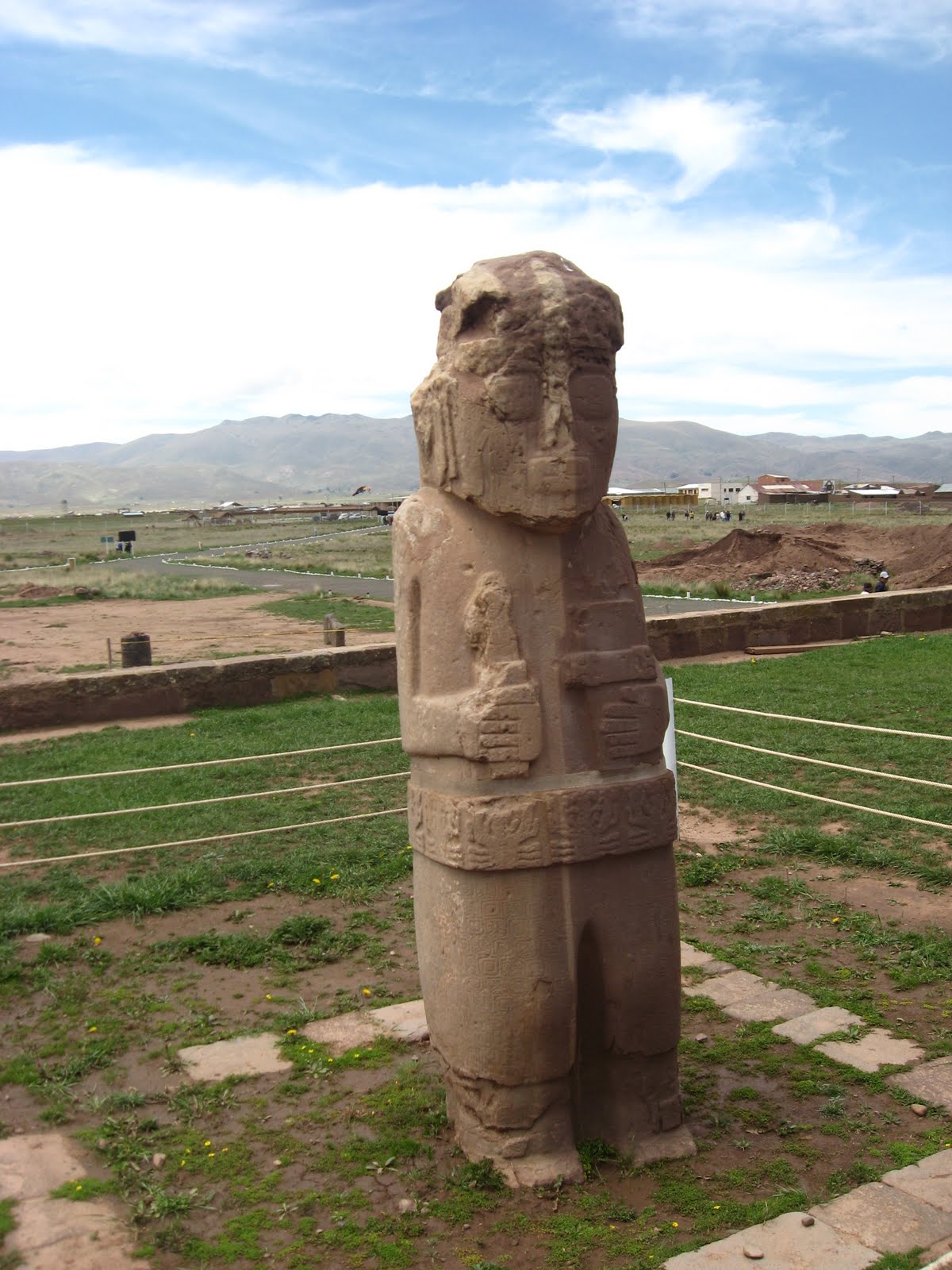
Above, you'll find some pictures of relics from the Tiwanaku site. The Spanish missionaries of the sixteenth century couldn’t let them be. They "exorcised" the spirit of the second relic by scraping a cross on the right shoulder. No doubt, this nasty bit of sabotage stemmed from a deep insecurity. If the God of Christianity was indeed the only worthy and true God, then why did that fact have to be imposed in a coercive manner?

Monday, June 14, 2010

Conquerors, but also cultural carriers

In the marvelous introduction to his book, Genghis khan And The Making Of The Modern World, Jack Weatherford writes,
The Mongols made no technological breakthroughs, founded no new religions, wrote few books or dramas, and gave the world no new crops or methods of agriculture. Their own craftsmen could not weave cloth, cast metal, make pottery or even bake bread. They manufactured neither porcelain nor pottery, painted no pictures, and built no buildings. Yet, as their army conquered culture after culture, they collected and passed all of these skills from one civilization to next.

The Mongols deliberately opened the world to new commerce not only in goods, but also in ideas and knowledge. The Mongols brought German miners to China and Chinese doctors to Persia. The transfers ranged from the monumental to the trivial. They spread the use of carpets everywhere they went and transplanted lemons and carrots from Persia to China, as well as noodles, playing cards, and tea from China to the West. They brought a metal worker from Paris to build a fountain on the dry steppes of Mongolia, recruited an English nobleman to serve as interpreter in their army, and took the practice of Chinese fingerprinting to Persia. They financed the building of Christian churches in China, Buddhist temples and stupas in Persia, and Muslim Koranic schools in Russia. The Mongols swept across the globe as conquerors, but also as civilization´s greatest cultural carriers.

The Mongols who inherited Genghis Khan´s empire exercised a determiend drive to move products and commodities around and to combine them in ways that produced entirely novel products and unprecedented invention. When their highly skilled engineers from
China, Persia and Europe combined Chinese gunpowder with Muslim flamethrowers and applied European bell casting technology, they produced the canon, an entirely new order of technological innovation, from which sprang the vast modern arsenal of weapons from pistols to missiles. While each item had some significance the larger imnpact came from in the way the Mongols selected and combined technologies to create unusual hybrids.

Seemingly every aspect of European life -- technology, warfare, clothing, commerce, food, art,liteature and music -- changed during the Renaissance as a result of the Mongol influence. In addition to new forms of fighting, new machines and new foods, even the most mundane aspects of daily life changed as the Europeans switched to Mongol fabrics, wearing pants and jackets instead of tunics and robes, played their musical instruments with the steppe bow rather than plucking them with the fingers, and painted their pictures in a new style. The Europeans even picked up the Mogol exclamation hurray as an enthusiastic cry of bravado and mutual encouragement.

Monday, June 07, 2010

The Mysore story

In the early 2000s, I wanted to write a short story set in the south Indian city of Mysore. I had been inspired by my travels to the city. The style of the story was a typical response of someone who had just arrived abroad -- I had come to the United States just then -- and feels nostalgic about home. What had once been part of my milieu now was exotic even to me. I never quite finished the story -- there are many failed versions in fact -- but here is whatever I managed to put to paper.

I present this in unedited form, so the typos and awkward sentences have not been corrected -- that is intended to be part of the charm. Or so I hope.


"""""""""

The line between the realms of mythology and reality is often thin and hazy, and sometimes a drifting vagabond never realizes when he has crossed one and is treading on the other. So it was, when, blown by an overnight storm and cocooned by a dark low-travelling rain-cloud, I was carried to the city of Mysore. Like a dream that is often forgotten when a slumbering person wakes up to groggy reality, the dark clouds that cradled me disappeared to reveal a shining morning and a smiling sun, and there wafted in the air the faint but unmistakable scent of sandalwood. I sniffed heartily to olfactory content, and saw a man-sized, live and moving toy, holding incense sticks that burned cheerfully orange at their tips and wore crumbling grey hats of ash.

“Welcome to Mysore,” said the toy. The orange flames burned brighter in acknowledgement. My guide was quite remarkable looking. Though made of sandalwood, his facial feaures and his limbs had the potential of free expression and movement. He had a great black moustache painted above his thick upper lip, and gold earrings dangled on his long Buddha-like ears; a huge red dot adorned his forehead, and a gold crown sat majestically over his head.

He walked and I followed him, but I really just had to follow the trail of scent that he left. We reached a roadside where a tonga stood; the horse that would give us a ride was nodding its head and clicking its hoofs musically in a slow foot dance. “Enter,” said the Sandalwood man grandly, and I did. He guided the tonga smoothly through the roads of Mysore. A quaint atmosphere enveloped me, and I absorbed it while my heart danced in it; there was a song on my lips to the tune of the undulating ride and the soft beats of the horse’s hoofs of the tar road. While I was thus singing to myself, my driver and escort started a lilting song too:

“ Tall eucalyptus and coconut trees
Rustle! Rustle! Rustle! in the gentle breeze
Cuckoos and mynahs sing their sweet songs
Tring!Tring!Tring! the bicycles respond!”


Indeed, there were lots of bicyclists right in the middle of the road, some on the sides, and the tonga had to weave through them as they waved and shouted and rang their bells. After a while we reached more crowded streets with the bazaars and the coffee houses where people chatted gaily, and sipped on coffee in ever-silver tumblers and cups. We were in the heart of the city, and the spectacular domes of the Mysore Palace had come into view.

“To there we head,” said the Sandalwood man with great hype. “We shall call on the Maharaja.”

We marched on slower through the traffic of people and reached the gates of the palace. The ochre domes shone bright in the sun. It was a great piece of architecture: European, Islamic and Hindu styles all merged into one fantastic palace.

“Indo-Saracenic, they call it,” said my guide, at whom I wasn’t looking, for the arresting sight that the palace had never allowed me to. We entered the palace, and armed guards bent in respect. If the exterior was majestic the interior was twice so: there were ornate dark brown wooden carvings on the doors of lotuses, peacocks, elephants, gods, and grazing deer of the forest; on the walls and stained glass windows there were intricately drawn designs and symmetrical patterns curvaceous as a swan’s neck and adorned with dots and geometrical shapes; there were paintings depicting the life of the king and his family, portraits of royal family’s ancestors, paintings of battles and those of celebration and horsemanship during the festival of Dasera for which the city was famous; and there was size, the immense size and height of the rooms, which ended in domes that made you feel dizzy with grandeur. All these I observed while I was being led to the Durbar room where on a golden throne sat Maharaja Wodeyar. He was attired with the best of clothes, those befitting a king; his robes flowed of silk and gold. And on his right side sat a strange-looking, furtive person, who looked like a puppet made of shining cloth. I caught a striking glint from his eye that seemed so powerful that I stood for a moment entranced, and then that mysterious bit of light disappeared.

“Welcome to Mysore,” said the Maharaja. His smile was bright and his demeanour cheerful; yet, if I was not wrong, I could detect the faint touch of a frown on his brow. Gesturing to the person on his right, he said: “And this is Silk, of the Mysore silk fame, that beautiful piece of everlasting luster. I can see that you have already met the Sandalwood.” He winked at me. “They don’t get along, the two of them; for both compete to make themselves famous in this city!”

“I am honored, O king, to be treated with such great hospitality,” I said with evident awe. All of us were seated now. A servant wandered in silently, and offered fresh coconut water to me. Sandalwood and Silk faced each other, their faces turned upward, each avoiding eye contact with the other. The Maharaja looked at me, and said:

“It is not without reason that you are treated with such special care.”

I arched my eyebrows, for there was something in his tone that suggested a burden.

“Yes, it is so. We got you from the real world for the stars foretold something about you. Our astrologer looked at the end of his long white beard in contemplation, and in his mind celestial objects floated – the planets, the stars, and the galaxies. His calculations matched with the date of your birth, the time, the exact hour – it seemed that you were the person we were looking for. Hence you were called to assist in a problem that bothers us.”

“This intrigues me. What is the nature of my assistance?”

“That has to do with your vagabond-like nature, your tendency to roam in the forests, and your knowledge of beasts.”

“A riddle it is all to me, and doubt resides like an dreadful intruder in my mind. Pray be clear.”

“In due time… do not make haste, although the issue at hand does require us not to be idle. We shall talk over lunch, which shall be soon, and my cook, who is also my vizier in matters of distress, shall join our talk.”

Lunch was served on banana leaves cleaned with water. The Maharaja ate with me while the cook supervised. The cook, whose name was Manisundar, talked a lot; he seemed quite an intelligent chap. His skin was covered with a formidable layer of oil and grease, and exuded the aromatic steam, heat and spice of the frying pan. He chattered on in a vocabulary that initially seemed strange, but later, when I was habituated to his “phrases”, I started to see light in his speech.

“Manisundar here has never liked anything as much as he has liked cooking. It is strange,” the Maharaja said. “Oh, how much he likes his cooking! He cannot stand anyone else in the royal kitchen, and does all the work himself.”

“Lord of all Vegetables, how will I survive without that?” asked Manisundar. “Cutting beans, snipping off those sticky ends of a ladysfinger, grating coconuts for chutney – of all these things if you deprive me, I shall have to fry myself deep one lunch in scalding vegetable oil!”

“There, there he goes again – stop that suicidal talk of yours!”

“Ah, okay, more mango pickle, tourist? Burns your tongue doesn’t it in a tangy-sour way! Quite my intention.”

“Er, yes, the food is quite delicious, delectable,” I said.

“Let’s talk of the pressing matters now that trouble the kingdom,” the Maharaja said importantly. “It is high time we did so.” There was a stern pause and I was all attention, with my ears straining and twitching with curiosity so much that they moved; and Manisundar watched them with glee and mirth.

“You may have heard of the buffalo demon Mahishashur, whose massive statue resides up Chamundi hill.” I nodded and he continued: “Well, he is the problem, the demon! He has the city named after him, what more does he want! Ages ago he was killed by Goddess Chamundeshwari, and the people of Mysore thought that was the end of that. But no, his spirit still moves, and he still troubles the people of Mysore; he is still as notorious as he was millennia ago, not giving up his mischief.

“You might ask what mischief he does. Ask what mischief he does not do! His apparition has been spotted in the night, moving about; people cringe in fear when he prowls around, troubling the innocent. But though that is a problem too for us, the real problem caused by him, I believe, lies elsewhere. His spirit is one with that of a living bandit named Marasuran, who lives, it is said, in the forest of Nagarhole. Occasionally, he comes to town with his cronies and wreaks havoc amongst the people, stealing their belongings, and even killing some. They come in strong and powerful horses, whose stamina is outstanding, far more than what our army horses can achieve. The most striking thing about this villain Marasuran is his capacity to elude. The forest is his home, and we have reason to believe that he has no one house or hideout; he lives all over the forest. Entire armies of men have gone about searching the thick dense parts of the forest, and they have sighted him, yes, but he has vanished strangely, and there is something miraculous about his escapades that has led me and my wise sages in court to believe that he is none other than an incarnation of the demon himself.”

There was silence for a while as the Maharaja paused and looked at Manisundar before he said in a low whisper, dramatically:

“Manisundar here believes that the bandit gets help from the birds and beasts of the forest.”

The cook nodded sagely, and said: “During my occasional visit to the forest to pluck some herbs and fresh leaves for the delicacies of the kitchen I have sensed and seen strange things. Steamed rice and round pumpkins, it was frightening! The whole living forest had its eyes on me, as if they knew I was from the Maharaja’s court. For some moments there was complete silence, and it is a terrible feeling; everything around you stands still, alert and frozen in time. I have never yearned for the sound of bursting mustards in hot oil more than in those chilly moments when shivers sneaked through my body. Once I saw someone running stealthily over rustling leaves and I followed the footsteps. At one point I was running parallel to the fugitive, and there were the trunks of trees between us. I saw the profile of a tall man dressed in shabby clothes, but remarkably athletic and lean. His running form went behind a tree and he evaded my vision for a split second or two; but what came out was utterly surprising and disturbing: a large croaking black bird, its wing flapping loudly, emerged from the other side to my astonishment, and a monkey, which I could have sworn was not there a moment ago, was suddenly climbing the tree. The fugitive was gone! I stood stunned and petrified; I felt deceived and cheated with a form of trickery that was beyond my comprehension. And as if basking in the glory of the deception, I heard a barking deer barking away somewhere; to me it sounded like laughter. Carrots are red, capsicums are green, and brinjals are violet, but after that little episode I felt the colour of all vegetables drowning into diabolical shades.” At this point his voice had reached a shrill squeak and tottered off lamely into silence; he gulped, and I could see his Adam’s apple bob up and then subside.

“What happened after that?” I asked

“Nothing. I just came back, and decided that I’d have to give up my fancy little herbs that could have enhanced the culinary treats that come out of the royal kitchen. There has been nothing more disheartening in life. I went to the masterful poet in the king’s court Devraya, told him of my problem, and to console me and ennoble my sorrow, he composed the following lovely verses:

Of cardamom and clove, I sing many praises
The flavour of coriander and cumin, I eulogize
Of these, I obtain, a good measure and plenty
But for the herbs of Nagarhole, I forever pine.”


He sighed and gloom hung over the room. Into this gloom came Sandalwood and Silk and joined us, exuding their scent and shine. The cook brightened and said: “These two great representatives of Mysore, they cheer me up so well! But I do hold a grudge against them for they never eat my food, not even the great, irresistibly sweet mysore pak that I prepare so often.”

It was well before dawn the next day that we set off for the forest of Nagarhole in two chariots. From Mysore, the forest was quite distant, and it would take a while to get there. Manisundar, Sandalwood and myself were in one chariot, whereas Silk and the Maharaja were in the other. It was still dark and the stars, if they weren’t hidden beneath pale-white scattered clouds, kept a twinkling vigil over us. Manisundar spoke to me almost incessantly, and whenever he was advising me to be cautious in my forest adventure, his voice dropped to a whisper as if he feared that the demon would listen.

“It is important for you to locate the bandit first. Like I locate those little worms than hide in grains of rice. Your skill with beasts is the way to do it.”

I nodded my head skeptically: “I know my way with beasts, and I have roamed in many forests, but that doesn’t mean I can deal with beasts who are under a spell of the bandit!”

“Enter the forest, and maybe you will see things differently. I know you agreed to this plan of mine as the allure of the forest is too much for you to resist! ”

He paused and said: “You may even meet people in forest, strange people, hermits, wanderers like you. Judge and do as you feel best.”

Sandalwood spoke for the first time: “Cut the wood of the tree closest to you if you need help or if you find something significant. The scent of a damaged bark of a tree is something I can detect early, and I’ll come rushing; it may take a little while, but I’ll be there.”

For the first time, I felt a tinge of fear tarnish the pure sense of anticipation and excitement that was within me.

Dawn was breaking and the eastern sky was starting to show light. The speed of the chariots had slowed, and after a while they came to a stop. All of us alighted. The Maharaja came to bid me goodbye: “You are almost in the forest now. This is where we leave you! I wish you good luck in your endeavour. The people of Mysore and myself cannot be more indebted to your courage and enthusiasm. May the great Goddess be with you! Remember, Silk and Sandalwood shall be in Nagarhole too, at some other points of the forest.”

The chariots rode away, and I was left alone. There were trees around me but it was not the dense forest yet. A thrill went through me as I inhaled the fresh air of the morning.

Tuesday, June 01, 2010

The art instinct

Edward Wilson writes in Sociobiology: The New Synthesis:
Artistic impulses are by no means limited to man. In 1962, when Desmond Morris reviewed the subject in The Biology of Art, 32 individual non-human primates had produced drawings and paintings in captivity. Twenty three were chimpanzees, 2 were gorillas, 3 were orangutans, and 4 were capuchin monkeys. None received special training or anything more than access to the necessary equipment. In fact, attempts to guide the efforts of the animals by inducing imitation were always unsuccessful. The drive to use the painting and drawing equipment was powerful, requiring no reinforcement from human observers. Both young and old animals became so engrossed with the activity that they preferred it to being fed and sometimes threw temper tantrums when stopped. Two of the chimpanzees studied extensively were highly productive. “Alpha” produced over 200 pictures, “Congo”, who deserves to the called the Picasso of the great apes, was responsible for nearly 400. Although most of the efforts consisted of scribbling, the patterns were far from random. Lines and smudges were spread over a blank page outward from a centrally located figure. When a drawing was started on one side of a blank page the chimpanzee usually shifted to the opposite side to offset it. With time the calligraphy became bolder, starting with simple lines and progressing to more complicated multiple scribbles. Congo’s patterns progressed along approximately the same developmental path as those of very young human children, yielding fan-shaped diagrams and even complete circles. Other chimpanzees drew crosses.

The artistic behavior of chimpanzees may well be a function of their tool using behavior. Members of the species display a total of about ten techniques, all of which require manual skill. Probably all are improved through practice, while at least a few are passed as traditions from one generation to the next. The chimpanzees have considerable faculty for inventing new techniques, such as the use of sticks to pull objects through cage bars and to pry open boxes. Thus the tendency to manipulate objects and to explore their uses appears to have an adaptive advantage for chimpanzees.

The same reasoning applies a fortiori to the origin of art in man…Human beings have been hunter-gatherers for over 99 per cent of their history, during which time each man made his own tools. The appraisal of form and skill in execution were necessary for survival, and they probably brought social approval as well. Both forms of success paid off in greater genetic fitness. If the chimpanzee Congo could reach the stage of elementary diagrams, it is not too hard to imagine primitive man progressing to representational figures. Once that stage was reached, the transition to the use of art in sympathetic magic and ritual must have followed quickly. Art might then have played a reciprocally reinforcing role in the development of culture and mental capacity. In the end, writing emerged as the idiographic representation of language.

Saturday, May 29, 2010

Liz

Elizabeth Adamitiz is seventy four. She lives alone two houses down from me, at the end of Summer Street in Amherst, Massachusetts. Late in the afternoon, she takes short walks in the neighborhood. She has a broad face and wears large glasses; her hair, short now, is sparse and mostly gray. From far, her stooped posture and slow gait makes her look old and helpless, but she has one of the widest smiles I know. It enlivens her face, carries a hint of mischief and is generally the prelude to a witty remark.

Liz has been single throughout. She enjoys company, but does not seek it. With a twinkle in her eye, she says she is a loner. But she regrets that no one she knows is around. She was the last of six children. “Everyone is dead; my sisters are dead, my family is dead. Well, for all you know, I am dead too!” She laughs. She has nieces who live in nearby towns; one of them, only four years younger, visits often to deliver groceries.

Liz‘s short term memory is poor enough to be nonexistent. She chats with me but remembers nothing of our previous conversations. She remembers me vaguely but not where I work or which house I live in. She even forgets what I told her minutes earlier: our conversations move in a loopy, circular manner, with repeated iterations through the same questions and themes. “Did you just tell me that?” she asks, well aware of her condition. I nod. “Oh jeez,” she says flashing her irresistible smile, “so that’s how knocked I am!”

In keeping with her playful demeanor, she asks me to “raise hell when I can”. When I give her a puzzled look, she repeats emphatically, “Raise hell, kid! Have fun in life! Go drink, go chase the girls! I raised a lot of hell when I was young.” When an attractive woman in her twenties jogged by us, she promptly took her glasses off, handed them to me and said: “Here, you'll need this to take a proper look.”

Liz grew up in Amherst and has stayed put. From her birth to now, she has lived in the same house. She has not traveled beyond New England; no visits abroad, to Europe, Mexico, or even Canada, only a few hours north by car. I found that striking. My family had moved from state to state, city to city, driven by circumstance and my father’s profession. My grandmother, who is a few years older than Liz, grew up in rural Tamil Nadu, moved to Madras and now stays occasionally with her two sons in Bangalore. By any standards, the degree of Liz’s rootedness is unique.
___

One day, I asked her how the neighborhood had changed. It was a warm spring afternoon; we were seated on her porch. Large bushes, well trimmed, flanked us on each side. Close to the street’s end – about fifty yards from where we sat – was the trail that ascends and curves to reveal a beautiful pond, surrounded by woods. In the evenings, beavers wade through the water to chew on the limbs of trees strewn at the pond’s rim. At its eastern end, a minute’s walk from Liz’s porch, is a small waterfall. I loved the neighborhood’s idyll and natural beauty. It was a quiet part of what was an already quiet college town. But it never occurred to me that it could have a history – until, Liz, with her unique perspective, gave me a sense.

Summer Street, she insisted, was once a “rough part of town”. Today, in American cities the phrase is an indirect reference to a poor black or Hispanic neighborhood. But Amherst never had – still does not have – much racial diversity. What, then, did rough mean in Liz’s day?

In early and mid twentieth century, the street was full of newly arrived Lithuanian immigrants. They were poor and their houses ramshackle. They were fond of drinking. Conveniently, there was a liquor store – a “packet store” as Liz called it – up the street. Even the police admitted that the street was tough; they would drive through not in one but two cars. Only one house did not belong to an immigrant. “He was a Yankee!” Liz said. “But he became one of us.”

Liz’s parents, Catholics, were from Lithuania, “the old country”; Lithuanian was the language she first learned. She still speaks it well. Her mother died in 1953 when she was seventeen. Her father earned a meager salary as a farm hand, taking care of cattle. He worked for Walter Jones, whose grandson now owns the major apartment complexes in Amherst. It was fascinating glimpse of how the early twentieth century families of the town, working class and well off, immigrant and Yankee, had ended up in two generations. Mill Hollow, the nondescript apartments built in the 1970s, across Liz’s small but nearly century old house, was Jones’ property. It had once been an open field where Liz played softball as a child. “I used to hit the ball hard and it would end up in the brook. The kids would holler at me.”

The poverty of her immigrant parents was important in Liz’s conception of her identity; she mentioned it every time we talked. But it was not an ideological or political stance -- just matter of fact. At elementary school, Liz could tell that she and her friends from the street were different from the others, mostly professors’ kids. “These smart kids were up to it; they spoke the language of the teachers. We didn’t really grasp much.”

That difference still exists. Amherst projects itself as a haven for progressives and in the process sometimes appears self absorbed and snobbish. It is not a deliberate, harmful or in-your-face snobbishness, but a subtle presence. The boutique stores and trendy coffee shops in downtown cater to this demographic -- generally well off students and professors. The other Amherst, working class Amherst, provides the local services: the garage mechanics, the electricians, the farmers, the construction workers. It is possible to tell them apart from their dress and demeanor. Tina, Liz’s immediate neighbor, whose husband works as a fireman and occasionally delivers newspapers at 4 am in the morning, is from the other Amherst (she also happens to be the only other Lithuanian descendant now living in the neighborhood.)
___

Liz did not go to college. She probably did not have the means. Instead, for thirty six years, she worked as helper at the university dining commons. Unsurprisingly, given her bright and spunky personality, Liz got along well with college kids. When she was thirty, she fell in love with a marine but he left her while away on duty. Her father passed away in 1974, but by that time, Liz had paid the mortgage and owned the house. She loves dogs and once raised three – all of them are buried in her backyard.

After retirement, she began talking long walks, chatting now and then with passersby. These days, she doesn’t walk far but walks no less frequently, surveying the neighborhood houses, now changed in color and style, full of new residents, very different from the “rough” Lithuanian look and feel she was used to. Even quiet streets in quiet towns change fast.

Monday, May 17, 2010

The genius of Inca masonry

During my travels in Peru, I found nothing more striking or elegant than Inca walls. Above you’ll find two examples. The first is in a street in the Andean city of Cuzco, once the capital of the Incas. The second is at Saqsayhuaman, an Inca fortress whose ruins today overlook the sprawl of Cuzco. Notice that the walls are not held together by mortar; rather they consist of large interlocking stones that fit like a puzzle. One can only imagine the labor and organization required for such precision. In a seismically active area, these structures have endured to this day – while many Spanish constructions in Peru since mid 1500s have collapsed. In some cases, the walls blend with the landscape, like a naturally formed jumble of rocks, to an extent that they do not seem constructed (the second picture for example). They have an austere, minimalist look which elevates their beauty even more.

The other distinctive feature of Inca architecture is trapezoidal doors and niches. As John Hemming writes in The Conquest of Incas:
Doors and niches were invariably built in trapezoidal shapes, with the sides tapering inwards towards the lintel at the top. This was a logical method for builders who had not discovered the principle of the arch. It reduced the length of the lintel stone and spread the thrust of the weight it supported. Rows of such trapezoidal niches broke the monotony of Inca walls. Sometimes the niches were the size of sentry-boxes, tall enough to accommodate a line of standing attendants, but more often they were smaller, sunk into the wall at chest height to form a row of convenient cupboard alcoves.


Examples above of a trapezoidal door (from Saqsayhuaman) and wall alcoves (from Machu Picchu).

Monday, May 10, 2010

Busy, but be back soon

Occupied with grading and other end of semester tasks -- typically a deluge -- but will be back in a week or so. There still much to write about my Dec-Jan trip to Peru and Bolivia, and I hope to get something on paper soon, before my memory begins to play tricks.

Tuesday, May 04, 2010

How a spider balloons itself, and Anthill

The [ballooning] method is widespread and ancient among spiders. When an immature spider possessing this ability wishes to travel a long distance, it crawls to an unrestricted site on a blade of grass or twig of a bush, lifts the rear part of its body to point the spinnerets at the tip upward, and lets out a line of silk. The delicate little thread is the spiderling’s kite. The air current lifts and pulls at it until the young spider feeling the tension, gradually lengthens the thread. When the strength of the pull exceeds its own body weight, it lets go with all eight feet and sets sail. A flying spiderling can reach thousands of feet of altitude and travel miles downwind. When it wishes to descend, it pulls in the silk thread and eats it millimeter by millimeter, heading for a soft if precarious landing. The risk it takes offers good odds. Sailing aloft under its silk balloon, the spiderling can reach land still uncrowded by competing spiders.
___

That’s from The Anthill Chronicles, a short, self-contained novella within the famous biologist E.O. Wilson’s first novel. The novella, one of the most beautiful and mysterious stories I’ve read in a while, is about the rise and fall of four ecologically intertwined ant colonies on a small tract of land, a longleaf pine savanna in rural Alabama. One of the ant societies is a "supercolony" that runs rampant. Wilson, wisely, does not make the ants speak as humans do; instead, he uses his immense scientific knowledge to tell us what goes on in their subterranean nests. The execution is superb; there is probably no better narrative description of how the world appears to ants. The ants' quest for territory and foraging grounds, brutal wars, cycles of dominance and decline -- epics condensed in time and space --are strikingly similar to ours; and yet there are some contrasts. Ant colonies, for example, are fanatically communist and are heavily dominated by females; males play a peripheral, utilitarian role.

Deftly interlinked with the story of the ants is the story of the protagonist, Raff Semmens Cody, a child of the American south (like Wilson himself). Raff is fascinated by the same tract of land that contains the anthills and is interested in protecting it. This dual structure of novel – one at the level of the ants, the other the level of humans, but both examining in understated fashion the perils of overburdening the ecosystem – allows for an unusual perspective.

Friday, April 30, 2010

The fun in teaching probability

My last class this semester will be on Monday. Whether you are a student or professor, the end of the semester is always something to look forward to, especially if a four month long summer free of classes awaits. This time, though, I won’t feel the same way – the sentiment is primarily because I've been teaching probability and statistics. Both these topics are so rich and full of startling revelations that I will, for the first time, miss preparing for lectures. The class itself, consisting of ninety undergraduates, was a lot of fun (even if grading was not); I used the personal response system which worked well (I ask students a question and have their answers displayed immediately, enabling instant feedback, like an audience poll in a game show).

The mathematician Steven Strogatz, whose short pieces in the New York Times have thrilled many readers, recently wrote about conditional probability, a notoriously twisted concept. I spent two weeks covering it. Using a common example, I tried to tell my students that “testing positive if you have the disease” is not the same as “having the disease if you test positive”. To some this is mere semantics or subterfuge -- and indeed, much of probability can seem like smoke and mirrors, like the Monty Hall Problem -- but trust me it is not. Strogatz provides another example:
Perhaps the most pulse-quickening topic of all is “conditional probability” — the probability that some event A happens, given (or “conditional” upon) the occurrence of some other event B. It’s a slippery concept, easily conflated with the probability of B given A. They’re not the same, but you have to concentrate to see why. For example, consider the following word problem.

Before going on vacation for a week, you ask your spacey friend to water your ailing plant. Without water, the plant has a 90 percent chance of dying. Even with proper watering, it has a 20 percent chance of dying. And the probability that your friend will forget to water it is 30 percent. (a) What’s the chance that your plant will survive the week? (b) If it’s dead when you return, what’s the chance that your friend forgot to water it? (c) If your friend forgot to water it, what’s the chance it’ll be dead when you return?
I am too tired to give a detailed answer; moreover, conditional probability is just one concept in probability. There are plenty others, and this semester I often felt like I've stumbled upon a treasure trove of delightful ideas. Even this week I was discovering some that I had glossed over as a student. Someday, I will write extended pieces on what I have learned and how they apply to common situations.

Meanwhile, for those of you who would like to be tested, here are a couple of questions I asked in my exams -- up to the challenge? The first one (credit Leonard Mlodinow's The Drunkard's Walk) is easier than the second; it does not need any prior knowledge of probability.
a. Two students were partying in another state the day before their final chemistry exam. They got back only after the exam was over. However, they made up an excuse. They lied to the professor that they had a flat tire while returning and asked if they could take a make-up test. The professor agreed, wrote out a test, and sent the two students to separate rooms to take it. The only question on the test, worth 100 points, was: “Which tire was it?”

What is the probability that both students will give the same answer?

b. Suppose you toss a coin once and roll a die 4 times (these are two independent sets of experiments). Success in a coin-toss is getting a heads, while success in a die roll is getting a 5 or a 6. What is the probability that the number of successes in the coin toss equals the number of successes in the 4 die rolls?

Tuesday, April 27, 2010

Socialism in ant colonies and its lack in human societies: E.O. Wilson's perspectives

I recently chanced upon an old, 1997 interview of the famous biologist Edward Wilson. Wilson is known for his work on ant societies and in the interview he provides some good insights. Ant societies are well and truly socialist -- why so and why not human societies? The answer might lie in the differences in reproductive abilities. Long excerpts below:
There are about 9.500 known species of ants, many of whom you studied, but there is only one species of Homo. Why?

I think I have the answer for that. That is because we are so big. We are giant animals. The bigger the animal, the larger the territory and home range that the animal needs. Ant-species, consisting of very tiny organisms, can divide the environment up very finely. You can have one species that lives only in hollow twigs at the tops of trees, another species that lives under the bark, and yet another species that lives on the ground. Human beings, being giant animals and particularly being partly carnivorous, cannot divide the environment up finely among different Homo-species. There have been episodes in which there were multiple hominid-species, probably two or three species of Australopithecus, co-existing perhaps with the earliest Homo. But it is evidently the tendency of hominid species and particularly of Homo to eradicate any rivals. It is a widespread idea among anthropologists that when Homo sapiens came out of Africa into southern Europe about a hundred-thousand years ago, it proceeded to eliminate Homo neandertalensis, which was a native European species that had survived very well along the fringe of the advancing glacier.

You write that ants often share food among themselves. Why, and how did you find out?

Back in the fifties Tom Eisner, a colleague of mine, and I did I believe the first experiments tracing radio-active label led sugar-water through colonies of ants. We were able to estimate the rate at which the food was exchanged, and the volume that was exchanged. Not only do many colonies exchange food with fanatic dedication, but in the colonies of many ant species the workers regurgitate food back and forth at an extraordinarily high rate. Now we understand that the result of this is that at any given time, all the workers have roughly the same food-content in their stomach. It is sort of a social stomach. So that an ant is informed of the status of a colony by the content of its own stomach. It therefore knows what it should be doing for the colony. If you only had a small number of extremely well-fed ants and the rest were hungry, the workers would go out hunting for more food, whereas in fact it might be a bad time to hunt for food.

Why doesn't this sort of communism exist among humans?

What I like to say is that Karl Marx was right, socialism works, it is just that he had the wrong species. Why doesn't it work in humans? Because we have reproductive independence, and we get maximum Darwinian fitness by looking after our own survival and having our own offspring. The great success of the social insects is that the success of the individual genes are invested in the success of the colony as a whole, and especially in the reproduction of the queen, and thus through her the reproduction of new colonies.

This was I think one of the main contributions of the idea of kin-selection. We now understand quite well why most species of social insects have sterile workers, and therefore can have communist-like systems. In which the colony is all, the individual is only a part of the colony, and the success of the whole community is what counts far above the success of the individual. The behavior of the individual social insect evolved with reference to what it contributes to the community, whereas the genetic fitness of a human being depends on how well it can individually use the society. We have become insect-like only by extreme contractual arrangements.

You write that a major difference between humans and ants is that we send our young men to war, while they send their old females. Why is that?

Well first of all, all the worker-ants are female. In the bee, ant and wasp-societies sisters are extremely closely related to one another, and therefore it pays to be altruistic toward sisters, whereas brothers do not benefit by giving anything to sisters. So the females are the ones who are fanatically devoted to one another.

Why are they old? Once again it comes down to this matter of what is best for the colony. As the workers grow older, they put more and more of their time outside, and as they become quite old or injured or sick, they spend their time either outside of the colony or right at the edge. The advantage of this is that the individuals that are going to die soon anyway, having already performed a lot of services, are the individuals that sacrifice themselves. It is the cheapest for the colony.

Whereas in humans, not only are the young males the strongest, but by being mammals in a competitive society young males tend to be greater risk-takers, braver and more adventurous. They are moving up in the ladder of status, rank, recognition, and power. And to be a member of the warrior-class when it is needed, has always been a rapid way of moving up. So that appears to be the main reason why we send young men out, and they are willing to go.

Thursday, April 22, 2010

Chance masquerading as skill: A personal take on T20 Cricket

For those who don’t follow cricket, the second part might not be of interest.

1. Not quite chess

As an only child, I had many ways of keeping myself occupied. I couldn’t play a game of chess by myself, so I had to create artificial teams that competed against each other. But the game could not be played the regular way – how can you outwit the opponent when you yourself are the opponent? So I created “dice chess”; I worked the specific rules out slowly, but the idea was simple. You moved a piece only as many squares as the outcome of a die roll. You could choose which piece to move, but there were restrictions. A pawn couldn’t be moved unless you rolled a one; a horse couldn't be moved unless you rolled a three or a six. More radically, you might have checkmated your opponent, but the game wasn’t over until you rolled the number that actually finished the job – the king could therefore escape even from a hopeless situation. This resulted in some very thrilling comebacks and unexpected results.

The dice meant that I could play by creating two artificial teams; I could now think for both teams, since the outcome of the die roll decided my moves. Given a roll, I did the best for each team. In all other respects, I was just a passive observer and commentator (yes, I did actually speak out loud when the games were going on). In my commentary, I put up the pretence that dice chess was a serious game and that there was serious skill involved in winning. My teams were typically based on the books and comics I read. Walt Disney had a team; Indrajal Comics had one; the Hardy Boys were in what I called the Franklin W Dixon (FWD) team; as I started reading more novels (around the eighth grade), Agatha Christie had hers. I would design elaborate tournaments, with the usual league round robins, semi finals and the finals. There was also an imaginary audience that cheered the teams (yes, I mimicked the roar of the audience too, when a something momentous happened on the board).

To be sure, there was some skill involved. For instance, a bishop might be two squares away from the opponent’s king: rolling a two would finish the game; the chance of winning was one in six. But if you had a bishop within two squares of the king and a horse within striking distance (the horse in fact turned out be an unusually powerful player in dice chess), it would mean rolling a 2, 3 or 6 could finish the game – you now had fifty percent chance of winning. It was all about maximizing your chances.

I conceived the game in fifth grade, and for fifteen years I kept it to myself-- until graduate school, when I introduced it to my lab mates. They were excited about it, and for a while, we were playing mini-tournaments in the afternoons and avoiding research.

A few key aspects I had not thought carefully about became evident as I played with others. First, the game was so dependent on the die roll that it was no longer chess. Yes, it was based on the rules of chess, but you had to think less. You reacted to the die roll rather anticipating what the opponent would do. Those who did not like chess because it is a mentally daunting game – I include myself in this group – found dice chess a much more relaxing option. Second, there was much less skill involved than I had thought; the victories were victories of chance and very little of skill.

Viewed less charitably, dice chess was a colossal insult to and a diminution of the original game. Chess champions like V Anand would laugh at it, and yet if they were paid millions of dollars – because large numbers of people liked it – it would be no laughing matter; they might feel compelled to play the significantly diminished game. And if separate schedule of a few months were to be carved out for dice chess, they might have less energy for the intense concentration and powers of extrapolation that the original game demands.

2. Not quite cricket

The analogy is obvious, even if not precise. T20 Cricket is not all chance, but most of it is – and this is precisely the reason it is “unpredictable” and “exciting”. It opens up the possibility that any team can win. There is no question that there some skilled players and they do their best within the limitations of the format; and some new strategies are now being used. But to claim that it is cricketing skill that decides T20 outcomes more than chance is to delude oneself. Most viewers, in fact, are aware of this, but just as dice chess thrilled me into excited commentary as I conducted my “solo” tournaments, so too are viewers, myself included, knowingly lured by the temporal pleasures of T20 cricket.

That randomness plays a greater role in T20 than in cricket’s longer forms can be inferred from the simplest statistical ideas. Every game of sport, whether cricket or soccer or tennis, is a random experiment, even if one team or player is stronger and more likely to win. In statistics, you conduct the same random experiment many times to make sure that the data you are collecting has validity. It matters how many times you do the experiment. But equally important is the length of each experiment. If the length is short (think, equivalently, of a one set tennis game or a twenty minute soccer game, or a one day golf tournament), then you cannot be confident of the outcome you are measuring, no matter how many times you measure it. So although a lot of T20 games are played – as in the IPL – there is little meaning in the outcome of each individual game.

In contrast, test matches are played over five days; the game is too long in the view of many but the length is precisely why we are able to infer something concrete (and some of the most exciting test games have been played over the last few years). The length is also why the format is the hardest; if you are skilled, it will eventually show. If you are not skilled, you will not survive test cricket. It is almost impossible for a really weak team (say Zimbabwe) to beat a strong team (say Australia). There are good reasons why New Zealand, a 2009 T20 World Cup finalist, has performed poorly, home and away, in the longest form of the game.

In T20s, the skilled will be successful over time – as Tendulkar and Kallis have demonstrated in this year's IPL – but the short format allows those without skill (read a few lusty blows, or a few freak wickets) to have an unusually high influence in determining a positive outcome for their team. Chance, in other words, masquerades as skill in T20 cricket. It is not a simplification to say that the IPL is a nationwide lottery, a kind of frenzy that urban Indians and the diaspora revel in. It is an exhibit for the worst excesses of capitalism and celebrity worship. It leaves little room for nuance.

At the moment, the murky financial side of IPL is unraveling. One hopes also that a more objective assessment of the format will be made. Even with twenty overs, there are more intelligent ways to design the game. Have 11 players in your team, but the batting team can lose only five wickets (a total of six batsmen), rather than ten; the remaining five will not bat, but are specialist bowlers. It won’t necessarily solve all problems, but at least, the contest between the bat and ball will be more even. Risks will have a high cost. Sixes and fours, which have been devalued in the current format, will gain some meaning.

Just as dice chess is not really chess, so T20 as it is now is not really cricket. Think, in contrast, the epic innings that the serene Hashim Amla played in vain in the second test at the Eden Gardens. That innings, played just before the T20 frenzy began this year, is the perfect antidote to the IPL’s numbing onslaught.

Monday, April 19, 2010

Perelman and the Poincaré Conjecture

A riveting account of the life and mathematical achievements of the recluse Grigory (Grisha) Perelman, who recently cracked the Poincaré Conjecture:
Masha Gessen’s Perfct Rigor is a fascinating biography of Grigory (Grisha) Perelman, the fearsomely brilliant and notoriously antisocial Russian mathematician. Perelman proved the Poincaré Conjecture, one of mathematics’ most important and intractable problems, in 2002—almost a century after it was first posed, and just two years after the Clay Mathematics Institute offered a one-million-dollar prize for its solution.

[...]

Up until March of this year, there remained one more chapter to the Perelman saga. Would he accept the one-million-dollar prize promised by the Clay Mathematics Institute for solving one of the seven so-called Millennium Problems? While the rules say that a proof must appear in a peer-reviewed mathematics journal (not just in an Internet posting), the mathematicians mentioned above have published papers in such journals expounding and amplifying the proof. Surely Perelman deserves the prize, which he was finally and officially offered on March 18.

Five days later, on March 23, Perelman rejected the Clay prize. He reportedly said through the closed door to his spartan apartment, “I have all I want.” The comments he made after rejecting the Fields Medal probably reflect his present state of mind as well:

"I don’t want to be on display like an animal in a zoo. I’m not a hero of mathematics. I’m not even that successful. That is why I don’t want to have everybody looking at me."

Some might argue that monetary awards for mathematical work are inappropriate, or that the Poincaré Conjecture is of little practical value and not worth the one-million-dollar prize. The aesthetic and epistemic value of the proof is priceless, however, and it may eventually yield more earthly consequences as well. As for the size of the award—how many no-name hacks are there on Wall Street who make a million dollars or more not just once but every year, and contribute exactly what? Whether Perelman has practical need for the money or not, he could use it to help support his mother or mathematicians of his liking, or to advance the kind of education conceived by Andrei Kolmogorov, or for some purpose only he could imagine. Reconsider your decision, Grisha.

Saturday, April 17, 2010

Pictures of Lake Titicaca

Titicaca is located on the border between Peru and Bolivia at an elevation of 12,000 feet. I took these pictures on the Bolivia side. In the second picture, the little town around the hill, facing the lake, is Copacabana.

Wednesday, April 14, 2010

The neglect of India's classical languages

Last year, the Sanskrit scholar Sheldon Pollock asked why India pays scant attention to its linguistic heritage. The neglect of classical languages means that the vast majority of Indians remain divorced from a deeper understanding of their own past. To put things in perspective, think of how well studied Western classical languages are; it is no surprise that the West understands its own journey to the present really well -- and is constantly reinterpreting it.

I feel proud of India’s Hindu-Buddhist history, but my knowledge of Sanskrit or even my own mother tongue Tamil – yet another classical language – is so poor, any understanding I may claim to have of this heritage can only be superficial. I have not read a single text in an Indian language. Even the realization that Sanskrit has a complex grammar, that novel numerical methods constitute much of ancient Indian mathematics, was recent – I learned of them through the painstaking work of Western scholars such as Nicholas Ostler and Kim Plofker.

In her new essay, Crisis in the Classics, Ananya Vajpeyi stresses the enormity of the Indian problem:
Kusum Pawde, a Maharashtrian woman of non-Brahmin origins, has written a seminal essay titled “The Story of my ‘Sanskrit’,” describing the struggles she faced growing up outside upper caste society in Maharashtra and becoming a Sanskrit scholar and university teacher. Her story took place back when the study of Sanskrit was still confined to Brahmin men; Pawde had to fight discrimination on the grounds of both caste and gender. Yet, when I first read her essay whilst doing my own doctoral work in Maharashtra thirty-five or forty years after she completed her education, even with my rather different social and financial situation, I found it no less difficult to navigate the world of Sanskrit scholarship.

The only place Sanskrit felt accessible was in the classroom at the University of Chicago with American professors and classmates, or on the fifth floor of the Regenstein Library, which housed every text – old or new, classical or vernacular, Indian or European – that one might conceivably need. Between 1998 and 2003, I spent almost five years in the field, travelling to every major centre of Sanskrit, learning throughout the Deccan and southern India. By the time I returned to Chicago to write my dissertation, I had to concede that there was no “there” there for the study of pre-modern India, in India.

In early 2010, Gurcharan Das told me that he was disturbed about having to go to American universities to study or refresh his Sanskrit in preparation for writing his latest book, The Difficulty of Being Good (2009). Das was an undergraduate at Harvard in the 1960s, where he read Sanskrit with Daniel Ingalls. Four decades later, he returned to the University of Chicago to brush up his philological skills with Ingalls’ students, Sheldon Pollock and Wendy Doniger.

As we shared stories across generations, I recounted to Das my own disappointments and difficulties in trying to study Sanskrit in India. I told him about my misadventures at universities, libraries, archives, and traditional schools in multiple states – Maharashtra, Karnataka, Uttar Pradesh, Tamil Nadu, and Bengal. I had spent my twenties in graduate school, searching for Sanskrit. I found it more readily in the U.K. and the U.S.; in India, it consistently eluded me. Das looked at me in amazement; it had not occurred to him that his experience – call it the difficulty of being good at classical studies in India – was not by any means unique to him.
[...]

Arguably, linguistic diversity and literary richness ought to be India’s strongest suit, given its history both as an old civilization and as a diverse and multi-vocal democracy. Alas, we have driven our languages and literatures into the ground. Linguistic chauvinism and language-centred identity politics abound. Yet, not a single political ideology protects and nurtures the languages, which remain orphans in the political process and in the networks of institutional patronage cultivated by different parties.
[...]

But Sanskrit was never merely – and certainly need no longer be – a tool of epistemic violence against vulnerable sections of our society, including women, lower castes, tribals, and Muslims. It is, like it or not, one of a very small number of keys to our entire recorded history; without an ability to be functional in this language, without preserving its texts, its archives, and its material residues, we simply cannot know our own origins. Wilfully destroying and forgetting the historical past, in the manner of Communist Russia and China in the twentieth century, or distancing and censoring it in the manner of other new republics based on old cultures, like Turkey and Iran, is not the way forward for India.

Try to imagine independent India without its founding, fundamental, and inalienable texts, whether ancient or modern, upper caste or outcaste: the sermons of the Buddha, the edicts of Asoka, the epics of Vyasa and Valmiki, the songs of its Sufis and bhakti poets, the teachings of its saints and sages, the lessons of its gurus, the Constitution of its Republic, Gandhi’s letters, Ambedkar’s articles, Nehru’s speeches, Tagore’s national anthem, and the innumerable stories that we continuously recount. Not land, blood, race, religion, or state – language itself is our essence. Without our words, we are nothing.
It's a superb essay, a heartfelt plea that one hopes will be heard -- and soon. Read it here.

Saturday, April 10, 2010

Travels in Tamil Nadu: Kumbakonam

Pardon the typos...
1.

The south Indian city of Kumbakonam lives up to its epithet. Temples are everywhere: their elaborate gopurams (towers) rise dramatically along its crowded, narrow streets, and in the villages and towns around the city, a varied pantheon finds representation. The city’s large Mahamanam tank is said to collect India’s holy rivers in miniature, imparting this local and insignificant seeming landmark a grander, pan-Indian connection. Bathing in the tank on the day of the Mahamanam Festival – Tamil Nadu’s own Kumbh Mela – is akin to washing one’s sins in such rivers as the Ganga, Yamuna, Saraswati, and Cauvery (see rare picture from 1905 below of the festival and the tank; picture credit here).


2.

I grew up with little interest in temples and deities. As characters in stories and epics, the gods with their quirks and foibles were fascinating, but as idols to be worshipped in a temple, they were invariably boring. Kumbakonam has the usual – Shiva, Vishnu, Murugan; there’s also a rare Brahma temple. But the majority of the holy places around town pivot on a fascinating theme -- the deification of celestial bodies: the sun, the moon, the planets, better known as navagraha. It made sense to me that these mysterious entities, markers of time, direction and the recurrence of seasons – and, in the case of the sun, indispensable – should be worshipped.

In the temples I visited as a child, the navagraha were personified as black figurines, their details faint; they were typically arranged on a raised platform in three rows. Though I was always instructed to circle them devoutly, they were never the main attraction. In Kumbakonam, there is a temple for each graha. Though they consist of five planets, the grahas generally refer to celestial landmarks – the sun (Suryan), the moon (Chandran), Mars (Chevai), Mercury (Budhan), Jupiter (Guru), Venus (Shukram or Velli) and Saturn (Sani). The remaining two, Raagu and Ketu, are not actual bodies but nodes: “they are the two points of intersection of the paths of the Sun and the Moon as they move on the celestial sphere”[source].

3.


The Gurukovil (or Guru Temple) is in Alangodi; it has the most garish gopuram (tower) I have ever seen. Though striking, I personally prefer the understated elegance of older temples, such as the Brihadishwara. The difference is in the degree of detail: the newer temples tend to exaggerate (dilated eyes, fiery moustaches, tusks and teeth), while the older temples prefer abstraction and are yet noticeably sensuous.

The cool inner sanctum of the Gurukovil hosts a lingam with a Nandi facing it. Guru himself is to the left of the sanctum, almost an afterthought, reached only by walking halfway around. But he receives plenty of attention from worshippers. I caught a glimpse of him right after an abhishekam, bejeweled, garlanded, slits that were eyes marked out from his otherwise ash-covered form. It was also at this temple that I noticed four Muslim women in black chadors lighting candles for him (I mentioned this in an earlier post).

4.

That same evening, I went to the Suryanar Kovil (Sun Temple). Guru was here too, facing a large idol of the Suryan: the heavyweights of the solar system, Jupiter and the Sun, enjoying a tete-a-tete.

The rest of the temple hosted the other seven grahas, each housed in a smaller enclosure, aptly around the sanctum for the Sun. At one of them, an archaka (a priest) was conducting an abhishekam for a large family. This meant stripping the black stone idol that represented the deity, bathing it in water, milk, a mash of chopped bananas, honey, jaggery and dates, washing it again with water, and finally dressing it in new cloth and adorning with flowers -- all this while prayers with a distinctive cadence were chanted.

The priest was stocky, pot-bellied and wore earrings and a sullied sacred thread; his veshti (a white wrap-around) was worn in a complicated, many-layered fashion and sat tight over his wide waist. He did his work earnestly. But the lady of the family – who was clearly in charge – was not satisfied with the material aspects of the abhishekam.

“Why aren’t you adorning more? Shouldn’t you be using more fresh flowers? What about the clothes for the grahas? I paid a lot for this; and I specifically asked for something elaborate.”

The priest was immediately on the defensive.

“Amma, what use is it telling me? I have no control over these things. You should have been more specific when you paid for the abhishekam; you should have told the people there. What use is it coming and telling the Iyer [Brahmin priest] here?”

It was a comical tussle about money and service quality in the middle of a somber religious ritual. As the priest moved from one graha to another (from Raagu to Chandran to Budhan), the lady kept insisting that it wasn’t enough. And the priest kept defending himself in his distinctive Brahmin-accented Tamil. At the end, the lady gave money to the priest as was customary, but he refused it, leaving the family bewildered and dissatisfied (though some of the younger members snickered).

There is a subtler issue at work here and it has to do with political control of temple revenue. The government of Tamil Nadu – currently led by the avowedly anti-Hindu Karunanidhi – has increasingly taken control of many temples. You pay for services, such as an abhishekam, to the temple officials and it is they who decide what you get. I am speculating here, but this probably puts priests at odds with the officials: the former who once had more control now have less say.

Saturday, April 03, 2010

On not being a morning person

They say you are either a morning or a night person. I am certainly the latter: it is a pity to miss the freshness of dawn, but it seems an even greater pity to miss a few extra hours of sleep. No matter how early I get to bed, my eyes just won’t open earlier than eight – so much for the old adage about rising early.

I wonder if I ended up this way because as a child I had to be in school only at 11:30 am. This was back in the eighties; my parents lived in Gujarat, in the Naranpura area of Ahmadabad. We were tenants in the small upper section of a house owned by a large family. The living room doubled as the bedroom; attached to it was a small kitchen. My mother would wake me up at eight, well after my father had left, and with eyes barely open, I would begin my journey to the toilet.

I call it a journey because the toilet was downstairs and was shared – we didn’t have our own. I made the descent lazily, leaning against the railing, contemplating a nap every step of the way; so slow was I that on some days it took me thirty minutes to get down. The stairs were out in the open and faced the backyard, most of which was under the canopy of a neem tree. To the left was a narrow pathway, a kind of neutral zone between houses that led to a nearby temple. The pathway was frequented by stray dogs, cats, and especially cows, which came to chew on discarded pieces of paper or rummage through trash. It was during those slow morning descents that I started observing domestic animals – to the point of being mesmerized. Even today, I can watch dogs play and interact for hours on end.

I got back around nine. Then, as I sipped Bournvita or Maltova (chocolate drinks) I felt the texture of my mother’s sari with my fingers. This meant she had to sit on the floor next to me for the entire time it took me to finish. It was a strange ritual, one I find hard to explain today. But I do remember distinctly that the drink tasted heavenly when her sari’s texture was somewhat rough.

Such laid back mornings – minus the chocolate drink and strange ritual – were still the norm during high school in Nagpur. At college in Trichy, though classes started at 8:30 am, I routinely bunked the first two, so I could have a leisurely breakfast of tea, eggs, bread and jam at the mess until 10:00. Early morning classes were harder to miss in grad school, where the quality of education was just too high to be ignored, but once course requirements were done, I reverted to the late start schedule. For a while, my breakfast consisted of enormous quantities of whole wheat bread, almond butter and soy milk.

And the pattern continues to this day. One of the pleasures of being an academic is that I don’t have to be in my office at 9; in fact, I don’t have to be there at all unless necessary. On the days that I don’t teach, I wake up, make my coffee (flavored hot milk really), and settle to read the the blogs listed on this page. It’s only around noon time that I really get going. The flip side, of course, is that I do most of my work at night, which thankfully is capacious enough to accommodate my worst procrastination excesses.