It’s late October already. The air outside is cold and crisp, and fallen leaves, the currency of the season, are everywhere; the woods are aflame with color. The strange thing about fall colors – the irresistibly rich shades of red and yellow – is that you want to experience them in some deep way, capture them forever, yet the awareness that they are transient and foreshadow the approaching gloom of winter tinges the season with melancholy.
The semester is busy as usual – I am writing publications and grants, claiming that I will solve the world’s most pressing healthcare delivery problems; serving on departmental committees, the most difficult part of which is dealing with the profusion of emails about when the committee should meet. In one committee, I have now counted twenty seven emails and there is still no agreement on a meeting time. That doesn't surprise me: professors live in their own autonomous worlds and only rarely do those worlds intersect.
I am teaching, for the third time, a class on linear optimization. Teaching is the most enjoyable part of academia and an intensely social activity (and hence the most tiring). I’ve got students from eleven countries this time. Asia, as usual, is well represented (Turkey, Iran, India, China), but there’s a also student from Chad and one from Nigeria.
I also attend the occasional conference where academics who feel supremely confident about themselves strut around fancy hotels in suits, their name tags weighed down by such pompous titles as “Cluster Chair” or “Section Chair”; conferences where academics talk in a cliquish, incomprehensible language, all the time forgetting (sometimes deliberately, for the sake of tenure and election to special academic societies) that the world outside is vastly more complex than their mathematical models or theories suggest. The biggest benefit of these gatherings, it would seem, is that they temporarily rejuvenate the economy of the downtowns they are held in. The hotels, the taxi-drivers who wait patiently to drop attendees to the airport, the waiters who serve drinks or politely take away dishes after a reception – and whom the conference attendees, so engrossed with their “networking”, are completely unaware of (because networking with regular people doesn’t get you anywhere) – benefit the most. There is a further irony: many plastic bottles of water will be wasted at these conferences and yet academics will present airy-fairy mathematical models on how the scarce resources of the world should be used more efficiently.
Academic talk (and rants) aside, I am aware I haven’t posted quite as regularly. That’s because I want my essays to evolve a little more. And yet, it’s hard to leave the blog blank for long – hence this rambling post. But let me assure you: there are travel pieces in the works. One is about a trip to my family’s ancestral temple in the district of Thanjavur in south India; another is about my travels in Peru and my conversations, while on the train to Machu Picchu, with fellow Latin American travelers.
I also want to mention the two books I am reading. The first is a 7th century work of fiction in Sanskrit, called Dasakumaracharita, by Dandin (translated by Isabelle Onians for the Clay Sanskrit Library; Onians’ interpretive notes at the end of the book are essential for a richer understanding of prose). The story is about the adventures of ten young men, who set out on separate and somewhat interlinked journeys in north India, which at the time consisted of a patchwork of kingdoms. Dasakumaracharita provides a glimpse of the sensibility and religious views of that period. I might write a longer essay on the book when I am done (and considering that I am terribly slow reader, you might have to wait a while).
The second book – in sharp contrast to Dasakumaracharita – is Brian Greene’s The Elegant Universe, my first real introduction to physics. When I was in the second grade, my father bought me a book called Children’s Knowledge Bank, a collection of easy-to-read articles, each a page long. There was one on Einstein’s General Theory of Relativity. Of course, I was clueless then, and I don’t understand much now either.
But Brian Greene’s summary of general relativity has at least provided the wonder I wish I had experienced long ago. What aesthetic elegance theories of physics can have! I never knew that space and time are inseparable and how we experience them is really a consequence of gravity. I never knew that no matter how fast you travel, light still travels at the same speed; that is, if you chased after light at very, very high speed, it would still escape from you at the same speed. And the bizarre idea that time would actually slow down if you move very fast. In fact, if you traveled at the speed of light, you would not age at all. As Greene writes, “light does not get old: a photon that emerged from the Big Bang is the same age today as it was then. There is no passage of time at light speed.”
This has been an exceptionally good year for science books – from the biologist Edward Wilson’s Nature Revealed, to Nicholas Nassim Taleb’s The Black Swan, and finally The Elegant Universe.
Monday, October 18, 2010


Tuesday, September 14, 2010
A little tied up
With the start of the new semester, I am kind of swamped; and there are plenty of other things going on too. Hence the lack of new posts. But I will try to be back as soon as time permits.
Thursday, September 09, 2010
The unexpected origin of ragi
KT Achaya writes in The Story of Our Food:
The great Russian botanist, Vavilow, about seventy years ago, identified what he called "centers of plant origin" in which the "evolution of plants was directed by the will of man." There were nearly a dozen of these centers all over the world where plants gradually took their place as foods for human beings. Of particular interest to India was the so-called Fertile Crescent of the Middle East, stretching from Israel to Iraq, which was an early center of agriculture and of plant evolution.What actually happened was this. Man would pick promising weeds growing wild which carried grains. By choosing plants with abundant or plump grains, a process called selection, the quality of the grains and the yield of the plant in the next crop were both improved. Sometimes, nature itself would take a hand in the process; a wild weed would cross by chance with a cultivated species to produce offspring of a quality superior to both.
Achaya then goes on to describe how ragi, ubiquitous in India for millennia, has an unexpected connection to a different part of the world:
Botanically, ragi is Eleusine coracana. It was born in Uganda in East Africa. How do we know this? For several botanical reasons, such as the existence of its wild ancestors, the long mention of the grain in tradition, and the fact that ragi figures in old religious ceremonies in those areas. Ragi is a tetraploid, and so is the African wild plant called E. africana, which gave rise to it. But the Indian wild plant, which is called E. indica, is a diploid which does not cross with ragi at all. Now what does this mean? Only this, that the Indian wild weed could not have given rise to the ragi plant in India. This plant must, therefore, have come to India from East Africa some time in the past. When did this happen? Ragi has been found in an Indian excavation which is dated at 1800 BC, and at several other archaeological sites in central India of a slightly later date. We must therefore infer that some unknown benefactor brought this foodgrain from Africa to India in about 2000 BC. It also seems possible that two other food-grains, jowar and bajra, also came at the same time to India, from the same area in East Africa, where they were originally evolved. You see, therefore, how no country ever stands really alone; certainly our food has come to us from unexpected places.
Tuesday, August 31, 2010
Quotes from the The Black Swan
I finished Nassim Nicholas Taleb's The Black Swan a month ago, and still can't (and do not want to) shake off its influence on my thinking. Here are some quotes from the book:
“Death is often a good career move for an author.”
“Complicated equations do not tend to happily cohabit with clarity of mind.”
“History is opaque. You see what comes out, not the script that produces events, the generator of history.”
“In the end we are being driven by history all the while thinking that we are doing the driving.”
“Uncertainty is our [Taleb’s] discipline, and that understanding how to act under conditions of incomplete information is the highest and most urgent human pursuit.”
“Perception of causation has a significant biological foundation.”
“We pull memories along causative lines revising them involuntarily and unconsciously.”
“The same condition [impulse] that makes us simplify pushes us to think the world is less random than it actually is.”
“Both the artistic and scientific enterprises are the product of our need to reduce dimensions and inflict some [illusory] order on things.”
“We tend to use knowledge as therapy.”
“Respect for elders in many societies might be a kind of compensation for our short term memory.”
“It is tough to deal with social consequences of the appearance of continuous failure.”
“It is my great hope one day to see science and decision makers rediscover what the ancients have always known, namely that our highest currency is respect.”
“A life saved is a statistic; a person hurt is an anecdote. Statistics are invisible; anecdotes are salient.”
“Gambling is sterilized and domesticated uncertainty.”
“Probability is a liberal art…” [one of the best quotes in the book!]
“One needs to exit doubt to produce science…” [a jab at science, especially scientific theories that dumb down skepticism]
“For many people knowledge has the remarkable power of producing confidence rather than measurable aptitude.”
“That strange activity called the business meeting, in which well fed but sedentary men involuntarily restrict their blood circulation with an expensive device called the necktie.”
“If you hear a prominent economist use the word equilibrium or normal distribution put a rat down his shirt.”
“Capitalism is, among other things, the revitalization of the world, thanks to the opportunity [for some people] to be lucky.”
“We tend to be against religious theories but not economic theories.”
“Luck is far more egalitarian than even intelligence.”
Friday, August 27, 2010
Our relationship to the natural world: Some initial thoughts
1.
Our relationship to the natural world is ambiguous. On the one hand, we are drawn to landscapes. We love to visit national parks; we like to build lakefront homes surrounded by woods; and even an overwhelmingly urban space such as New York needs Central Park. The biologist Edward Wilson has a term for this: biophilia.
What is behind the instinct? One possible explanation – Wilson’s, not mine – is that humans, for hundreds of thousands of years, were inextricably part of the natural world: it is where we evolved. Our survival demanded an intimate and practical knowledge of the flora and fauna around us. We probably developed our innate fear of snakes, aggressive carnivores and heights then; these reactions are still hard wired in us. We developed also an appreciation for the environment. That too is still with us; that is why excessive development at the expense of forests and the wilderness provokes a reaction.
But even as hunter gatherers, we were always constantly tinkering with our habitats, trying to figure out ways to use it more effectively: controlled burning, deliberately dispersing certain seeds, slow attempts to tame certain animals. Around ten thousand years ago – and this seems to have happened independently within a few millennia in different parts of the world – we developed or “chanced upon” agriculture.
Agriculture fundamentally changed our relationship with the natural world. We no longer needed to be jointly involved in the process of creating food. The farmers were there to do that. We could follow other passions – the arts, the sciences. The time we gained for these pursuits has brought “progress”, to where we are today. But we still are very much part of the natural world. It is just that we don’t look at it that way. We feel the environment is something on the outside, to be enjoyed during walks or excursions.
2.
Cultures interact in distinct ways with the environments they inhabit. The United States is famous for its stunning national parks. The dedicated rangers, caretakers of these parks, are passionate about their work. They convey their wonder of the natural world, but their curiosity is mainly scientific. The ranger will likely be excited about the park's geology, botany and details of what might have happened during the Paleolithic era.
Then there are the trekkers, the mountain climbers, the campers. Their motivation comes from the need to experience nature up close or to get away from the world of work and stress, or the thrill of a daring feat.
In this sense, the American relationship to the natural world is “secular”. Religion resides not in nature but in the church, synagogue or mosque and their associated communities. That is understandable: Christianity is after all a Middle Eastern religion; and the Middle East is where all the holy places are.
Contrast this with how American Indians looked at the land. For them, the connection was much deeper, inextricable. I don’t mean this in a shallow, “hippie” way; neither do I think there was something consciously “environmental” about it. Rather, the land was part of their origins as a people. The mountains, rock formations, rivers, the birds, the animals, waterfalls and natural landmarks were sacred. Stories about them were relayed across generations through oral tradition.
This aspect is not unique to American Indians of course. Plenty of cultures where the religion is homegrown and old have it too. But India is perhaps – to me at least – the most illustrative modern example. Hinduism is about as homegrown and diverse as any religion can be; and it is intimately connected to the land. While traveling through Tamil Nadu last year, I was struck by how temples were used to commemorate natural landmarks – be it the Cauvery River, or a cave, or a hilltop.
If the Grand Canyon had, by some accident of geology, been in India, it would have been a national park, yes, but it would also be a sacred place, where millions of pilgrims might visit a certain time of the year.
Perhaps, in the beginning, all human religions were necessarily religions connected to the earth. Agriculture led to an increase in societal complexity, and paved the way for the more social religions: the world conquering monotheisms of the Middle East. And in recent centuries, economic ideologies and science have created their own worldviews. We seem, in the process, to have lost the instinctive spiritual connection we once had with the earth. Now, the environmental conservation and biodiversity movement is trying, using the framework of science, to make us aware of what we are losing. That may be the correct way in this time and age. But who knows; we’ll just have to wait and see.
Our relationship to the natural world is ambiguous. On the one hand, we are drawn to landscapes. We love to visit national parks; we like to build lakefront homes surrounded by woods; and even an overwhelmingly urban space such as New York needs Central Park. The biologist Edward Wilson has a term for this: biophilia.
What is behind the instinct? One possible explanation – Wilson’s, not mine – is that humans, for hundreds of thousands of years, were inextricably part of the natural world: it is where we evolved. Our survival demanded an intimate and practical knowledge of the flora and fauna around us. We probably developed our innate fear of snakes, aggressive carnivores and heights then; these reactions are still hard wired in us. We developed also an appreciation for the environment. That too is still with us; that is why excessive development at the expense of forests and the wilderness provokes a reaction.
But even as hunter gatherers, we were always constantly tinkering with our habitats, trying to figure out ways to use it more effectively: controlled burning, deliberately dispersing certain seeds, slow attempts to tame certain animals. Around ten thousand years ago – and this seems to have happened independently within a few millennia in different parts of the world – we developed or “chanced upon” agriculture.
Agriculture fundamentally changed our relationship with the natural world. We no longer needed to be jointly involved in the process of creating food. The farmers were there to do that. We could follow other passions – the arts, the sciences. The time we gained for these pursuits has brought “progress”, to where we are today. But we still are very much part of the natural world. It is just that we don’t look at it that way. We feel the environment is something on the outside, to be enjoyed during walks or excursions.
2.
Cultures interact in distinct ways with the environments they inhabit. The United States is famous for its stunning national parks. The dedicated rangers, caretakers of these parks, are passionate about their work. They convey their wonder of the natural world, but their curiosity is mainly scientific. The ranger will likely be excited about the park's geology, botany and details of what might have happened during the Paleolithic era.
Then there are the trekkers, the mountain climbers, the campers. Their motivation comes from the need to experience nature up close or to get away from the world of work and stress, or the thrill of a daring feat.
In this sense, the American relationship to the natural world is “secular”. Religion resides not in nature but in the church, synagogue or mosque and their associated communities. That is understandable: Christianity is after all a Middle Eastern religion; and the Middle East is where all the holy places are.
Contrast this with how American Indians looked at the land. For them, the connection was much deeper, inextricable. I don’t mean this in a shallow, “hippie” way; neither do I think there was something consciously “environmental” about it. Rather, the land was part of their origins as a people. The mountains, rock formations, rivers, the birds, the animals, waterfalls and natural landmarks were sacred. Stories about them were relayed across generations through oral tradition.
This aspect is not unique to American Indians of course. Plenty of cultures where the religion is homegrown and old have it too. But India is perhaps – to me at least – the most illustrative modern example. Hinduism is about as homegrown and diverse as any religion can be; and it is intimately connected to the land. While traveling through Tamil Nadu last year, I was struck by how temples were used to commemorate natural landmarks – be it the Cauvery River, or a cave, or a hilltop.
If the Grand Canyon had, by some accident of geology, been in India, it would have been a national park, yes, but it would also be a sacred place, where millions of pilgrims might visit a certain time of the year.
Perhaps, in the beginning, all human religions were necessarily religions connected to the earth. Agriculture led to an increase in societal complexity, and paved the way for the more social religions: the world conquering monotheisms of the Middle East. And in recent centuries, economic ideologies and science have created their own worldviews. We seem, in the process, to have lost the instinctive spiritual connection we once had with the earth. Now, the environmental conservation and biodiversity movement is trying, using the framework of science, to make us aware of what we are losing. That may be the correct way in this time and age. But who knows; we’ll just have to wait and see.
Monday, August 16, 2010
The food post -- Part 1
1.
But with food it’s a different story. I have a hard time understanding those who want to “get done” with the chore of eating. To me, every meal has to be deliberated on, even if the options are limited and even if I am busy. When I am on the road and alone (and especially so), I search earnestly for a place to sit and enjoy a hearty, elaborate meal.
I am picky though. I prefer vegetarian because that is the way I was brought up. Meat turns me off with its texture and odor. I am willing to reconsider if I am at a Pakistani restaurant that is known to make exemplary chicken curries. I prefer foods that are “liquidy”: soups and moist dips. Dry sandwiches are okay but they have to be nothing short of spectacular, else they risk condemnation. That is why the bagel is my least favorite food: it turns my mouth (and throat) into an arid, oasis-less desert. No, it does not matter how much cream cheese I add -- sorry!
2.
Indian food was all I’d tasted when I first came to the US. I was unwilling for a few months to try anything outside what we graduate students cooked (and I was afraid of credit cards: I had never used one and it seemed like the most complicated process, what with signatures and all). Someone suggested a restaurant called Haji Baba. At the time, I had a subconscious anti-Muslim bias and the Arabic lettering outside the restaurant frightened me. The irony is that the same place later became a favorite, and a way to signal to my more “parochial” friends how “cool” and “multicultural” I was.
Indian food was all I’d tasted when I first came to the US. I was unwilling for a few months to try anything outside what we graduate students cooked (and I was afraid of credit cards: I had never used one and it seemed like the most complicated process, what with signatures and all). Someone suggested a restaurant called Haji Baba. At the time, I had a subconscious anti-Muslim bias and the Arabic lettering outside the restaurant frightened me. The irony is that the same place later became a favorite, and a way to signal to my more “parochial” friends how “cool” and “multicultural” I was.
So it was a gradual and tentative opening out: the inauthentic yet ubiquitous Chinese restaurants with food soaked in sugar syrup to please the super sweet American tooth; the excitement and later exhaustion with the dull Indian buffets with mass produced northern fare; the repulsion upon first encountering pasta and raw broccoli (Newman, the postal officer in sitcom Seinfeld, rightly calls the latter a “vile weed”, though recently I’ve figured out how to use it well).
In time, I discovered my flavors. The farther north and west of India the cuisine's origins were (but not quite as far as Europe), the better I liked the food. In any American city, if I spot an Afghani or Iranian restaurant, I will not have the slightest hesitation. But it is not the famous kababs that I like, rather it is the simpler vegetable preparations. Eggplant dishes such as kashk e badejmaan and mirza ghassemi for example bring out the essence of the vegetable much better than the Indian version, the baingan bhartha.
And the rice! Rice made the Iranian way (polo, which may be the etymological root of the Indian pulao) is something else. My favorite is the adas polo – rice with lentils, raisins, dates, saffron – at Persian Room, a somewhat upscale restaurant in Scottsdale, Arizona. At that high ceilinged place with blemish-less white napkins, it was easy to forget, because of the quality of food on offer, that I was a poor graduate student.
There are dozens of such Middle Eastern restaurants in the Phoenix metro area (Arizona). The Lebanese restaurant, Haji Baba, I’ve already mentioned. Dipping pita bread in garlicky mashes, hummus and babaghanouj, or having falafels with tahini sauce: these are the usual pleasures. But an under appreciated dish, and one I love, is fava beans, seasoned with sumac and served curry style, along with buttered long grain rice.
There are dozens of such Middle Eastern restaurants in the Phoenix metro area (Arizona). The Lebanese restaurant, Haji Baba, I’ve already mentioned. Dipping pita bread in garlicky mashes, hummus and babaghanouj, or having falafels with tahini sauce: these are the usual pleasures. But an under appreciated dish, and one I love, is fava beans, seasoned with sumac and served curry style, along with buttered long grain rice.
3.
Farther west and in a different continent is a cuisine that has captivated me for years now. To most, Ethiopia suggests only famine and poverty. But the tragedies stick in our minds longer of course, and we forget the day to day. I find an echo in Ethiopian cuisine of Indian styles – in the spices, the lentils and the vegetables – but I do not mean to lessen its distinctness or originality by making that comparison.
For starters, Ethiopia is the place where the nutritious yet largely unknown grain teff was domesticated (coffee too is first traced to Ethiopia). Teff is used to make injera, a sour, porous and spongy flatbread (like a dosa). It is a mystery why this African grain, so rich in ingredients, never leapt continents to become as popular as wheat, rice and maize.
Injera is served on a large circular plate. On top, are arrayed small sized vegetable and lentil preparations (I always order the veggie combo; meat is the farthest thing from my mind at an Ethiopian restaurant). The meal is supposed to be communal and eaten without silverware. The lentil preparations – misir watt, kik misir watt – are striking; I rate them much higher than the ubiquitous dals of India. Among the vegetables, my favorite is the the gomen watt, a collard greens dish.
I attribute my love of Ethiopian food to Blue Nile, a restaurant that opened very near my apartment in Tempe, Arizona. So taken was I from then on that during my travels, I made a conscious effort to look for Ethiopian meals. In DC, where the community is the strongest, I’ve tried Meskerem and Etete; in Minneapolis, Fasika; in Las Vegas, Merkato. Then there are two restaurants whose names I do not remember, but whose food I do. In Tucson, I ate the spiciest Ethiopian meal I’ve ever tasted; I remember enjoying immensely even as I sweated throughout. And in Sioux Falls, South Dakota (during this trip), a hole in the wall place unexpectedly turned out to be memorable.
I’ll stop here for now, but the journey isn’t quite complete. In the continuing piece, I’ll turn my eye, briefly, to cuisines to the east of India. And rather than talk of the history of Mexico, Peru and Bolivia – I’ve bored you enough with that – I’ll talk of my meals there.
Farther west and in a different continent is a cuisine that has captivated me for years now. To most, Ethiopia suggests only famine and poverty. But the tragedies stick in our minds longer of course, and we forget the day to day. I find an echo in Ethiopian cuisine of Indian styles – in the spices, the lentils and the vegetables – but I do not mean to lessen its distinctness or originality by making that comparison.
For starters, Ethiopia is the place where the nutritious yet largely unknown grain teff was domesticated (coffee too is first traced to Ethiopia). Teff is used to make injera, a sour, porous and spongy flatbread (like a dosa). It is a mystery why this African grain, so rich in ingredients, never leapt continents to become as popular as wheat, rice and maize.
Injera is served on a large circular plate. On top, are arrayed small sized vegetable and lentil preparations (I always order the veggie combo; meat is the farthest thing from my mind at an Ethiopian restaurant). The meal is supposed to be communal and eaten without silverware. The lentil preparations – misir watt, kik misir watt – are striking; I rate them much higher than the ubiquitous dals of India. Among the vegetables, my favorite is the the gomen watt, a collard greens dish.
I attribute my love of Ethiopian food to Blue Nile, a restaurant that opened very near my apartment in Tempe, Arizona. So taken was I from then on that during my travels, I made a conscious effort to look for Ethiopian meals. In DC, where the community is the strongest, I’ve tried Meskerem and Etete; in Minneapolis, Fasika; in Las Vegas, Merkato. Then there are two restaurants whose names I do not remember, but whose food I do. In Tucson, I ate the spiciest Ethiopian meal I’ve ever tasted; I remember enjoying immensely even as I sweated throughout. And in Sioux Falls, South Dakota (during this trip), a hole in the wall place unexpectedly turned out to be memorable.
I’ll stop here for now, but the journey isn’t quite complete. In the continuing piece, I’ll turn my eye, briefly, to cuisines to the east of India. And rather than talk of the history of Mexico, Peru and Bolivia – I’ve bored you enough with that – I’ll talk of my meals there.
Sunday, August 08, 2010
The motivation behind the travel
To the uninitiated reader, my travels can seem a little puzzling. Why Mexico, Peru, and Bolivia? A friend recently said I was traveling to places with “rich histories but screwed up economies”. He asked whether there was a “mission”. There is indeed one and I shall try to explain it here.
I came to the United States a decade ago, in August 2000, to start graduate school in engineering. I was fresh out of college and had no idea of the history of any place, including India. I did not for example know that Judaism was the religion of the Jews, even that it referred to a religion. Most students get radicalized, develop a political and historical consciousness during college. But the place I attended in south India failed as much in this regard as it failed to give me a half-decent technical education.
The milieu in the United States, in Phoenix Arizona, was a curious one. On the one hand, graduate school was full of highly motivated students from all parts of Asia. On the other, the neighborhood I lived consisted almost entirely of immigrants from Mexico’s poorer parts, who did odd jobs, legally and illegally, for a living.
This change in the frame of reference as confusing as it was invigorating. It was a first glimpse of how complex the world was. History, which I had long ignored and thought boring, suddenly became indispensable. I was stunned to learn that Muslims had been dominant in Asia, Europe and North Africa before the Renaissance; that a tribal like Genghis Khan had, through a combination of shrewdness and military strategy, built an unimaginably vast empire. I was equally stunned that India too once had a great past, a claim that had earlier, living with Indian realities, sounded hollow.
Without realizing it, I had, like millions of people the world over, internalized the idea of Western superiority. The notion that non-Western people could be dominant was liberating.
But there was one group of people I knew nothing about. They had walked the very land I had now come to; they were even called what I was called -- Indians. From my days in school, I carried the most basic stereotype: horse-mounted, tall and splendidly feathered men. Otherwise I drew a blank. Who were these Indians, why did one hear so little of them and why weren’t there many among us?
The demographic decline of American Indians has been such that it is easy to believe there were very few when the Europeans arrived. There is a certain inevitability about it: technologically superior people come to pristine wilderness that is mostly empty. A few hostile tribes put up a valiant fight, but they stood no chance in the long run. To me, as to many other Asians, the Americas were a place where Europeans had come as a busload of tourists might come to an exotic setting. They liked the place and happened to stay.
It is true that North American Indians did not have large continent spanning empires as in Europe or Asia. But the idea that the land was sparsely populated is a myth. North America had an immense diversity of groups, from the basic hunter-gatherer tribes to those practicing a mix of hunting and agriculture; from the Plains tribes to the coastal cultures; there were dozens or languages and subcultures; and many groups – the Iroquois for example – had coalesced into confederacies (take a look at this map; click to zoom in on the specific names in different regions). European ships that sailed along the east coast in the 1600s could not strike deep roots along the coast because it was thickly populated.
Why then are there only 3-4 million people of American Indian descent today in the US population of 300 million? Massachusetts, Connecticut, Chattanooga, Potomac, Dakota, Kansas, and scores more such names in every state, every region: today etymology provides the only evidence of American Indian presence. The people who left these names have either disappeared altogether or have been marginalized. Phoenix, the sprawling Arizonan city I lived in, was itself a tribute to the Indians, but few are aware of it. White settlers in the late nineteenth century named it so because they anticipated a modern city to rise out of the ashes of the Hohokam, an agricultural people who had marked the desert valley with their well engineered irrigation canals in the centuries before Columbus.
Something profoundly tragic had happened here. In the heat of America’s meteoric rise over the last century, that something has been forgotten and left at the margins of history. Its scale tends to get underestimated, because the evidence is silent and not obvious. An entire continent lost its voice and, most importantly, its people. Today, we have worldviews – African, Chinese, Indian, Western – that are deeply rooted in their histories, even if the externals are predominantly Western. But to find an Indian perspective in North America one has to travel to little known but still culturally vibrant reservations.
It was this history that I began to explore while living in Arizona. I visited archaeological sites in Arizona, Colorado and New Mexico, from the large and architecturally sophisticated – the much ignored and remote Chaco Canyon in New Mexico – to small but equally instructive ruins around Phoenix and northern Arizona. I went to the Navajo, Hopi, Zuni, Apache and Tohono Odham reservations, to see how modern day American Indians had fashioned some measure of cultural continuity in impoverished settings. When I moved to Minnesota, I visited the Pine Ridge reservation in South Dakota, where the same history of dispossession and ethnic cleansing had culminated in the Wounded Knee massacre of 1890. Because of its geographic isolation, the Americas (along with Australia) faced the worst consequences of European colonialism. Diseases, to which American Indians had no immunity, wiped out entire societies.
If the North Americans had faced such devastation, then how had the rest of the Americas, similarly isolated, fared? While the predominantly tribal societies of North America had been conquered by European Protestants, the massive empires of the Central and South had been downed by a band of daring conquistadors from Catholic Spain. The Caribbean natives faded in the decades after Columbus’ arrival; Argentina’s natives were exterminated in the eighteenth century. But in Mexico and the Andean nations (Peru, Ecuador, Bolivia) the descendants of the Aztecs, the Mayans, the Incas (and many other indigenous groups) are still there. The conquests were no less devastating, but a forcibly imposed Catholicism had brought Indians into its fold, even as it erased earlier beliefs.
The new culture also allowed for racial mixing between Native Americans and Europeans (giving rise to the Mestizo) – and blacks too. The poor southern Mexican immigrants in my neighborhood in Phoenix Arizona, brown skinned like me and noticeably short, were of that stock. In fact, Hispanics, who are partly American Indian, are achieving demographic parity with the whites in southwestern America. In a different way, they are reversing what whites once did when they conquered these lands.
My curiosity about indigenous Latin America spurred visits to Mexico City (formerly the Aztec capital, Tenochtitlan), Chiapas (in Mexico’s Mayan south), the Andean parts of Peru and Bolivia. These places are the polar opposites of the United States since Indians are the majority. But Spanish colonialism has marked them badly and left them poor. That is why the places have strong socialist movements: the Zapatistas in Chiapas, Evo Morales in Bolivia.
The small discoveries that I make during my visits are the reason why I travel; that is why I have been writing about my visits to Indian reservations in the United States, and more recently about Mexico, Peru and Bolivia. Of course, I know only a fraction of the story. In Latin America, my progress has been hindered because I do not know Spanish. I don’t have any overarching theories, but I always find it instructive to understand the specifics of each place, yet be aware of the broader contrasts.
The arrival of the Europeans to America was a Black Swan – an unprecedented event that had a massive impact. No one could have predicted the consequences. Millions of American Indians died, either due to disease or conquest, and the Americas (especially North America) lost their voice and culture. Europe and Asia benefited immensely from the crops and foods domesticated in the Americas (corn, tomatoes, potatoes, chilies to name a few). Europeans found a new place to emigrate to – for them it was a positive Black Swan that unleashed new energies.
History works in quirky ways and its logic remains only partly visible to us – and that too only after the fact.
I came to the United States a decade ago, in August 2000, to start graduate school in engineering. I was fresh out of college and had no idea of the history of any place, including India. I did not for example know that Judaism was the religion of the Jews, even that it referred to a religion. Most students get radicalized, develop a political and historical consciousness during college. But the place I attended in south India failed as much in this regard as it failed to give me a half-decent technical education.
The milieu in the United States, in Phoenix Arizona, was a curious one. On the one hand, graduate school was full of highly motivated students from all parts of Asia. On the other, the neighborhood I lived consisted almost entirely of immigrants from Mexico’s poorer parts, who did odd jobs, legally and illegally, for a living.
This change in the frame of reference as confusing as it was invigorating. It was a first glimpse of how complex the world was. History, which I had long ignored and thought boring, suddenly became indispensable. I was stunned to learn that Muslims had been dominant in Asia, Europe and North Africa before the Renaissance; that a tribal like Genghis Khan had, through a combination of shrewdness and military strategy, built an unimaginably vast empire. I was equally stunned that India too once had a great past, a claim that had earlier, living with Indian realities, sounded hollow.
Without realizing it, I had, like millions of people the world over, internalized the idea of Western superiority. The notion that non-Western people could be dominant was liberating.
But there was one group of people I knew nothing about. They had walked the very land I had now come to; they were even called what I was called -- Indians. From my days in school, I carried the most basic stereotype: horse-mounted, tall and splendidly feathered men. Otherwise I drew a blank. Who were these Indians, why did one hear so little of them and why weren’t there many among us?
The demographic decline of American Indians has been such that it is easy to believe there were very few when the Europeans arrived. There is a certain inevitability about it: technologically superior people come to pristine wilderness that is mostly empty. A few hostile tribes put up a valiant fight, but they stood no chance in the long run. To me, as to many other Asians, the Americas were a place where Europeans had come as a busload of tourists might come to an exotic setting. They liked the place and happened to stay.
It is true that North American Indians did not have large continent spanning empires as in Europe or Asia. But the idea that the land was sparsely populated is a myth. North America had an immense diversity of groups, from the basic hunter-gatherer tribes to those practicing a mix of hunting and agriculture; from the Plains tribes to the coastal cultures; there were dozens or languages and subcultures; and many groups – the Iroquois for example – had coalesced into confederacies (take a look at this map; click to zoom in on the specific names in different regions). European ships that sailed along the east coast in the 1600s could not strike deep roots along the coast because it was thickly populated.
Why then are there only 3-4 million people of American Indian descent today in the US population of 300 million? Massachusetts, Connecticut, Chattanooga, Potomac, Dakota, Kansas, and scores more such names in every state, every region: today etymology provides the only evidence of American Indian presence. The people who left these names have either disappeared altogether or have been marginalized. Phoenix, the sprawling Arizonan city I lived in, was itself a tribute to the Indians, but few are aware of it. White settlers in the late nineteenth century named it so because they anticipated a modern city to rise out of the ashes of the Hohokam, an agricultural people who had marked the desert valley with their well engineered irrigation canals in the centuries before Columbus.
Something profoundly tragic had happened here. In the heat of America’s meteoric rise over the last century, that something has been forgotten and left at the margins of history. Its scale tends to get underestimated, because the evidence is silent and not obvious. An entire continent lost its voice and, most importantly, its people. Today, we have worldviews – African, Chinese, Indian, Western – that are deeply rooted in their histories, even if the externals are predominantly Western. But to find an Indian perspective in North America one has to travel to little known but still culturally vibrant reservations.
It was this history that I began to explore while living in Arizona. I visited archaeological sites in Arizona, Colorado and New Mexico, from the large and architecturally sophisticated – the much ignored and remote Chaco Canyon in New Mexico – to small but equally instructive ruins around Phoenix and northern Arizona. I went to the Navajo, Hopi, Zuni, Apache and Tohono Odham reservations, to see how modern day American Indians had fashioned some measure of cultural continuity in impoverished settings. When I moved to Minnesota, I visited the Pine Ridge reservation in South Dakota, where the same history of dispossession and ethnic cleansing had culminated in the Wounded Knee massacre of 1890. Because of its geographic isolation, the Americas (along with Australia) faced the worst consequences of European colonialism. Diseases, to which American Indians had no immunity, wiped out entire societies.
If the North Americans had faced such devastation, then how had the rest of the Americas, similarly isolated, fared? While the predominantly tribal societies of North America had been conquered by European Protestants, the massive empires of the Central and South had been downed by a band of daring conquistadors from Catholic Spain. The Caribbean natives faded in the decades after Columbus’ arrival; Argentina’s natives were exterminated in the eighteenth century. But in Mexico and the Andean nations (Peru, Ecuador, Bolivia) the descendants of the Aztecs, the Mayans, the Incas (and many other indigenous groups) are still there. The conquests were no less devastating, but a forcibly imposed Catholicism had brought Indians into its fold, even as it erased earlier beliefs.
The new culture also allowed for racial mixing between Native Americans and Europeans (giving rise to the Mestizo) – and blacks too. The poor southern Mexican immigrants in my neighborhood in Phoenix Arizona, brown skinned like me and noticeably short, were of that stock. In fact, Hispanics, who are partly American Indian, are achieving demographic parity with the whites in southwestern America. In a different way, they are reversing what whites once did when they conquered these lands.
My curiosity about indigenous Latin America spurred visits to Mexico City (formerly the Aztec capital, Tenochtitlan), Chiapas (in Mexico’s Mayan south), the Andean parts of Peru and Bolivia. These places are the polar opposites of the United States since Indians are the majority. But Spanish colonialism has marked them badly and left them poor. That is why the places have strong socialist movements: the Zapatistas in Chiapas, Evo Morales in Bolivia.
The small discoveries that I make during my visits are the reason why I travel; that is why I have been writing about my visits to Indian reservations in the United States, and more recently about Mexico, Peru and Bolivia. Of course, I know only a fraction of the story. In Latin America, my progress has been hindered because I do not know Spanish. I don’t have any overarching theories, but I always find it instructive to understand the specifics of each place, yet be aware of the broader contrasts.
The arrival of the Europeans to America was a Black Swan – an unprecedented event that had a massive impact. No one could have predicted the consequences. Millions of American Indians died, either due to disease or conquest, and the Americas (especially North America) lost their voice and culture. Europe and Asia benefited immensely from the crops and foods domesticated in the Americas (corn, tomatoes, potatoes, chilies to name a few). Europeans found a new place to emigrate to – for them it was a positive Black Swan that unleashed new energies.
History works in quirky ways and its logic remains only partly visible to us – and that too only after the fact.
Wednesday, August 04, 2010
Taleb on history
History is totally unpredictable. If you ask me how the world will be in ten years I really have no idea. One assumes it will not change much or will change only gradually, but who knows. Once a significant event has happened, everything seems inevitable; we tend to invent convenient narratives. We like to use newly inferred "knowledge" to advance our ideologies.
I too, in my writings on history, have been guilty of such theorizing. Narratives based on past events are therapeutic and invigorating; they give the illusory sense of greater knowledge and a warm glow when one is able to talk about them at parties and social events. I am not suggesting that there is no causality or narrative at all, or that history should not be studied. But the current manner in which it is analyzed does suffer from these issues that Nasim Taleb points out in The Black Swan:
History is opaque. You see what comes out, not the script that produces events, the generator of history. There is fundamental incompleteness in your grasp of such events, since you do not see what’s inside the box, how the mechanisms work.The human mind suffers from three ailments as it comes into contact with history, what I call the triplet of opacity. They are:a. the illusion of understanding, or how everyone thinks he knows what is going on in a world that is more complicated (or random) than they realize;b. the retrospective distortion, or how we can assess matters only after the fact, as if they were in a rearview mirror (history seems clearer and more organized in history books than in empirical reality); andc. the overvaluation of factual information and the handicap of authoritative and learned people, particularly when they create categories – when they “Platonify.”
Sunday, July 25, 2010
The Arab conquest of Sind, and the Spanish conquest of Mexico
Contrasts in the historical trajectories of different regions can provide fresh perspectives. That is why my favorite books are those that synthesize anthropological and historical knowledge across continents – Alfred Crosby’s The Columbian Exchange, Jared Diamond’s Guns Germs and Steel, Charles Mann’s 1491. And in literature, Octavio Paz and VS Naipaul are superb at interweaving the contrasts of world history in their nonfiction.
In Among the Believers for example, Naipaul dedicates a chapter analyzing the seventh century Arab conquest of Sind as narrated in historical text Chachnama. That first incursion of Islam in Hindu-Buddhist South Asia – now Pakistan – has a striking similarity to the violent advance of a different but ideologically similar monotheism, Catholisicm, almost eight hundred years later, in the Americas. I’ll let the excerpts below tell the full story:
In Among the Believers for example, Naipaul dedicates a chapter analyzing the seventh century Arab conquest of Sind as narrated in historical text Chachnama. That first incursion of Islam in Hindu-Buddhist South Asia – now Pakistan – has a striking similarity to the violent advance of a different but ideologically similar monotheism, Catholisicm, almost eight hundred years later, in the Americas. I’ll let the excerpts below tell the full story:
In the imagination, the Arabs of the seventh century, inflamed by the message of the Prophet, pour out of Arabia and spread east and west, overthrowing decayed kingdoms and imposing the new faith. They move fast. In the West, they invade Visigothic Spain in 710; in the east, in the same year, they move beyond Persia to invade the great Hindu-Buddhist kingdom of Sind. The symmetry of the expansion reinforces the idea of elemental energy, a lava flow of the faith. But the Arab account of the conquest of Sind – contained in the book called the Chachnama, which I read in Pakistan in a paperback reprint of the English translation first published in 1900 in Karachi – tells a less apocalyptic story.And at the end of the chapter, Naipaul writes:
The Arabs had to fight hard. They turned their attention to Sind at some time between 634 and 644, during the reign of the second caliph or successor to the Prophet, and in the next sixty or seventy years made ten attempts at conquest. The aim of the final invasion, as the Chachnama makes clear, was not the propagation of the faith. The invasion was a commercial-imperial enterprise; it had to show a profit.
There are resemblances to the Spanish conquest of Mexico and Peru, and they are not accidental. The Arab conquest of Spain, occurring at the same time as the conquest of Sind, marked Spain. Eight hundred years later, in the New World, the Spanish conquistadores were like Arabs in their faith, fanaticism, toughness, poverty and greed. The Chachnama is in many ways like The Conquest of New Spain by Bernal Diaz del Castillo, the Spanish soldier who in his old age wrote of his campaigns in Mexico with Cortes in 1519 and after. The theme of both works is the same: the destruction, by an imperialist power with a strong sense of mission and a wide knowledge of the world, of a remote culture that knows only itself and doesn’t begin to understand what it is fighting. The world conquerors, the establishers of long-lived systems, have a wider view; men are bound together by a larger idea. The people to be conquered see less, know less; their stratified or fragmented societies are ready to be taken over. And, interestingly, both in Mexico in 1519 and in Sind in 710 people were weakened by prophecies of conquest.
There is this difference between The Conquest of New Spain and the Chachnama. Bernal Diaz, the Spaniard, was writing of events he had taken part in. The Chachnama is Arab or Muslim genre writing, a “pleasant story of conquest”, and it was written five hundred years after the conquest of Sind. The author was Persian; his source was an Arabic manuscript preserved by the family of the conqueror, Bin Qasim.
The intervening five centuries have added no extra moral or historical sense to the Persian narrative, no new wonder or compassion, no idea of what is cruel or what is not cruel, such as even Bernal Diaz, the Spanish solder, possesses. To the Persian, writing in 1216, the Arab conquests are glorious; they are the story of the spread of true civilization. Conquest is pleasant to read about because conquest is “based on spiritual rectitude and temporal excellence… of which learned philosophers and generous kings would be proud, because all men attain advancement to perfection by acknowledging as true the belief of the people of Arabia.” There is an irony in this praise of conquest: not many years after those words were written, the invading Mongols were to arrive in Persia and Iraq, and the Arab civilization which the Chachnama celebrated was to be shattered, stupefied for centuries.
The Chachnama shows the Arabs of the seventh century as a people stimulated and enlightened by the discipline of Islam, developing fast, picking up learning and new ways and new weapons (catapults, Greek fire) from the people they conquer, intelligently curious about the people they intend to conquer. The current fundamentalist wish in Pakistan [Naipaul was writing in 1979] to go back to that pure Islamic time has nothing to do with a historical understanding of the Arab expansion. The fundamentalists feel that to be like those early Arabs they need only one tool: the Koran. Islam, which made seventh-century Arabs world conquerors, now clouds the minds of their successors or pretended successors.
Wednesday, July 21, 2010
Five years of Thirty Letters in My Name
This blog turns five today. I've enjoyed writing here immensely. Consider this an open thread; do post what you feel about this blog, why you dislike or like it, what type of writing you'd like to see more.
Tuesday, July 06, 2010
Pictures of Cuzco, Peru
I've been terrible about posting lately, and for that, my apologies. Last year, I was consistent with eight posts a month, but that kind of target driven writing has its problems. I've been slower this year and that may continue, not because there isn't enough write, but because I hope to produce posts with more content. The pictures and the long excerpts from books, though, shall continue. On that note, here are a few snaps from Cuzco.


Tuesday, June 29, 2010
Human nature and wild nature
Edward Wilson, yet again with a startling insight, in the 25th anniversary foreword to Sociobiology: The New Synthesis:
Human nature – the epigenetic rules – did not originate in cities and croplands, which are too recent in human history to have driven significant amounts of genetic evolution. They arose in natural environments, especially the savannas and transitional woodlands of Africa, where Homo Sapiens and its antecedents evolved over hundreds of thousands of years. What we call the natural environment or wilderness today was home then – the environment that cradled humanity. Before agriculture the lives of people depended on their intimate familiarity with wild biodiversity, both the surrounding ecosystems and the plants and animals composing them.
The link was, on a scale of evolutionary time, abruptly weakened by the invention and spread of agriculture and then erased by the implosion of a large part of the agricultural population into the cities during the industrial and postindustrial revolutions. As global culture advanced into the new, technoscientific age, human nature stayed back in the Paleolithic era.
Hence the ambivalent stance taken by modern Homo Sapiens to the natural environment. Natural environments are cherished at the same time they are subdued and converted. The ideal planet for the human psyche seems to be one that offers an endless expanse of fertile, unoccupied wilderness to be churned up for the production of more people. But Earth is finite, and it still exponentially growing human population is rapidly running out of productive land for conversion. Clearly humanity must find a way simultaneously to stabilize its population and attain a universal decent standard of living while preserving much of Earth’s natural environment and biodiversity as possible.
Conservation, I have long believed, is ultimately an ethical issue. Moral precepts in turn must be based on a sound, objective knowledge of human nature…I am persuaded that as the need to stabilize and protect the environment grows more urgent in the coming decades, the linking of the two natures – human nature and wild Nature – will become a central intellectual concern.
Thursday, June 24, 2010
Pictures from El Alto, Bolivia


El Alto is a Aymara city perched at the rim of the canyon in which the world's highest capital, La Paz, is nestled. So El Alto, at 13,615 feet, is higher than La Paz. It is also poorer, confirming the trend I'd noticed in Andean Peru and in Lima: material wealth diminishes with elevation. The gated communities and the fancy stores are at the lowest points of La Paz. Complexion also changes with the drop in elevation: from Aymara dark brown to Spanish white. Evo, whom I mentioned in my last post, is a hero in El Alto, but the billboards celebrating his election victory disappear as you descend.
Despite the naked brick buildings and the generally unsanitary conditions, El Alto is full of entrepreneurial energy. The city market is full of every imaginable commodity -- second hand cars, cattle, clothes -- and sprawls over dozens of blocks. Some of the prosperity shows in El Alto: the wealthier Aymaras have offices with glass facades on their originally naked brick buildings.
Friday, June 18, 2010
Tiwanaku and Evo Morales
Most of us have heard of the Incas, but they were only the last of a line of empires that rose in western South America. Before them, in the high and mostly dry plateau of the Andes, called the Altiplano, the Tiwanaku flourished. The indigenous Aymara of modern day Bolivia consider themselves descendants of the Tiwanaku. In January 2006, a day before he assumed presidential office, Evo Morales, an Aymara himself, attended a ceremony at the principal archaeological site of of this ancient culture, two hours from La Paz.
The Spanish colonized this part of the world with much brutality in the 16th century; Bolivia became independent in the 19th century but it was a sham independence: the Spanish descended elites still held power. Evo Morales’s remarkable ascension to the highest office in Bolivia in 2006 – he had been a Coca farmer once – was a truly historic moment. Hence the coronation at Tiwanaku. Like the blacks of South Africa, the majority Aymara too were denied for a long time. Evo Morales may be viewed skeptically in the West because he is socialist, but it is from the perspective of indigenous empowerment that his rise is significant. In 2009, a month before I visited La Paz, he was reelected with an even stronger majority.


Above, you'll find some pictures of relics from the Tiwanaku site. The Spanish missionaries of the sixteenth century couldn’t let them be. They "exorcised" the spirit of the second relic by scraping a cross on the right shoulder. No doubt, this nasty bit of sabotage stemmed from a deep insecurity. If the God of Christianity was indeed the only worthy and true God, then why did that fact have to be imposed in a coercive manner?
The Spanish colonized this part of the world with much brutality in the 16th century; Bolivia became independent in the 19th century but it was a sham independence: the Spanish descended elites still held power. Evo Morales’s remarkable ascension to the highest office in Bolivia in 2006 – he had been a Coca farmer once – was a truly historic moment. Hence the coronation at Tiwanaku. Like the blacks of South Africa, the majority Aymara too were denied for a long time. Evo Morales may be viewed skeptically in the West because he is socialist, but it is from the perspective of indigenous empowerment that his rise is significant. In 2009, a month before I visited La Paz, he was reelected with an even stronger majority.
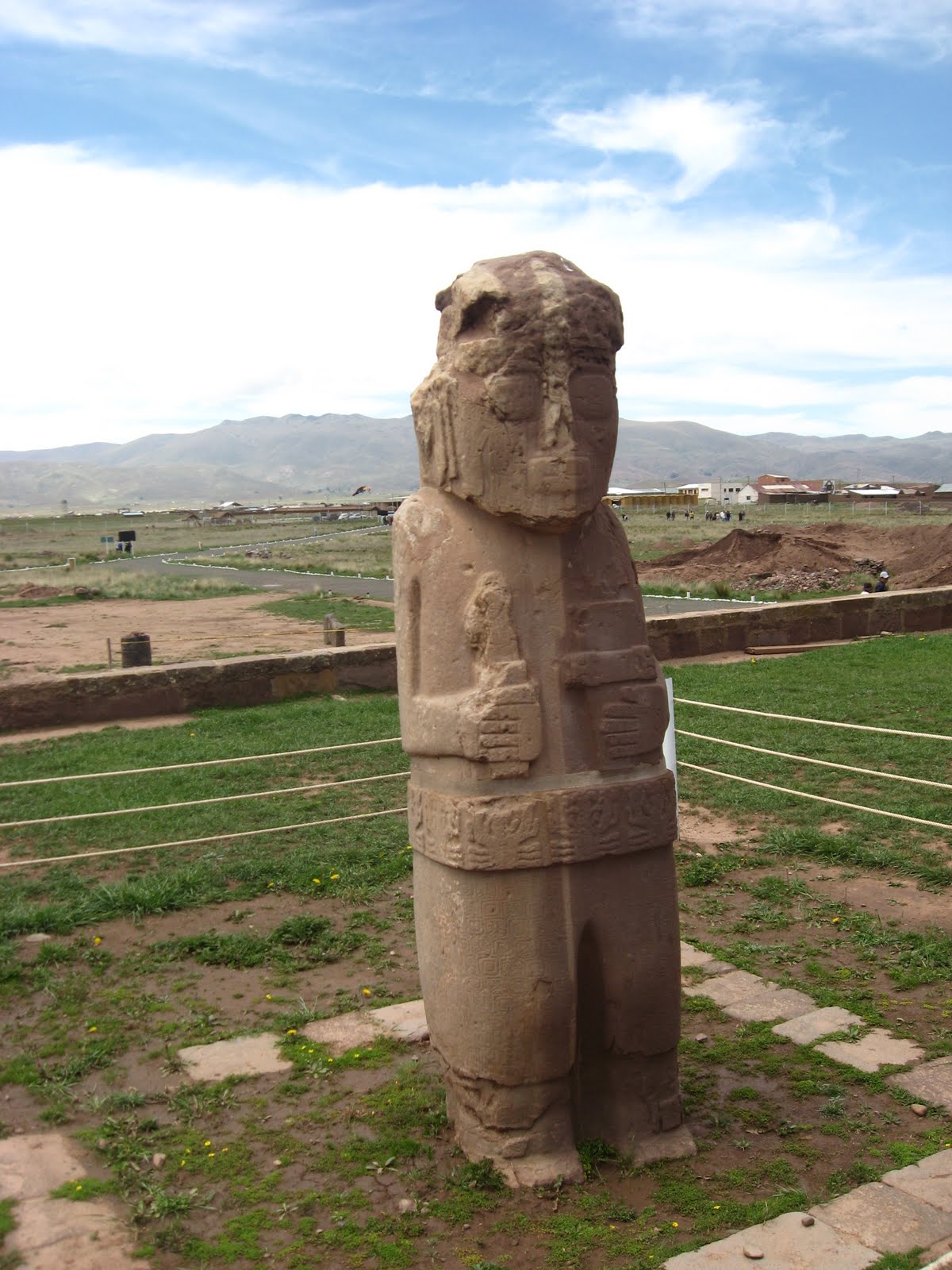


Above, you'll find some pictures of relics from the Tiwanaku site. The Spanish missionaries of the sixteenth century couldn’t let them be. They "exorcised" the spirit of the second relic by scraping a cross on the right shoulder. No doubt, this nasty bit of sabotage stemmed from a deep insecurity. If the God of Christianity was indeed the only worthy and true God, then why did that fact have to be imposed in a coercive manner?
Monday, June 14, 2010
Conquerors, but also cultural carriers
In the marvelous introduction to his book, Genghis khan And The Making Of The Modern World, Jack Weatherford writes,
The Mongols made no technological breakthroughs, founded no new religions, wrote few books or dramas, and gave the world no new crops or methods of agriculture. Their own craftsmen could not weave cloth, cast metal, make pottery or even bake bread. They manufactured neither porcelain nor pottery, painted no pictures, and built no buildings. Yet, as their army conquered culture after culture, they collected and passed all of these skills from one civilization to next.
The Mongols deliberately opened the world to new commerce not only in goods, but also in ideas and knowledge. The Mongols brought German miners to China and Chinese doctors to Persia. The transfers ranged from the monumental to the trivial. They spread the use of carpets everywhere they went and transplanted lemons and carrots from Persia to China, as well as noodles, playing cards, and tea from China to the West. They brought a metal worker from Paris to build a fountain on the dry steppes of Mongolia, recruited an English nobleman to serve as interpreter in their army, and took the practice of Chinese fingerprinting to Persia. They financed the building of Christian churches in China, Buddhist temples and stupas in Persia, and Muslim Koranic schools in Russia. The Mongols swept across the globe as conquerors, but also as civilization´s greatest cultural carriers.
The Mongols who inherited Genghis Khan´s empire exercised a determiend drive to move products and commodities around and to combine them in ways that produced entirely novel products and unprecedented invention. When their highly skilled engineers from
China, Persia and Europe combined Chinese gunpowder with Muslim flamethrowers and applied European bell casting technology, they produced the canon, an entirely new order of technological innovation, from which sprang the vast modern arsenal of weapons from pistols to missiles. While each item had some significance the larger imnpact came from in the way the Mongols selected and combined technologies to create unusual hybrids.
Seemingly every aspect of European life -- technology, warfare, clothing, commerce, food, art,liteature and music -- changed during the Renaissance as a result of the Mongol influence. In addition to new forms of fighting, new machines and new foods, even the most mundane aspects of daily life changed as the Europeans switched to Mongol fabrics, wearing pants and jackets instead of tunics and robes, played their musical instruments with the steppe bow rather than plucking them with the fingers, and painted their pictures in a new style. The Europeans even picked up the Mogol exclamation hurray as an enthusiastic cry of bravado and mutual encouragement.
Monday, June 07, 2010
The Mysore story
In the early 2000s, I wanted to write a short story set in the south Indian city of Mysore. I had been inspired by my travels to the city. The style of the story was a typical response of someone who had just arrived abroad -- I had come to the United States just then -- and feels nostalgic about home. What had once been part of my milieu now was exotic even to me. I never quite finished the story -- there are many failed versions in fact -- but here is whatever I managed to put to paper.
I present this in unedited form, so the typos and awkward sentences have not been corrected -- that is intended to be part of the charm. Or so I hope.
"""""""""
The line between the realms of mythology and reality is often thin and hazy, and sometimes a drifting vagabond never realizes when he has crossed one and is treading on the other. So it was, when, blown by an overnight storm and cocooned by a dark low-travelling rain-cloud, I was carried to the city of Mysore. Like a dream that is often forgotten when a slumbering person wakes up to groggy reality, the dark clouds that cradled me disappeared to reveal a shining morning and a smiling sun, and there wafted in the air the faint but unmistakable scent of sandalwood. I sniffed heartily to olfactory content, and saw a man-sized, live and moving toy, holding incense sticks that burned cheerfully orange at their tips and wore crumbling grey hats of ash.
“Welcome to Mysore,” said the toy. The orange flames burned brighter in acknowledgement. My guide was quite remarkable looking. Though made of sandalwood, his facial feaures and his limbs had the potential of free expression and movement. He had a great black moustache painted above his thick upper lip, and gold earrings dangled on his long Buddha-like ears; a huge red dot adorned his forehead, and a gold crown sat majestically over his head.
“To there we head,” said the Sandalwood man with great hype. “We shall call on the Maharaja.”
We marched on slower through the traffic of people and reached the gates of the palace. The ochre domes shone bright in the sun. It was a great piece of architecture: European, Islamic and Hindu styles all merged into one fantastic palace.
I present this in unedited form, so the typos and awkward sentences have not been corrected -- that is intended to be part of the charm. Or so I hope.
"""""""""
The line between the realms of mythology and reality is often thin and hazy, and sometimes a drifting vagabond never realizes when he has crossed one and is treading on the other. So it was, when, blown by an overnight storm and cocooned by a dark low-travelling rain-cloud, I was carried to the city of Mysore. Like a dream that is often forgotten when a slumbering person wakes up to groggy reality, the dark clouds that cradled me disappeared to reveal a shining morning and a smiling sun, and there wafted in the air the faint but unmistakable scent of sandalwood. I sniffed heartily to olfactory content, and saw a man-sized, live and moving toy, holding incense sticks that burned cheerfully orange at their tips and wore crumbling grey hats of ash.
“Welcome to Mysore,” said the toy. The orange flames burned brighter in acknowledgement. My guide was quite remarkable looking. Though made of sandalwood, his facial feaures and his limbs had the potential of free expression and movement. He had a great black moustache painted above his thick upper lip, and gold earrings dangled on his long Buddha-like ears; a huge red dot adorned his forehead, and a gold crown sat majestically over his head.
He walked and I followed him, but I really just had to follow the trail of scent that he left. We reached a roadside where a tonga stood; the horse that would give us a ride was nodding its head and clicking its hoofs musically in a slow foot dance. “Enter,” said the Sandalwood man grandly, and I did. He guided the tonga smoothly through the roads of Mysore. A quaint atmosphere enveloped me, and I absorbed it while my heart danced in it; there was a song on my lips to the tune of the undulating ride and the soft beats of the horse’s hoofs of the tar road. While I was thus singing to myself, my driver and escort started a lilting song too:
“ Tall eucalyptus and coconut trees
Rustle! Rustle! Rustle! in the gentle breeze
Cuckoos and mynahs sing their sweet songs
Tring!Tring!Tring! the bicycles respond!”
Indeed, there were lots of bicyclists right in the middle of the road, some on the sides, and the tonga had to weave through them as they waved and shouted and rang their bells. After a while we reached more crowded streets with the bazaars and the coffee houses where people chatted gaily, and sipped on coffee in ever-silver tumblers and cups. We were in the heart of the city, and the spectacular domes of the Mysore Palace had come into view.
“ Tall eucalyptus and coconut trees
Rustle! Rustle! Rustle! in the gentle breeze
Cuckoos and mynahs sing their sweet songs
Tring!Tring!Tring! the bicycles respond!”
Indeed, there were lots of bicyclists right in the middle of the road, some on the sides, and the tonga had to weave through them as they waved and shouted and rang their bells. After a while we reached more crowded streets with the bazaars and the coffee houses where people chatted gaily, and sipped on coffee in ever-silver tumblers and cups. We were in the heart of the city, and the spectacular domes of the Mysore Palace had come into view.
“To there we head,” said the Sandalwood man with great hype. “We shall call on the Maharaja.”
We marched on slower through the traffic of people and reached the gates of the palace. The ochre domes shone bright in the sun. It was a great piece of architecture: European, Islamic and Hindu styles all merged into one fantastic palace.
“Indo-Saracenic, they call it,” said my guide, at whom I wasn’t looking, for the arresting sight that the palace had never allowed me to. We entered the palace, and armed guards bent in respect. If the exterior was majestic the interior was twice so: there were ornate dark brown wooden carvings on the doors of lotuses, peacocks, elephants, gods, and grazing deer of the forest; on the walls and stained glass windows there were intricately drawn designs and symmetrical patterns curvaceous as a swan’s neck and adorned with dots and geometrical shapes; there were paintings depicting the life of the king and his family, portraits of royal family’s ancestors, paintings of battles and those of celebration and horsemanship during the festival of Dasera for which the city was famous; and there was size, the immense size and height of the rooms, which ended in domes that made you feel dizzy with grandeur. All these I observed while I was being led to the Durbar room where on a golden throne sat Maharaja Wodeyar. He was attired with the best of clothes, those befitting a king; his robes flowed of silk and gold. And on his right side sat a strange-looking, furtive person, who looked like a puppet made of shining cloth. I caught a striking glint from his eye that seemed so powerful that I stood for a moment entranced, and then that mysterious bit of light disappeared.
“Welcome to Mysore,” said the Maharaja. His smile was bright and his demeanour cheerful; yet, if I was not wrong, I could detect the faint touch of a frown on his brow. Gesturing to the person on his right, he said: “And this is Silk, of the Mysore silk fame, that beautiful piece of everlasting luster. I can see that you have already met the Sandalwood.” He winked at me. “They don’t get along, the two of them; for both compete to make themselves famous in this city!”
“I am honored, O king, to be treated with such great hospitality,” I said with evident awe. All of us were seated now. A servant wandered in silently, and offered fresh coconut water to me. Sandalwood and Silk faced each other, their faces turned upward, each avoiding eye contact with the other. The Maharaja looked at me, and said:
“It is not without reason that you are treated with such special care.”
I arched my eyebrows, for there was something in his tone that suggested a burden.
“Yes, it is so. We got you from the real world for the stars foretold something about you. Our astrologer looked at the end of his long white beard in contemplation, and in his mind celestial objects floated – the planets, the stars, and the galaxies. His calculations matched with the date of your birth, the time, the exact hour – it seemed that you were the person we were looking for. Hence you were called to assist in a problem that bothers us.”
“This intrigues me. What is the nature of my assistance?”
“That has to do with your vagabond-like nature, your tendency to roam in the forests, and your knowledge of beasts.”
“A riddle it is all to me, and doubt resides like an dreadful intruder in my mind. Pray be clear.”
“In due time… do not make haste, although the issue at hand does require us not to be idle. We shall talk over lunch, which shall be soon, and my cook, who is also my vizier in matters of distress, shall join our talk.”
Lunch was served on banana leaves cleaned with water. The Maharaja ate with me while the cook supervised. The cook, whose name was Manisundar, talked a lot; he seemed quite an intelligent chap. His skin was covered with a formidable layer of oil and grease, and exuded the aromatic steam, heat and spice of the frying pan. He chattered on in a vocabulary that initially seemed strange, but later, when I was habituated to his “phrases”, I started to see light in his speech.
Lunch was served on banana leaves cleaned with water. The Maharaja ate with me while the cook supervised. The cook, whose name was Manisundar, talked a lot; he seemed quite an intelligent chap. His skin was covered with a formidable layer of oil and grease, and exuded the aromatic steam, heat and spice of the frying pan. He chattered on in a vocabulary that initially seemed strange, but later, when I was habituated to his “phrases”, I started to see light in his speech.
“Manisundar here has never liked anything as much as he has liked cooking. It is strange,” the Maharaja said. “Oh, how much he likes his cooking! He cannot stand anyone else in the royal kitchen, and does all the work himself.”
“Lord of all Vegetables, how will I survive without that?” asked Manisundar. “Cutting beans, snipping off those sticky ends of a ladysfinger, grating coconuts for chutney – of all these things if you deprive me, I shall have to fry myself deep one lunch in scalding vegetable oil!”
“There, there he goes again – stop that suicidal talk of yours!”
“Ah, okay, more mango pickle, tourist? Burns your tongue doesn’t it in a tangy-sour way! Quite my intention.”
“Er, yes, the food is quite delicious, delectable,” I said.
“Let’s talk of the pressing matters now that trouble the kingdom,” the Maharaja said importantly. “It is high time we did so.” There was a stern pause and I was all attention, with my ears straining and twitching with curiosity so much that they moved; and Manisundar watched them with glee and mirth.
“You may have heard of the buffalo demon Mahishashur, whose massive statue resides up Chamundi hill.” I nodded and he continued: “Well, he is the problem, the demon! He has the city named after him, what more does he want! Ages ago he was killed by Goddess Chamundeshwari, and the people of Mysore thought that was the end of that. But no, his spirit still moves, and he still troubles the people of Mysore; he is still as notorious as he was millennia ago, not giving up his mischief.
“You might ask what mischief he does. Ask what mischief he does not do! His apparition has been spotted in the night, moving about; people cringe in fear when he prowls around, troubling the innocent. But though that is a problem too for us, the real problem caused by him, I believe, lies elsewhere. His spirit is one with that of a living bandit named Marasuran, who lives, it is said, in the forest of Nagarhole. Occasionally, he comes to town with his cronies and wreaks havoc amongst the people, stealing their belongings, and even killing some. They come in strong and powerful horses, whose stamina is outstanding, far more than what our army horses can achieve. The most striking thing about this villain Marasuran is his capacity to elude. The forest is his home, and we have reason to believe that he has no one house or hideout; he lives all over the forest. Entire armies of men have gone about searching the thick dense parts of the forest, and they have sighted him, yes, but he has vanished strangely, and there is something miraculous about his escapades that has led me and my wise sages in court to believe that he is none other than an incarnation of the demon himself.”
There was silence for a while as the Maharaja paused and looked at Manisundar before he said in a low whisper, dramatically:
“Manisundar here believes that the bandit gets help from the birds and beasts of the forest.”
The cook nodded sagely, and said: “During my occasional visit to the forest to pluck some herbs and fresh leaves for the delicacies of the kitchen I have sensed and seen strange things. Steamed rice and round pumpkins, it was frightening! The whole living forest had its eyes on me, as if they knew I was from the Maharaja’s court. For some moments there was complete silence, and it is a terrible feeling; everything around you stands still, alert and frozen in time. I have never yearned for the sound of bursting mustards in hot oil more than in those chilly moments when shivers sneaked through my body. Once I saw someone running stealthily over rustling leaves and I followed the footsteps. At one point I was running parallel to the fugitive, and there were the trunks of trees between us. I saw the profile of a tall man dressed in shabby clothes, but remarkably athletic and lean. His running form went behind a tree and he evaded my vision for a split second or two; but what came out was utterly surprising and disturbing: a large croaking black bird, its wing flapping loudly, emerged from the other side to my astonishment, and a monkey, which I could have sworn was not there a moment ago, was suddenly climbing the tree. The fugitive was gone! I stood stunned and petrified; I felt deceived and cheated with a form of trickery that was beyond my comprehension. And as if basking in the glory of the deception, I heard a barking deer barking away somewhere; to me it sounded like laughter. Carrots are red, capsicums are green, and brinjals are violet, but after that little episode I felt the colour of all vegetables drowning into diabolical shades.” At this point his voice had reached a shrill squeak and tottered off lamely into silence; he gulped, and I could see his Adam’s apple bob up and then subside.
“What happened after that?” I asked
“Nothing. I just came back, and decided that I’d have to give up my fancy little herbs that could have enhanced the culinary treats that come out of the royal kitchen. There has been nothing more disheartening in life. I went to the masterful poet in the king’s court Devraya, told him of my problem, and to console me and ennoble my sorrow, he composed the following lovely verses:
Of cardamom and clove, I sing many praises
The flavour of coriander and cumin, I eulogize
Of these, I obtain, a good measure and plenty
But for the herbs of Nagarhole, I forever pine.”
He sighed and gloom hung over the room. Into this gloom came Sandalwood and Silk and joined us, exuding their scent and shine. The cook brightened and said: “These two great representatives of Mysore, they cheer me up so well! But I do hold a grudge against them for they never eat my food, not even the great, irresistibly sweet mysore pak that I prepare so often.”
It was well before dawn the next day that we set off for the forest of Nagarhole in two chariots. From Mysore, the forest was quite distant, and it would take a while to get there. Manisundar, Sandalwood and myself were in one chariot, whereas Silk and the Maharaja were in the other. It was still dark and the stars, if they weren’t hidden beneath pale-white scattered clouds, kept a twinkling vigil over us. Manisundar spoke to me almost incessantly, and whenever he was advising me to be cautious in my forest adventure, his voice dropped to a whisper as if he feared that the demon would listen.
The flavour of coriander and cumin, I eulogize
Of these, I obtain, a good measure and plenty
But for the herbs of Nagarhole, I forever pine.”
He sighed and gloom hung over the room. Into this gloom came Sandalwood and Silk and joined us, exuding their scent and shine. The cook brightened and said: “These two great representatives of Mysore, they cheer me up so well! But I do hold a grudge against them for they never eat my food, not even the great, irresistibly sweet mysore pak that I prepare so often.”
It was well before dawn the next day that we set off for the forest of Nagarhole in two chariots. From Mysore, the forest was quite distant, and it would take a while to get there. Manisundar, Sandalwood and myself were in one chariot, whereas Silk and the Maharaja were in the other. It was still dark and the stars, if they weren’t hidden beneath pale-white scattered clouds, kept a twinkling vigil over us. Manisundar spoke to me almost incessantly, and whenever he was advising me to be cautious in my forest adventure, his voice dropped to a whisper as if he feared that the demon would listen.
“It is important for you to locate the bandit first. Like I locate those little worms than hide in grains of rice. Your skill with beasts is the way to do it.”
I nodded my head skeptically: “I know my way with beasts, and I have roamed in many forests, but that doesn’t mean I can deal with beasts who are under a spell of the bandit!”
“Enter the forest, and maybe you will see things differently. I know you agreed to this plan of mine as the allure of the forest is too much for you to resist! ”
He paused and said: “You may even meet people in forest, strange people, hermits, wanderers like you. Judge and do as you feel best.”
Sandalwood spoke for the first time: “Cut the wood of the tree closest to you if you need help or if you find something significant. The scent of a damaged bark of a tree is something I can detect early, and I’ll come rushing; it may take a little while, but I’ll be there.”
For the first time, I felt a tinge of fear tarnish the pure sense of anticipation and excitement that was within me.
Dawn was breaking and the eastern sky was starting to show light. The speed of the chariots had slowed, and after a while they came to a stop. All of us alighted. The Maharaja came to bid me goodbye: “You are almost in the forest now. This is where we leave you! I wish you good luck in your endeavour. The people of Mysore and myself cannot be more indebted to your courage and enthusiasm. May the great Goddess be with you! Remember, Silk and Sandalwood shall be in Nagarhole too, at some other points of the forest.”
The chariots rode away, and I was left alone. There were trees around me but it was not the dense forest yet. A thrill went through me as I inhaled the fresh air of the morning.
Tuesday, June 01, 2010
The art instinct
Edward Wilson writes in Sociobiology: The New Synthesis:
Artistic impulses are by no means limited to man. In 1962, when Desmond Morris reviewed the subject in The Biology of Art, 32 individual non-human primates had produced drawings and paintings in captivity. Twenty three were chimpanzees, 2 were gorillas, 3 were orangutans, and 4 were capuchin monkeys. None received special training or anything more than access to the necessary equipment. In fact, attempts to guide the efforts of the animals by inducing imitation were always unsuccessful. The drive to use the painting and drawing equipment was powerful, requiring no reinforcement from human observers. Both young and old animals became so engrossed with the activity that they preferred it to being fed and sometimes threw temper tantrums when stopped. Two of the chimpanzees studied extensively were highly productive. “Alpha” produced over 200 pictures, “Congo”, who deserves to the called the Picasso of the great apes, was responsible for nearly 400. Although most of the efforts consisted of scribbling, the patterns were far from random. Lines and smudges were spread over a blank page outward from a centrally located figure. When a drawing was started on one side of a blank page the chimpanzee usually shifted to the opposite side to offset it. With time the calligraphy became bolder, starting with simple lines and progressing to more complicated multiple scribbles. Congo’s patterns progressed along approximately the same developmental path as those of very young human children, yielding fan-shaped diagrams and even complete circles. Other chimpanzees drew crosses.
The artistic behavior of chimpanzees may well be a function of their tool using behavior. Members of the species display a total of about ten techniques, all of which require manual skill. Probably all are improved through practice, while at least a few are passed as traditions from one generation to the next. The chimpanzees have considerable faculty for inventing new techniques, such as the use of sticks to pull objects through cage bars and to pry open boxes. Thus the tendency to manipulate objects and to explore their uses appears to have an adaptive advantage for chimpanzees.
The same reasoning applies a fortiori to the origin of art in man…Human beings have been hunter-gatherers for over 99 per cent of their history, during which time each man made his own tools. The appraisal of form and skill in execution were necessary for survival, and they probably brought social approval as well. Both forms of success paid off in greater genetic fitness. If the chimpanzee Congo could reach the stage of elementary diagrams, it is not too hard to imagine primitive man progressing to representational figures. Once that stage was reached, the transition to the use of art in sympathetic magic and ritual must have followed quickly. Art might then have played a reciprocally reinforcing role in the development of culture and mental capacity. In the end, writing emerged as the idiographic representation of language.
Saturday, May 29, 2010
Liz
Elizabeth Adamitiz is seventy four. She lives alone two houses down from me, at the end of Summer Street in Amherst, Massachusetts. Late in the afternoon, she takes short walks in the neighborhood. She has a broad face and wears large glasses; her hair, short now, is sparse and mostly gray. From far, her stooped posture and slow gait makes her look old and helpless, but she has one of the widest smiles I know. It enlivens her face, carries a hint of mischief and is generally the prelude to a witty remark.
Liz has been single throughout. She enjoys company, but does not seek it. With a twinkle in her eye, she says she is a loner. But she regrets that no one she knows is around. She was the last of six children. “Everyone is dead; my sisters are dead, my family is dead. Well, for all you know, I am dead too!” She laughs. She has nieces who live in nearby towns; one of them, only four years younger, visits often to deliver groceries.
Liz‘s short term memory is poor enough to be nonexistent. She chats with me but remembers nothing of our previous conversations. She remembers me vaguely but not where I work or which house I live in. She even forgets what I told her minutes earlier: our conversations move in a loopy, circular manner, with repeated iterations through the same questions and themes. “Did you just tell me that?” she asks, well aware of her condition. I nod. “Oh jeez,” she says flashing her irresistible smile, “so that’s how knocked I am!”
In keeping with her playful demeanor, she asks me to “raise hell when I can”. When I give her a puzzled look, she repeats emphatically, “Raise hell, kid! Have fun in life! Go drink, go chase the girls! I raised a lot of hell when I was young.” When an attractive woman in her twenties jogged by us, she promptly took her glasses off, handed them to me and said: “Here, you'll need this to take a proper look.”
Liz grew up in Amherst and has stayed put. From her birth to now, she has lived in the same house. She has not traveled beyond New England; no visits abroad, to Europe, Mexico, or even Canada, only a few hours north by car. I found that striking. My family had moved from state to state, city to city, driven by circumstance and my father’s profession. My grandmother, who is a few years older than Liz, grew up in rural Tamil Nadu, moved to Madras and now stays occasionally with her two sons in Bangalore. By any standards, the degree of Liz’s rootedness is unique.
___
One day, I asked her how the neighborhood had changed. It was a warm spring afternoon; we were seated on her porch. Large bushes, well trimmed, flanked us on each side. Close to the street’s end – about fifty yards from where we sat – was the trail that ascends and curves to reveal a beautiful pond, surrounded by woods. In the evenings, beavers wade through the water to chew on the limbs of trees strewn at the pond’s rim. At its eastern end, a minute’s walk from Liz’s porch, is a small waterfall. I loved the neighborhood’s idyll and natural beauty. It was a quiet part of what was an already quiet college town. But it never occurred to me that it could have a history – until, Liz, with her unique perspective, gave me a sense.
Summer Street, she insisted, was once a “rough part of town”. Today, in American cities the phrase is an indirect reference to a poor black or Hispanic neighborhood. But Amherst never had – still does not have – much racial diversity. What, then, did rough mean in Liz’s day?
In early and mid twentieth century, the street was full of newly arrived Lithuanian immigrants. They were poor and their houses ramshackle. They were fond of drinking. Conveniently, there was a liquor store – a “packet store” as Liz called it – up the street. Even the police admitted that the street was tough; they would drive through not in one but two cars. Only one house did not belong to an immigrant. “He was a Yankee!” Liz said. “But he became one of us.”
Liz’s parents, Catholics, were from Lithuania, “the old country”; Lithuanian was the language she first learned. She still speaks it well. Her mother died in 1953 when she was seventeen. Her father earned a meager salary as a farm hand, taking care of cattle. He worked for Walter Jones, whose grandson now owns the major apartment complexes in Amherst. It was fascinating glimpse of how the early twentieth century families of the town, working class and well off, immigrant and Yankee, had ended up in two generations. Mill Hollow, the nondescript apartments built in the 1970s, across Liz’s small but nearly century old house, was Jones’ property. It had once been an open field where Liz played softball as a child. “I used to hit the ball hard and it would end up in the brook. The kids would holler at me.”
The poverty of her immigrant parents was important in Liz’s conception of her identity; she mentioned it every time we talked. But it was not an ideological or political stance -- just matter of fact. At elementary school, Liz could tell that she and her friends from the street were different from the others, mostly professors’ kids. “These smart kids were up to it; they spoke the language of the teachers. We didn’t really grasp much.”
That difference still exists. Amherst projects itself as a haven for progressives and in the process sometimes appears self absorbed and snobbish. It is not a deliberate, harmful or in-your-face snobbishness, but a subtle presence. The boutique stores and trendy coffee shops in downtown cater to this demographic -- generally well off students and professors. The other Amherst, working class Amherst, provides the local services: the garage mechanics, the electricians, the farmers, the construction workers. It is possible to tell them apart from their dress and demeanor. Tina, Liz’s immediate neighbor, whose husband works as a fireman and occasionally delivers newspapers at 4 am in the morning, is from the other Amherst (she also happens to be the only other Lithuanian descendant now living in the neighborhood.)
___
Liz did not go to college. She probably did not have the means. Instead, for thirty six years, she worked as helper at the university dining commons. Unsurprisingly, given her bright and spunky personality, Liz got along well with college kids. When she was thirty, she fell in love with a marine but he left her while away on duty. Her father passed away in 1974, but by that time, Liz had paid the mortgage and owned the house. She loves dogs and once raised three – all of them are buried in her backyard.
After retirement, she began talking long walks, chatting now and then with passersby. These days, she doesn’t walk far but walks no less frequently, surveying the neighborhood houses, now changed in color and style, full of new residents, very different from the “rough” Lithuanian look and feel she was used to. Even quiet streets in quiet towns change fast.
Liz has been single throughout. She enjoys company, but does not seek it. With a twinkle in her eye, she says she is a loner. But she regrets that no one she knows is around. She was the last of six children. “Everyone is dead; my sisters are dead, my family is dead. Well, for all you know, I am dead too!” She laughs. She has nieces who live in nearby towns; one of them, only four years younger, visits often to deliver groceries.
Liz‘s short term memory is poor enough to be nonexistent. She chats with me but remembers nothing of our previous conversations. She remembers me vaguely but not where I work or which house I live in. She even forgets what I told her minutes earlier: our conversations move in a loopy, circular manner, with repeated iterations through the same questions and themes. “Did you just tell me that?” she asks, well aware of her condition. I nod. “Oh jeez,” she says flashing her irresistible smile, “so that’s how knocked I am!”
In keeping with her playful demeanor, she asks me to “raise hell when I can”. When I give her a puzzled look, she repeats emphatically, “Raise hell, kid! Have fun in life! Go drink, go chase the girls! I raised a lot of hell when I was young.” When an attractive woman in her twenties jogged by us, she promptly took her glasses off, handed them to me and said: “Here, you'll need this to take a proper look.”
Liz grew up in Amherst and has stayed put. From her birth to now, she has lived in the same house. She has not traveled beyond New England; no visits abroad, to Europe, Mexico, or even Canada, only a few hours north by car. I found that striking. My family had moved from state to state, city to city, driven by circumstance and my father’s profession. My grandmother, who is a few years older than Liz, grew up in rural Tamil Nadu, moved to Madras and now stays occasionally with her two sons in Bangalore. By any standards, the degree of Liz’s rootedness is unique.
___
One day, I asked her how the neighborhood had changed. It was a warm spring afternoon; we were seated on her porch. Large bushes, well trimmed, flanked us on each side. Close to the street’s end – about fifty yards from where we sat – was the trail that ascends and curves to reveal a beautiful pond, surrounded by woods. In the evenings, beavers wade through the water to chew on the limbs of trees strewn at the pond’s rim. At its eastern end, a minute’s walk from Liz’s porch, is a small waterfall. I loved the neighborhood’s idyll and natural beauty. It was a quiet part of what was an already quiet college town. But it never occurred to me that it could have a history – until, Liz, with her unique perspective, gave me a sense.
Summer Street, she insisted, was once a “rough part of town”. Today, in American cities the phrase is an indirect reference to a poor black or Hispanic neighborhood. But Amherst never had – still does not have – much racial diversity. What, then, did rough mean in Liz’s day?
In early and mid twentieth century, the street was full of newly arrived Lithuanian immigrants. They were poor and their houses ramshackle. They were fond of drinking. Conveniently, there was a liquor store – a “packet store” as Liz called it – up the street. Even the police admitted that the street was tough; they would drive through not in one but two cars. Only one house did not belong to an immigrant. “He was a Yankee!” Liz said. “But he became one of us.”
Liz’s parents, Catholics, were from Lithuania, “the old country”; Lithuanian was the language she first learned. She still speaks it well. Her mother died in 1953 when she was seventeen. Her father earned a meager salary as a farm hand, taking care of cattle. He worked for Walter Jones, whose grandson now owns the major apartment complexes in Amherst. It was fascinating glimpse of how the early twentieth century families of the town, working class and well off, immigrant and Yankee, had ended up in two generations. Mill Hollow, the nondescript apartments built in the 1970s, across Liz’s small but nearly century old house, was Jones’ property. It had once been an open field where Liz played softball as a child. “I used to hit the ball hard and it would end up in the brook. The kids would holler at me.”
The poverty of her immigrant parents was important in Liz’s conception of her identity; she mentioned it every time we talked. But it was not an ideological or political stance -- just matter of fact. At elementary school, Liz could tell that she and her friends from the street were different from the others, mostly professors’ kids. “These smart kids were up to it; they spoke the language of the teachers. We didn’t really grasp much.”
That difference still exists. Amherst projects itself as a haven for progressives and in the process sometimes appears self absorbed and snobbish. It is not a deliberate, harmful or in-your-face snobbishness, but a subtle presence. The boutique stores and trendy coffee shops in downtown cater to this demographic -- generally well off students and professors. The other Amherst, working class Amherst, provides the local services: the garage mechanics, the electricians, the farmers, the construction workers. It is possible to tell them apart from their dress and demeanor. Tina, Liz’s immediate neighbor, whose husband works as a fireman and occasionally delivers newspapers at 4 am in the morning, is from the other Amherst (she also happens to be the only other Lithuanian descendant now living in the neighborhood.)
___
Liz did not go to college. She probably did not have the means. Instead, for thirty six years, she worked as helper at the university dining commons. Unsurprisingly, given her bright and spunky personality, Liz got along well with college kids. When she was thirty, she fell in love with a marine but he left her while away on duty. Her father passed away in 1974, but by that time, Liz had paid the mortgage and owned the house. She loves dogs and once raised three – all of them are buried in her backyard.
After retirement, she began talking long walks, chatting now and then with passersby. These days, she doesn’t walk far but walks no less frequently, surveying the neighborhood houses, now changed in color and style, full of new residents, very different from the “rough” Lithuanian look and feel she was used to. Even quiet streets in quiet towns change fast.
Sunday, May 23, 2010


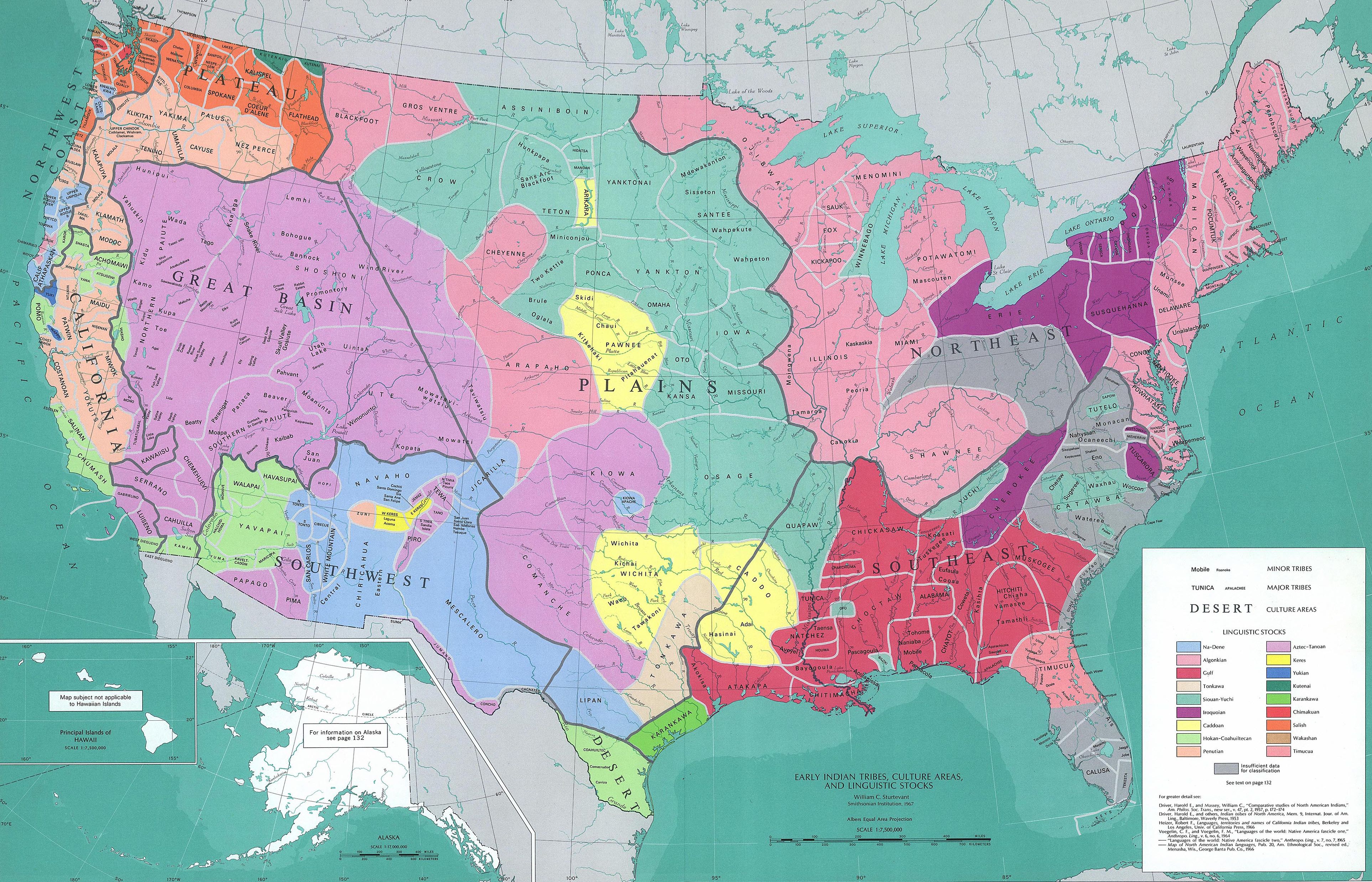

Monday, May 17, 2010
The genius of Inca masonry

 During my travels in Peru, I found nothing more striking or elegant than Inca walls. Above you’ll find two examples. The first is in a street in the Andean city of Cuzco, once the capital of the Incas. The second is at Saqsayhuaman, an Inca fortress whose ruins today overlook the sprawl of Cuzco. Notice that the walls are not held together by mortar; rather they consist of large interlocking stones that fit like a puzzle. One can only imagine the labor and organization required for such precision. In a seismically active area, these structures have endured to this day – while many Spanish constructions in Peru since mid 1500s have collapsed. In some cases, the walls blend with the landscape, like a naturally formed jumble of rocks, to an extent that they do not seem constructed (the second picture for example). They have an austere, minimalist look which elevates their beauty even more.
The other distinctive feature of Inca architecture is trapezoidal doors and niches. As John Hemming writes in The Conquest of Incas:
Doors and niches were invariably built in trapezoidal shapes, with the sides tapering inwards towards the lintel at the top. This was a logical method for builders who had not discovered the principle of the arch. It reduced the length of the lintel stone and spread the thrust of the weight it supported. Rows of such trapezoidal niches broke the monotony of Inca walls. Sometimes the niches were the size of sentry-boxes, tall enough to accommodate a line of standing attendants, but more often they were smaller, sunk into the wall at chest height to form a row of convenient cupboard alcoves.


Examples above of a trapezoidal door (from Saqsayhuaman) and wall alcoves (from Machu Picchu).
Monday, May 10, 2010
Busy, but be back soon
Occupied with grading and other end of semester tasks -- typically a deluge -- but will be back in a week or so. There still much to write about my Dec-Jan trip to Peru and Bolivia, and I hope to get something on paper soon, before my memory begins to play tricks.
Tuesday, May 04, 2010
How a spider balloons itself, and Anthill
The [ballooning] method is widespread and ancient among spiders. When an immature spider possessing this ability wishes to travel a long distance, it crawls to an unrestricted site on a blade of grass or twig of a bush, lifts the rear part of its body to point the spinnerets at the tip upward, and lets out a line of silk. The delicate little thread is the spiderling’s kite. The air current lifts and pulls at it until the young spider feeling the tension, gradually lengthens the thread. When the strength of the pull exceeds its own body weight, it lets go with all eight feet and sets sail. A flying spiderling can reach thousands of feet of altitude and travel miles downwind. When it wishes to descend, it pulls in the silk thread and eats it millimeter by millimeter, heading for a soft if precarious landing. The risk it takes offers good odds. Sailing aloft under its silk balloon, the spiderling can reach land still uncrowded by competing spiders.
___
 That’s from The Anthill Chronicles, a short, self-contained novella within the famous biologist E.O. Wilson’s first novel. The novella, one of the most beautiful and mysterious stories I’ve read in a while, is about the rise and fall of four ecologically intertwined ant colonies on a small tract of land, a longleaf pine savanna in rural Alabama. One of the ant societies is a "supercolony" that runs rampant. Wilson, wisely, does not make the ants speak as humans do; instead, he uses his immense scientific knowledge to tell us what goes on in their subterranean nests. The execution is superb; there is probably no better narrative description of how the world appears to ants. The ants' quest for territory and foraging grounds, brutal wars, cycles of dominance and decline -- epics condensed in time and space --are strikingly similar to ours; and yet there are some contrasts. Ant colonies, for example, are fanatically communist and are heavily dominated by females; males play a peripheral, utilitarian role.
Deftly interlinked with the story of the ants is the story of the protagonist, Raff Semmens Cody, a child of the American south (like Wilson himself). Raff is fascinated by the same tract of land that contains the anthills and is interested in protecting it. This dual structure of novel – one at the level of the ants, the other the level of humans, but both examining in understated fashion the perils of overburdening the ecosystem – allows for an unusual perspective.
Subscribe to:
Posts (Atom)