Showing posts with label History. Show all posts

Tuesday, June 18, 2013

Notes from Yellowstone and Wyoming -- Part 2

Second part of my trip to Yellowstone National Park and Wyoming in August 2012 (read Part 1). The focus here is on the drive through some lesser known towns and parts of Wyoming, in particular the Wind River Indian Reservation, home of the Northern Arapahoe and Shoshone. I’ve reproduced the Greater Yellowstone map again below.

1.

Beyond Lamar Valley is the northeastern exit to Yellowstone. Here, the route south eventually becomes the Chief Joseph Scenic Highway. It runs through the pristine wilderness of Shoshone National Forest. Unlike Yellowstone, there were no cars and people around; it felt like we’d left the world behind. It was late in the afternoon; the desolate vistas that opened up along high mountain passes – over 8000 feet – were beautiful and striking in the fading light. It was a remarkably intimate experience of wilderness, exactly what I had been yearning for, but paradoxically I had found it outside national park borders. 

The presence of a few cattle grazing on steep slopes suggested that people did live around here. But the ranches that they presumably owned were nowhere to be seen.

The highway is named after Chief Joseph, the leader of a group of 800 Nez Perce Indians who were escaping from the US army in 1877. By this time, America's westward expansion and its capture of land that belonged to Indians had reached its peak. The Nez Perce band had refused to live in lands that US government had designated for them. Their defiance made them outlaws in their own land. Around 2000 American troops followed the escaping Nez Perce to arrest them and forcibly bring them back within the confines of a reservation -- the term refers to a territory designated by the US government for Indian tribes. It’s a strange term, but now accepted and commonplace; I’d encountered it first in Aldous Huxley’s Brave New World, which I’d read as a college student. The Phoenix metropolitan area, where I spent six years, and the state of Arizona more generally, has a number of reservations, including the largest, the Navajo Nation. In all, there are 550 recognized tribes and around 300 reservations.

Beginning in Oregon and passing through Idaho, Wyoming and Montana, the chase of the Nez Perce lasted for an astonishing 1,170 miles. This included a section through Yellowstone, and the Wyoming wilderness we were now driving through. The Nez Perce deftly avoided the US army at many points in the chase. But just 40 miles south of the Canadian Border and their destination painfully close, Chief Joseph and his group, exhausted and having suffered many casualties, surrendered.

Everywhere I’ve traveled to the US, there is such a story of forced dispossession and ethnic cleansing. In Massachusetts, where I now live, I learned about the Wampanoag, who helped the Pilgrims (this alliance may have resulted in the very first Thanksgiving), but eventually lost their own lands and people to wars and diseases. During a trip to Pine Ridge reservation in South Dakota, I learned of the infamous Wounded Knee Massacre. For the Cherokees, there is the Trail of Tears; for the Navajos in the Southwest, there is the forced Long Walk to eastern New Mexico. For the Arapahoes  who now have a home in the Wyoming – the Wind River Indian Reservation, which I’ll come to in a bit – there is the Sand Creek Massacre. If you collect these individual tragedies together – there is such a Wikipedia page that does exactly this – you realize the scale of the tragedy, the silent evidence that lies beneath the much touted notion of American greatness.

2.

After the beautiful mountain scenery, the landscape turned flatter and more arid, as we approached the western edge of the Great Plains in Wyoming. The Great Plains were the stage of the many of the Indian Wars of the 19th century, and refer to the vast swathe of land east of the Rocky Mountains: the United States' sparsely populated middle. We stayed in the town of Cody for a night. There were irrigated farms at the outskirts of Cody, and among the long shoots of corn, gazing at us as we drove past, were small groups of deer.

Cody fit the template I had in mind of remote and small Western town: a single row of shops and hotels, a few side streets, and not much else; a rodeo every evening of the summer; the historic, Wild West themed Irma Hotel; no fancy organic stores as in Bozeman, Montana (see Part 1); and unlike Bozeman, no major university to influence the demographics and outlook; mostly steak restaurants, which, given the free ranging cattle, are likely to be good (though preferring vegetarian food, I wouldn’t know anything about quality); and the occasional Mexican or Chinese restaurant providing the only variety.

3.

The Wind River Indian Reservation is about three hours southeast of Yellowstone and Grand Teton National Parks. It is jointly shared by the Northern Arapahoe and Eastern Shoshone. Before European arrival, the Arapahoe had lived on the eastern plains of Colorado and Wyoming; American expansion drove them west. The Shoshones, in contrast, had lived in this region probably well before American settlement. Sacajawea, the famous Indian woman had helped Lewis and Clarke on their expedition to the Pacific, was Shoshone.  

A few weeks before the trip, I had read a New York Times article titled “Brutal Crimes Grip Wind River Indian Reservation”. It talked about arbitrary homicide, drugs, health problems and depression that plagued the Arapahoe and Shoshone. While all this may be true, the article itself was not convincing; it lacked depth and proper engagement, and was more intent on painting a certain surface portrait. But the disheartening facts in the article, which probably did have some basis in reality, made me think twice about whether I should visit.  

We stayed in Riverton, which I initially thought was in the reservation. At least that is what the map suggested. But land ownership in and around a reservation is often a complicated matter. Riverton turned out to be a majority white town. It sits on the outside edge of the reservation but is not in it. The town has benefited a recent oil boom; executives from big firms frequented the two or three high end hotel chains in town. I wondered if the oil boom also included the natural gas extracted by the controversial “fracking” technique, whose potential impacts on neighboring rivers, streams and house water supply are highlighted dramatically in the documentary Gasland. Indeed, recent sampling of wells in Pavillion, a small town in the reservation northeast or Riverton, seem to support these claims. Not surprisingly Encana, the Canadian corporation that is responsible for the drilling in the region has questioned these results. 

4.

The reservation starts one mile south of Riverton, with the newly opened and Arapaho owned Wind River Casino. The casino building had minimal but attractive Arapaho motifs. In the open space of the casino parking lot, a roping championship was going on. Roping refers to the cowboy sport where a pair of riders on horses ensures that an escaping calf is lassoed around the neck in just the right way and at just the right time. It was less violent sport than I’d imagined, although it was clear – and painful to contemplate – that a slight mistake could easily break the calf’s neck. The parking lot had large trailers to accommodate horses. The participants had red, sunburned faces and wore cowboy hats; they all seemed solemn, keen to perform well in the event, but in good spirits.

The interior of the casino was like any in Las Vegas: dark as a cave, with the strong odor of smoke and alcohol; scores of pair of eyes patiently – or perhaps obsessively – glued to the screens of slot machines; and the cacophony of rings and bells that accompany a successful or failed slot trial.

The local Indians were among the staff, but the gamblers were mostly white. The casino was not full, but I nevertheless wondered where the gamblers had traveled from. This part of the country is sparsely populated: Jackson, Casper, Cheyenne and Fort Laramie, the moderate sized towns in the state, were more than 2 hours away; and Denver more than five hours away. But I guess distance is no match for addictions. Perhaps gambling would also attract those passing through Riverton, on their way to Yellowstone or Grand Teton.

In modern day America, Indian reservations are closely associated with casinos: the National Indian Gaming Commission states that there are 460 gambling operations run by 240 tribes. Because reservations have some degree of sovereignty, states have limited tax and regulation control over what happens in reservations. So in a strange, roundabout way, reservation land, which is where the US government wanted Indian tribes to be confined to, would attain a degree of independence, and pave the way of lucrative gaming operations in the late 20th century -- although it remains puzzling why it is only the casino business, and not others, that have boomed as a result of state tax exemptions. 

Casino revenues are sometimes used by tribes to open new healthcare facilities, elder care centers, and retention of indigenous languages. They have enabled a kind of cultural renaissance for American Indians. But Indian casinos are successful only when they are close to large metropolitan areas: 12% of the casinos make 65% of the total revenue. The small minority of reservations and Indians that have benefited have become tremendously rich; it does not seem that Wind River is among them. The Foxwoods Casino in Connecticut -- not far from where I now live – is one of the most successful reservation casinos in the country. Owned by Pequot Tribe, it is successful primarily because of population and travel density in the Boston-New York corridor. 

5.

We had dinner that evening at a restaurant owned by a Mexican family, back in Riverton, about two miles north of the Wind River Casino. A stocky, young man, about eighteen years old, the son of the immigrant couple who had started the restaurant, came to talk with us. He was cheerful and curious. Noticing that I did not want meat, he asked – with a sincerity that I found endearing – how it was possible to have such meals. His sister, he said, had recently turned vegetarian, but he could not understand it; he laughed heartily about it. He’d grown up in the US, but his parents were from the city of Guadalajara  Their family also owned a restaurant in Jackson, the affluent town near Grand Teton National Park.

The presence of this Mexican family, so far from home, and in such a remote part of Wyoming, is not surprising. There is a lot of that sort of immigration everywhere in the world. But then I remembered the Arapahoe and Shoshone Indians who had lived in this region well before American settlement. It struck me that Mexicans might not be that far apart from them genetically, despite the significant cultural differences. Here in Riverton, more than a thousand miles north of the US-Mexico border, the young Mexican-origin teenager at the restaurant could easily walk through the reservation and be considered native. 

6.

The next day, we drove through the Wind River Reservation. The place was quiet, as most reservations are; you wouldn't even know you were driving through one but for the signs. We passed by single story homes with old, disassembled cars rusting in the backyards; the odd high school, church or tribal administrative unit. But, strikingly, no businesses, no sellers of arts of crafts in old pick-up trucks or stalls (common in the Southwest), no small stores or restaurants let alone malls. Even gas stations were few and far between. Except for the newly opened casino, which may or may not do well, there was nothing that could contribute to the economy. This was made more puzzling by the fact that in Riverton, which is also geographically remote, there are plenty of businesses. What are the dynamics between reservations and states that keeps reservations so poor when the majority white communities in surrounding cities are able to do so much better?

Near the town of Fort Washakie, at the eastern end of the reservation – this was the Shoshone side – we found a small market. We went in to ask about lunch. They did have a kitchen of sorts, but only pizza and deep fried food. I asked a man in charge of the kitchen if he knew of any nearby restaurants in Fort Washakie.

Without a hint of irony, he said: “This is the best restaurant in town.”

He and the other staff who worked in the kitchen were genuinely friendly and wanted to help as much as they could. Their skin shone with sweat from the heat of the all oven cooking and deep frying. Their features and complexion reminded me of the Mexican immigrants I’d met in kitchens of restaurants in southwestern towns. When I asked for vegetarian options, they all looked sincerely around to see if they could get me a cheese pizza, which they’d run out of. In the end, I found some jalapeno poppers and some meat lasagna without pieces of meat. It was good comfort food, something I’d not had in a while.   

Three hours northeast of Fort Washakie, at the base of the dramatic Teton Range of the Rocky Mountains – jagged peaks that rise suddenly for thousands of feet from the valley, creating a view that is scarcely believable and extensively photographed – is one of the more affluent towns in the country: Jackson. The contrast from Wind River could not have been sharper. In Jackson, I would get the fancy vegetarian food I was looking for. At the restaurant, the waiters and waitresses were all well dressed formally; there was emphasis on etiquette that had no intrinsic meaning or essence except to signal social status and refinement; there was a separate and extensive menu for all kinds of drinks; the diners held wine glasses the right way; the smart phones were out for pictures and the instant Facebook uploads; the expensive bills were conveniently paid by gleaming credit cards. The main plaza of Jackson is full of boutique shops and store of brands such as Eddy Bauer and Gap. One bookshop I went into prominently featured a biography of former vice president Dick Cheney, who is from Wyoming. 

Such different socioeconomic realities, in the space of a few hours! 

Sunday, October 31, 2010

Travels in Cuzco

In December last year, I took a flight from Lima, Peru’s coastal capital, to Cuzco, the once splendid high altitude capital of the Incas. Cuzco, now a booming and rampantly commercial tourist town, is the starting point of a trip to the famous Machu Picchu. The journey by bus, a steep uphill climb into the mountains, takes over twenty hours, but by flight it is a pleasant hour and a half. The Andes slice through the nations of western South America – Columbia, Ecuador, Peru, Bolivia, and Chile – to leave remarkably different terrains. In Peru, to the west of the Andes is a thin coastal strip that is mostly dry desert; this is where Lima is. To the east – surprisingly for the uninitiated visitor – is the dense jungle of the Amazon and the border with Brazil. The Andes themselves are not monolithic; the succession of mountains, rivers and high valleys gives way in the south of Peru to a high plateau called the Altiplano, where the surreally blue waters of Lake Titicaca are to be found, along the border with Bolivia.

Like the Fertile Crescent region of the Middle East, which saw the early rise of complex societies, western South America too has for millennia seen a series of kingdoms and empires. The largest, best known and last of these empires was the Incan one, which stretched for few thousand miles along the length of the Andes, from Columbia to Chile. The Incas’ was an unabashedly high-altitude culture: Cuzco, their grand capital, is at an elevation of 12,000 feet. The mountains were an artery through the empire. Roads, suspension bridges, supplies along the routes, and a system of runners who ran the length of mountain range at breakneck speeds to relay messages: all this kept the empire well connected.

From the air, Cuzco revealed itself as an extended sprawl in a high valley. The houses were closely spaced, and had sloping, red-tile roofs. In atmosphere and style – the high setting, the medieval look, the predominance of tourists and their revelry, the narrow streets of stone rather than asphalt, the dark American Indian faces of the locals – it reminded me of San Cristobal de las Casas, the southern and Mayan part of Mexico. A tall, young taxi driver who spoke fluent English took me to my hostel. He was savvy, knew a few Hindi words, and after much fumbling with the CD player, finally managed to play a popular Punjabi song. He was one of many young men I met during my travels who had smartly aligned themselves to make an impression on tourists.

My hostel was at the steep upper end of what was called the Choquechaca Street, away from the bustle and noise or the Plaza de Armas (the main square). It was run by Peruvians in their early twenties. Like their traveling guests, they too had the air of vagabonds. They worked irregular shifts, partied hard, and never gave the impression of permanence. There was Jose, who had a family in one of Lima’s shantytowns; Christina, also from Lima, who had abandoned her degree and now was attached to a bearded, dreamy Australian wanderer in Cuzco; and Luigi, a short, frail man, from the town of Iquitos, at the remote eastern end of Peru, reachable only by air or water. Luigi’s flirtatious way with women, the slightness of his physique and even his classically American Indian features – high slanted cheekbones, dark-red complexion – bore an uncanny resemblance to my roommate in college, from Mirzapur in North India.

The nations of the Americas fall into two broad categories. In some, American Indians have been marginalized and their numbers have reduced to an extent that they remain largely invisible. The United States, Argentina, and the Caribbean Islands fall in this category. And then there are countries, like Mexico (southern Mexico especially), Guatemala, Ecuador, Peru and Bolivia where indigenous populations form a significant majority.

In the Andean highland cities of Peru, the Quechuas, whose ancestors built the Incan empire, are the largest group. And it was the Quechuas that I saw in large numbers in the main square of Cuzco. I had arrived the day before Christmas. It was cold even though it wasn’t winter in Peru. The high altitude, which I hadn’t adjusted to, made the short walk to the main square strenuous. The square was abuzz with preparations. Indigenous women, their children in tow, had come to sell their wares in what was going to be a huge market. The older women had plaited hair and their attire was distinct: bowler hats and skirts; and many layers of clothing to protect against the cold, which made them look stocky. There was a long queue on one side of the square. Food and soup were being distributed in ladles to the poor, especially children: the largesse of Christmas.

It was there, in the fading light of the day, that the strangeness of where I was struck me. All around, in the higher elevations of the surrounding mountains, were the outer settlements of Cuzco. The city was much larger that I had thought. The square itself had once had been surrounded by palaces of the Inca rulers; in their place now stood imposing ocher-colored cathedrals and churches. Church imposed over a Pre-Columbian place of significance: the trend repeats over and over again in Latin America. But here, high in the Andes, with the indigenous Quechua filling the square on the eve of Christmas, the violence of that 16th century clash felt especially real.

The Spanish arrived in Peru in 1533, twelve years after conquering the Aztec empire in Mexico. They took Cuzco fairly easily in the beginning, but then the Incas fought back ferociously. From various vantage points the Inca army hurled red hot stones onto the roofs of houses, setting them on fire. The whole of Cuzco burned and for a while, it must have seemed, as the Inca army slowly circled in, that the outnumbered Spaniards would lose the city. They didn’t. They survived narrowly and fought back. The cathedrals in the main square of Cuzco are testament to the eventual victory of the Spanish.

In a side street, I had seen intact examples of Inca walls: large and smooth interlocking blocks of stone, without mortar and which fit like a puzzle. Their minimalism, their lack of adornment, only elevated their beauty. They hinted at another sensibility, much of which had been lost.

But the Quechuas I met insisted that it wasn’t a simple case of one culture dominating the other. Catholicism merely provided the outer shell beneath which the animist ways of the past still carried on. Even in the cathedrals, there are subtle but unequivocal hints of indigenous influence: a rendition of the Last Supper has a guinea pig, an Andean delicacy, as the main dish and not lamb; the virgins are cleverly portrayed in the shape of Andean mountains since the Quechua worship the mountains. But at a more mundane, day to day level, I had no sense – and no time to explore – how the two ways were being reconciled. And I often got the sense that the question was moot, that enough time had passed since the conquest for a kind of unselfconscious synthesis to emerge.

It was dark now and on one of the high hills surrounding Cuzco was a luminescent statue of Jesus – Cristo Blanco, or White Christ. I was struck by it: it was as if the light was coming from within, as if the statue itself were a fluorescent piece.

Two days later, I made the ascent up the steep hill that led to Cristo Blanco. The hill was immediately adjacent to my hostel. The path took me through haphazardly set one story houses along the slope. On the way a drunk, unhappy man helped with directions; another man asked if I was interested in riding a horse; and a woman could be seen beating up and shouting at her husband for having cheated. A little later I met Doggy, the large stray that for some reason unfailingly retired at the hostel for the night (though no one there “owned” him), but during the day roamed the corners of Cuzco, with a total lack of fear of other dogs. I saw him a few days later in a completely different part of the city. He seemed to possess some of the conquistadorial spirit of the 16th Spanish invaders of the Americas, who time and again rushed headlong into conflicts and toppled empires despite being hopelessly outnumbered. Doggy in fact was at that moment fighting an equally spunky dog. It took the stones of passersby to separate the two.

A hundred odd feet below Cristo Blanco is Saqsayhuaman, the remains of an Inca fortress. Unlike the smooth walls I had seen in the center of Cuzco, these were much larger, coarser structures, but no less impressive. They were ideal fortifications. They seemed like arbitrary and natural agglomerations of boulders until you noticed how carefully they had been assembled. Yet again there was no mortar holding the different pieces together. The Inca army, in an effort to recapture Cuzco from the Spaniards, had used Saqsayhuaman as their base. In fact, if John Hemming’s meticulously researched The Conquest of the Incas is to be believed, their attack had followed the same steep path I had taken from my hostel.

It was a short ascent from Saqsayhuaman to the large white statue of Christ. Most of Cuzco, which sits in a valley, could be seen from here, the various shades of the red of the roofs and the white of the walls mingling together, as if a carpet of those colors blanketed the valley. Christ is portrayed as he is other parts of the world. His arms were raised in a gesture of welcome. This positive image contrasted with slumped posture of a hooded man who sat at the base. His face was not visible; he did not move for the entire duration of my visit. Nearby there were large crosses wrapped in fine cloth, with designs woven onto them. At night, a powerful set of lamps on the platform shone white light onto the statue, and this gave the impression of luminescence I had been so struck by.

Thursday, September 09, 2010

The unexpected origin of ragi

KT Achaya writes in The Story of Our Food:
The great Russian botanist, Vavilow, about seventy years ago, identified what he called "centers of plant origin" in which the "evolution of plants was directed by the will of man." There were nearly a dozen of these centers all over the world where plants gradually took their place as foods for human beings. Of particular interest to India was the so-called Fertile Crescent of the Middle East, stretching from Israel to Iraq, which was an early center of agriculture and of plant evolution.

What actually happened was this. Man would pick promising weeds growing wild which carried grains. By choosing plants with abundant or plump grains, a process called selection, the quality of the grains and the yield of the plant in the next crop were both improved. Sometimes, nature itself would take a hand in the process; a wild weed would cross by chance with a cultivated species to produce offspring of a quality superior to both.
Achaya then goes on to describe how ragi, ubiquitous in India for millennia, has an unexpected connection to a different part of the world:
Botanically, ragi is Eleusine coracana. It was born in Uganda in East Africa. How do we know this? For several botanical reasons, such as the existence of its wild ancestors, the long mention of the grain in tradition, and the fact that ragi figures in old religious ceremonies in those areas. Ragi is a tetraploid, and so is the African wild plant called E. africana, which gave rise to it. But the Indian wild plant, which is called E. indica, is a diploid which does not cross with ragi at all. Now what does this mean? Only this, that the Indian wild weed could not have given rise to the ragi plant in India. This plant must, therefore, have come to India from East Africa some time in the past. When did this happen? Ragi has been found in an Indian excavation which is dated at 1800 BC, and at several other archaeological sites in central India of a slightly later date. We must therefore infer that some unknown benefactor brought this foodgrain from Africa to India in about 2000 BC. It also seems possible that two other food-grains, jowar and bajra, also came at the same time to India, from the same area in East Africa, where they were originally evolved. You see, therefore, how no country ever stands really alone; certainly our food has come to us from unexpected places.

Friday, August 27, 2010

Our relationship to the natural world: Some initial thoughts

1.

Our relationship to the natural world is ambiguous. On the one hand, we are drawn to landscapes. We love to visit national parks; we like to build lakefront homes surrounded by woods; and even an overwhelmingly urban space such as New York needs Central Park. The biologist Edward Wilson has a term for this: biophilia.

What is behind the instinct? One possible explanation – Wilson’s, not mine – is that humans, for hundreds of thousands of years, were inextricably part of the natural world: it is where we evolved. Our survival demanded an intimate and practical knowledge of the flora and fauna around us. We probably developed our innate fear of snakes, aggressive carnivores and heights then; these reactions are still hard wired in us. We developed also an appreciation for the environment. That too is still with us; that is why excessive development at the expense of forests and the wilderness provokes a reaction.

But even as hunter gatherers, we were always constantly tinkering with our habitats, trying to figure out ways to use it more effectively: controlled burning, deliberately dispersing certain seeds, slow attempts to tame certain animals. Around ten thousand years ago – and this seems to have happened independently within a few millennia in different parts of the world – we developed or “chanced upon” agriculture.

Agriculture fundamentally changed our relationship with the natural world. We no longer needed to be jointly involved in the process of creating food. The farmers were there to do that. We could follow other passions – the arts, the sciences. The time we gained for these pursuits has brought “progress”, to where we are today. But we still are very much part of the natural world. It is just that we don’t look at it that way. We feel the environment is something on the outside, to be enjoyed during walks or excursions.

2.

Cultures interact in distinct ways with the environments they inhabit. The United States is famous for its stunning national parks. The dedicated rangers, caretakers of these parks, are passionate about their work. They convey their wonder of the natural world, but their curiosity is mainly scientific. The ranger will likely be excited about the park's geology, botany and details of what might have happened during the Paleolithic era.

Then there are the trekkers, the mountain climbers, the campers. Their motivation comes from the need to experience nature up close or to get away from the world of work and stress, or the thrill of a daring feat.

In this sense, the American relationship to the natural world is “secular”. Religion resides not in nature but in the church, synagogue or mosque and their associated communities. That is understandable: Christianity is after all a Middle Eastern religion; and the Middle East is where all the holy places are.

Contrast this with how American Indians looked at the land. For them, the connection was much deeper, inextricable. I don’t mean this in a shallow, “hippie” way; neither do I think there was something consciously “environmental” about it. Rather, the land was part of their origins as a people. The mountains, rock formations, rivers, the birds, the animals, waterfalls and natural landmarks were sacred. Stories about them were relayed across generations through oral tradition.

This aspect is not unique to American Indians of course. Plenty of cultures where the religion is homegrown and old have it too. But India is perhaps – to me at least – the most illustrative modern example. Hinduism is about as homegrown and diverse as any religion can be; and it is intimately connected to the land. While traveling through Tamil Nadu last year, I was struck by how temples were used to commemorate natural landmarks – be it the Cauvery River, or a cave, or a hilltop.

If the Grand Canyon had, by some accident of geology, been in India, it would have been a national park, yes, but it would also be a sacred place, where millions of pilgrims might visit a certain time of the year.

Perhaps, in the beginning, all human religions were necessarily religions connected to the earth. Agriculture led to an increase in societal complexity, and paved the way for the more social religions: the world conquering monotheisms of the Middle East. And in recent centuries, economic ideologies and science have created their own worldviews. We seem, in the process, to have lost the instinctive spiritual connection we once had with the earth. Now, the environmental conservation and biodiversity movement is trying, using the framework of science, to make us aware of what we are losing. That may be the correct way in this time and age. But who knows; we’ll just have to wait and see.

Sunday, August 08, 2010

The motivation behind the travel

To the uninitiated reader, my travels can seem a little puzzling. Why Mexico, Peru, and Bolivia? A friend recently said I was traveling to places with “rich histories but screwed up economies”. He asked whether there was a “mission”. There is indeed one and I shall try to explain it here.

I came to the United States a decade ago, in August 2000, to start graduate school in engineering. I was fresh out of college and had no idea of the history of any place, including India. I did not for example know that Judaism was the religion of the Jews, even that it referred to a religion. Most students get radicalized, develop a political and historical consciousness during college. But the place I attended in south India failed as much in this regard as it failed to give me a half-decent technical education.

The milieu in the United States, in Phoenix Arizona, was a curious one. On the one hand, graduate school was full of highly motivated students from all parts of Asia. On the other, the neighborhood I lived consisted almost entirely of immigrants from Mexico’s poorer parts, who did odd jobs, legally and illegally, for a living.

This change in the frame of reference as confusing as it was invigorating. It was a first glimpse of how complex the world was. History, which I had long ignored and thought boring, suddenly became indispensable. I was stunned to learn that Muslims had been dominant in Asia, Europe and North Africa before the Renaissance; that a tribal like Genghis Khan had, through a combination of shrewdness and military strategy, built an unimaginably vast empire. I was equally stunned that India too once had a great past, a claim that had earlier, living with Indian realities, sounded hollow.

Without realizing it, I had, like millions of people the world over, internalized the idea of Western superiority. The notion that non-Western people could be dominant was liberating.

But there was one group of people I knew nothing about. They had walked the very land I had now come to; they were even called what I was called -- Indians. From my days in school, I carried the most basic stereotype: horse-mounted, tall and splendidly feathered men. Otherwise I drew a blank. Who were these Indians, why did one hear so little of them and why weren’t there many among us?

The demographic decline of American Indians has been such that it is easy to believe there were very few when the Europeans arrived. There is a certain inevitability about it: technologically superior people come to pristine wilderness that is mostly empty. A few hostile tribes put up a valiant fight, but they stood no chance in the long run. To me, as to many other Asians, the Americas were a place where Europeans had come as a busload of tourists might come to an exotic setting. They liked the place and happened to stay.

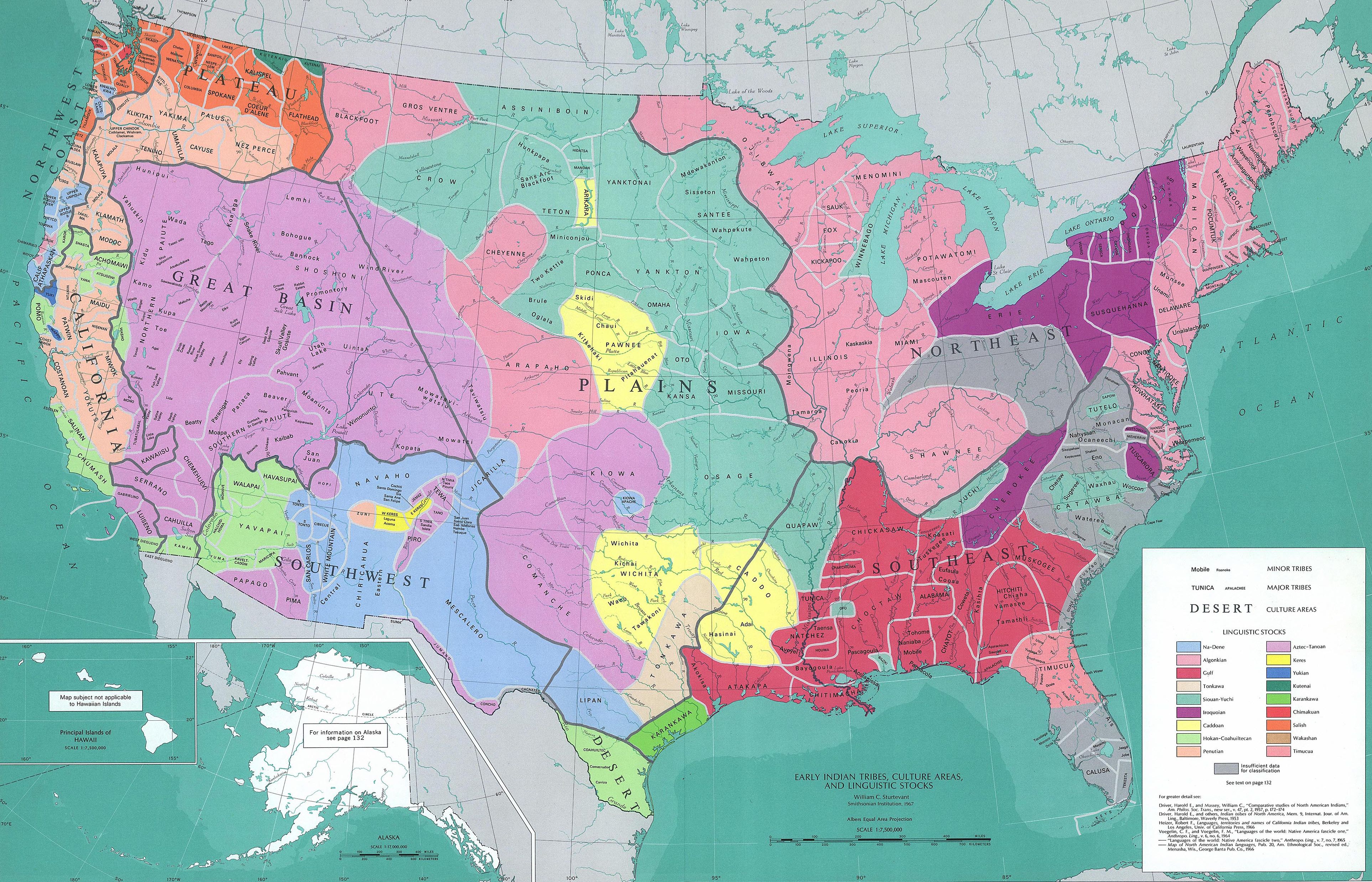
It is true that North American Indians did not have large continent spanning empires as in Europe or Asia. But the idea that the land was sparsely populated is a myth. North America had an immense diversity of groups, from the basic hunter-gatherer tribes to those practicing a mix of hunting and agriculture; from the Plains tribes to the coastal cultures; there were dozens or languages and subcultures; and many groups – the Iroquois for example – had coalesced into confederacies (take a look at this map; click to zoom in on the specific names in different regions). European ships that sailed along the east coast in the 1600s could not strike deep roots along the coast because it was thickly populated.

Why then are there only 3-4 million people of American Indian descent today in the US population of 300 million? Massachusetts, Connecticut, Chattanooga, Potomac, Dakota, Kansas, and scores more such names in every state, every region: today etymology provides the only evidence of American Indian presence. The people who left these names have either disappeared altogether or have been marginalized. Phoenix, the sprawling Arizonan city I lived in, was itself a tribute to the Indians, but few are aware of it. White settlers in the late nineteenth century named it so because they anticipated a modern city to rise out of the ashes of the Hohokam, an agricultural people who had marked the desert valley with their well engineered irrigation canals in the centuries before Columbus.

Something profoundly tragic had happened here. In the heat of America’s meteoric rise over the last century, that something has been forgotten and left at the margins of history. Its scale tends to get underestimated, because the evidence is silent and not obvious. An entire continent lost its voice and, most importantly, its people. Today, we have worldviews – African, Chinese, Indian, Western – that are deeply rooted in their histories, even if the externals are predominantly Western. But to find an Indian perspective in North America one has to travel to little known but still culturally vibrant reservations.

It was this history that I began to explore while living in Arizona. I visited archaeological sites in Arizona, Colorado and New Mexico, from the large and architecturally sophisticated – the much ignored and remote Chaco Canyon in New Mexico – to small but equally instructive ruins around Phoenix and northern Arizona. I went to the Navajo, Hopi, Zuni, Apache and Tohono Odham reservations, to see how modern day American Indians had fashioned some measure of cultural continuity in impoverished settings. When I moved to Minnesota, I visited the Pine Ridge reservation in South Dakota, where the same history of dispossession and ethnic cleansing had culminated in the Wounded Knee massacre of 1890. Because of its geographic isolation, the Americas (along with Australia) faced the worst consequences of European colonialism. Diseases, to which American Indians had no immunity, wiped out entire societies.

If the North Americans had faced such devastation, then how had the rest of the Americas, similarly isolated, fared? While the predominantly tribal societies of North America had been conquered by European Protestants, the massive empires of the Central and South had been downed by a band of daring conquistadors from Catholic Spain. The Caribbean natives faded in the decades after Columbus’ arrival; Argentina’s natives were exterminated in the eighteenth century. But in Mexico and the Andean nations (Peru, Ecuador, Bolivia) the descendants of the Aztecs, the Mayans, the Incas (and many other indigenous groups) are still there. The conquests were no less devastating, but a forcibly imposed Catholicism had brought Indians into its fold, even as it erased earlier beliefs.

The new culture also allowed for racial mixing between Native Americans and Europeans (giving rise to the Mestizo) – and blacks too. The poor southern Mexican immigrants in my neighborhood in Phoenix Arizona, brown skinned like me and noticeably short, were of that stock. In fact, Hispanics, who are partly American Indian, are achieving demographic parity with the whites in southwestern America. In a different way, they are reversing what whites once did when they conquered these lands.

My curiosity about indigenous Latin America spurred visits to Mexico City (formerly the Aztec capital, Tenochtitlan), Chiapas (in Mexico’s Mayan south), the Andean parts of Peru and Bolivia. These places are the polar opposites of the United States since Indians are the majority. But Spanish colonialism has marked them badly and left them poor. That is why the places have strong socialist movements: the Zapatistas in Chiapas, Evo Morales in Bolivia.

The small discoveries that I make during my visits are the reason why I travel; that is why I have been writing about my visits to Indian reservations in the United States, and more recently about Mexico, Peru and Bolivia. Of course, I know only a fraction of the story. In Latin America, my progress has been hindered because I do not know Spanish. I don’t have any overarching theories, but I always find it instructive to understand the specifics of each place, yet be aware of the broader contrasts.

The arrival of the Europeans to America was a Black Swan – an unprecedented event that had a massive impact. No one could have predicted the consequences. Millions of American Indians died, either due to disease or conquest, and the Americas (especially North America) lost their voice and culture. Europe and Asia benefited immensely from the crops and foods domesticated in the Americas (corn, tomatoes, potatoes, chilies to name a few). Europeans found a new place to emigrate to – for them it was a positive Black Swan that unleashed new energies.

History works in quirky ways and its logic remains only partly visible to us – and that too only after the fact.

Wednesday, August 04, 2010

Taleb on history

History is totally unpredictable. If you ask me how the world will be in ten years I really have no idea. One assumes it will not change much or will change only gradually, but who knows. Once a significant event has happened, everything seems inevitable; we tend to invent convenient narratives. We like to use newly inferred "knowledge" to advance our ideologies.

I too, in my writings on history, have been guilty of such theorizing. Narratives based on past events are therapeutic and invigorating; they give the illusory sense of greater knowledge and a warm glow when one is able to talk about them at parties and social events. I am not suggesting that there is no causality or narrative at all, or that history should not be studied. But the current manner in which it is analyzed does suffer from these issues that Nasim Taleb points out in The Black Swan:
History is opaque. You see what comes out, not the script that produces events, the generator of history. There is fundamental incompleteness in your grasp of such events, since you do not see what’s inside the box, how the mechanisms work.

The human mind suffers from three ailments as it comes into contact with history, what I call the triplet of opacity. They are:

a. the illusion of understanding, or how everyone thinks he knows what is going on in a world that is more complicated (or random) than they realize;

b. the retrospective distortion, or how we can assess matters only after the fact, as if they were in a rearview mirror (history seems clearer and more organized in history books than in empirical reality); and

c. the overvaluation of factual information and the handicap of authoritative and learned people, particularly when they create categories – when they “Platonify.”

Sunday, July 25, 2010

The Arab conquest of Sind, and the Spanish conquest of Mexico

Contrasts in the historical trajectories of different regions can provide fresh perspectives. That is why my favorite books are those that synthesize anthropological and historical knowledge across continents – Alfred Crosby’s The Columbian Exchange, Jared Diamond’s Guns Germs and Steel, Charles Mann’s 1491. And in literature, Octavio Paz and VS Naipaul are superb at interweaving the contrasts of world history in their nonfiction.

In Among the Believers for example, Naipaul dedicates a chapter analyzing the seventh century Arab conquest of Sind as narrated in historical text Chachnama. That first incursion of Islam in Hindu-Buddhist South Asia – now Pakistan – has a striking similarity to the violent advance of a different but ideologically similar monotheism, Catholisicm, almost eight hundred years later, in the Americas. I’ll let the excerpts below tell the full story:
In the imagination, the Arabs of the seventh century, inflamed by the message of the Prophet, pour out of Arabia and spread east and west, overthrowing decayed kingdoms and imposing the new faith. They move fast. In the West, they invade Visigothic Spain in 710; in the east, in the same year, they move beyond Persia to invade the great Hindu-Buddhist kingdom of Sind. The symmetry of the expansion reinforces the idea of elemental energy, a lava flow of the faith. But the Arab account of the conquest of Sind – contained in the book called the Chachnama, which I read in Pakistan in a paperback reprint of the English translation first published in 1900 in Karachi – tells a less apocalyptic story.

The Arabs had to fight hard. They turned their attention to Sind at some time between 634 and 644, during the reign of the second caliph or successor to the Prophet, and in the next sixty or seventy years made ten attempts at conquest. The aim of the final invasion, as the Chachnama makes clear, was not the propagation of the faith. The invasion was a commercial-imperial enterprise; it had to show a profit.

There are resemblances to the Spanish conquest of Mexico and Peru, and they are not accidental. The Arab conquest of Spain, occurring at the same time as the conquest of Sind, marked Spain. Eight hundred years later, in the New World, the Spanish conquistadores were like Arabs in their faith, fanaticism, toughness, poverty and greed. The Chachnama is in many ways like The Conquest of New Spain by Bernal Diaz del Castillo, the Spanish soldier who in his old age wrote of his campaigns in Mexico with Cortes in 1519 and after. The theme of both works is the same: the destruction, by an imperialist power with a strong sense of mission and a wide knowledge of the world, of a remote culture that knows only itself and doesn’t begin to understand what it is fighting. The world conquerors, the establishers of long-lived systems, have a wider view; men are bound together by a larger idea. The people to be conquered see less, know less; their stratified or fragmented societies are ready to be taken over. And, interestingly, both in Mexico in 1519 and in Sind in 710 people were weakened by prophecies of conquest.

There is this difference between The Conquest of New Spain and the Chachnama. Bernal Diaz, the Spaniard, was writing of events he had taken part in. The Chachnama is Arab or Muslim genre writing, a “pleasant story of conquest”, and it was written five hundred years after the conquest of Sind. The author was Persian; his source was an Arabic manuscript preserved by the family of the conqueror, Bin Qasim.

The intervening five centuries have added no extra moral or historical sense to the Persian narrative, no new wonder or compassion, no idea of what is cruel or what is not cruel, such as even Bernal Diaz, the Spanish solder, possesses. To the Persian, writing in 1216, the Arab conquests are glorious; they are the story of the spread of true civilization. Conquest is pleasant to read about because conquest is “based on spiritual rectitude and temporal excellence… of which learned philosophers and generous kings would be proud, because all men attain advancement to perfection by acknowledging as true the belief of the people of Arabia.” There is an irony in this praise of conquest: not many years after those words were written, the invading Mongols were to arrive in Persia and Iraq, and the Arab civilization which the Chachnama celebrated was to be shattered, stupefied for centuries.
And at the end of the chapter, Naipaul writes:
The Chachnama shows the Arabs of the seventh century as a people stimulated and enlightened by the discipline of Islam, developing fast, picking up learning and new ways and new weapons (catapults, Greek fire) from the people they conquer, intelligently curious about the people they intend to conquer. The current fundamentalist wish in Pakistan [Naipaul was writing in 1979] to go back to that pure Islamic time has nothing to do with a historical understanding of the Arab expansion. The fundamentalists feel that to be like those early Arabs they need only one tool: the Koran. Islam, which made seventh-century Arabs world conquerors, now clouds the minds of their successors or pretended successors.

Friday, June 18, 2010

Tiwanaku and Evo Morales

Most of us have heard of the Incas, but they were only the last of a line of empires that rose in western South America. Before them, in the high and mostly dry plateau of the Andes, called the Altiplano, the Tiwanaku flourished. The indigenous Aymara of modern day Bolivia consider themselves descendants of the Tiwanaku. In January 2006, a day before he assumed presidential office, Evo Morales, an Aymara himself, attended a ceremony at the principal archaeological site of of this ancient culture, two hours from La Paz.

The Spanish colonized this part of the world with much brutality in the 16th century; Bolivia became independent in the 19th century but it was a sham independence: the Spanish descended elites still held power. Evo Morales’s remarkable ascension to the highest office in Bolivia in 2006 – he had been a Coca farmer once – was a truly historic moment. Hence the coronation at Tiwanaku. Like the blacks of South Africa, the majority Aymara too were denied for a long time. Evo Morales may be viewed skeptically in the West because he is socialist, but it is from the perspective of indigenous empowerment that his rise is significant. In 2009, a month before I visited La Paz, he was reelected with an even stronger majority.


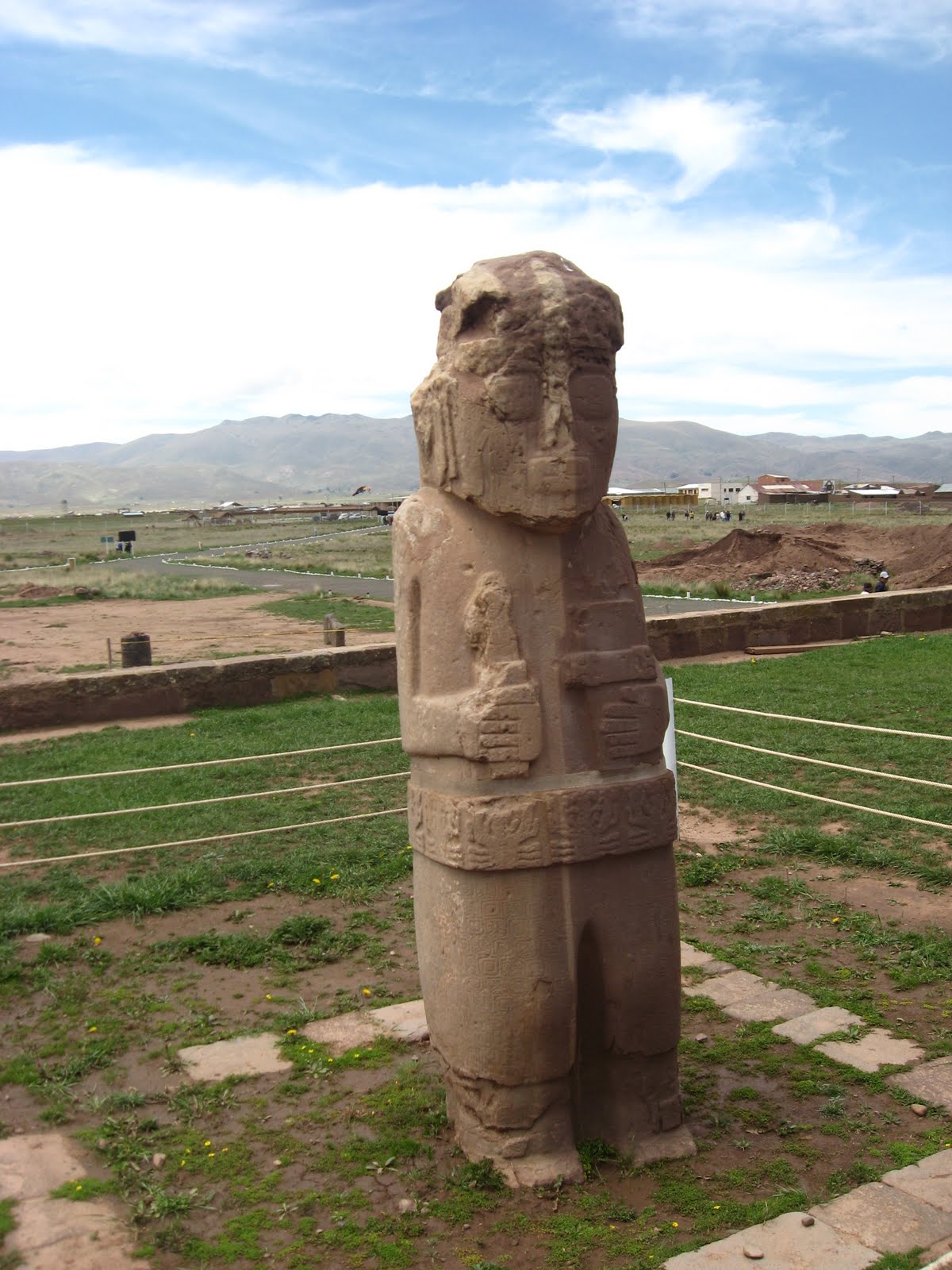
Above, you'll find some pictures of relics from the Tiwanaku site. The Spanish missionaries of the sixteenth century couldn’t let them be. They "exorcised" the spirit of the second relic by scraping a cross on the right shoulder. No doubt, this nasty bit of sabotage stemmed from a deep insecurity. If the God of Christianity was indeed the only worthy and true God, then why did that fact have to be imposed in a coercive manner?

Monday, June 14, 2010

Conquerors, but also cultural carriers

In the marvelous introduction to his book, Genghis khan And The Making Of The Modern World, Jack Weatherford writes,
The Mongols made no technological breakthroughs, founded no new religions, wrote few books or dramas, and gave the world no new crops or methods of agriculture. Their own craftsmen could not weave cloth, cast metal, make pottery or even bake bread. They manufactured neither porcelain nor pottery, painted no pictures, and built no buildings. Yet, as their army conquered culture after culture, they collected and passed all of these skills from one civilization to next.

The Mongols deliberately opened the world to new commerce not only in goods, but also in ideas and knowledge. The Mongols brought German miners to China and Chinese doctors to Persia. The transfers ranged from the monumental to the trivial. They spread the use of carpets everywhere they went and transplanted lemons and carrots from Persia to China, as well as noodles, playing cards, and tea from China to the West. They brought a metal worker from Paris to build a fountain on the dry steppes of Mongolia, recruited an English nobleman to serve as interpreter in their army, and took the practice of Chinese fingerprinting to Persia. They financed the building of Christian churches in China, Buddhist temples and stupas in Persia, and Muslim Koranic schools in Russia. The Mongols swept across the globe as conquerors, but also as civilization´s greatest cultural carriers.

The Mongols who inherited Genghis Khan´s empire exercised a determiend drive to move products and commodities around and to combine them in ways that produced entirely novel products and unprecedented invention. When their highly skilled engineers from
China, Persia and Europe combined Chinese gunpowder with Muslim flamethrowers and applied European bell casting technology, they produced the canon, an entirely new order of technological innovation, from which sprang the vast modern arsenal of weapons from pistols to missiles. While each item had some significance the larger imnpact came from in the way the Mongols selected and combined technologies to create unusual hybrids.

Seemingly every aspect of European life -- technology, warfare, clothing, commerce, food, art,liteature and music -- changed during the Renaissance as a result of the Mongol influence. In addition to new forms of fighting, new machines and new foods, even the most mundane aspects of daily life changed as the Europeans switched to Mongol fabrics, wearing pants and jackets instead of tunics and robes, played their musical instruments with the steppe bow rather than plucking them with the fingers, and painted their pictures in a new style. The Europeans even picked up the Mogol exclamation hurray as an enthusiastic cry of bravado and mutual encouragement.

Tuesday, June 01, 2010

The art instinct

Edward Wilson writes in Sociobiology: The New Synthesis:
Artistic impulses are by no means limited to man. In 1962, when Desmond Morris reviewed the subject in The Biology of Art, 32 individual non-human primates had produced drawings and paintings in captivity. Twenty three were chimpanzees, 2 were gorillas, 3 were orangutans, and 4 were capuchin monkeys. None received special training or anything more than access to the necessary equipment. In fact, attempts to guide the efforts of the animals by inducing imitation were always unsuccessful. The drive to use the painting and drawing equipment was powerful, requiring no reinforcement from human observers. Both young and old animals became so engrossed with the activity that they preferred it to being fed and sometimes threw temper tantrums when stopped. Two of the chimpanzees studied extensively were highly productive. “Alpha” produced over 200 pictures, “Congo”, who deserves to the called the Picasso of the great apes, was responsible for nearly 400. Although most of the efforts consisted of scribbling, the patterns were far from random. Lines and smudges were spread over a blank page outward from a centrally located figure. When a drawing was started on one side of a blank page the chimpanzee usually shifted to the opposite side to offset it. With time the calligraphy became bolder, starting with simple lines and progressing to more complicated multiple scribbles. Congo’s patterns progressed along approximately the same developmental path as those of very young human children, yielding fan-shaped diagrams and even complete circles. Other chimpanzees drew crosses.

The artistic behavior of chimpanzees may well be a function of their tool using behavior. Members of the species display a total of about ten techniques, all of which require manual skill. Probably all are improved through practice, while at least a few are passed as traditions from one generation to the next. The chimpanzees have considerable faculty for inventing new techniques, such as the use of sticks to pull objects through cage bars and to pry open boxes. Thus the tendency to manipulate objects and to explore their uses appears to have an adaptive advantage for chimpanzees.

The same reasoning applies a fortiori to the origin of art in man…Human beings have been hunter-gatherers for over 99 per cent of their history, during which time each man made his own tools. The appraisal of form and skill in execution were necessary for survival, and they probably brought social approval as well. Both forms of success paid off in greater genetic fitness. If the chimpanzee Congo could reach the stage of elementary diagrams, it is not too hard to imagine primitive man progressing to representational figures. Once that stage was reached, the transition to the use of art in sympathetic magic and ritual must have followed quickly. Art might then have played a reciprocally reinforcing role in the development of culture and mental capacity. In the end, writing emerged as the idiographic representation of language.

Monday, May 17, 2010

The genius of Inca masonry

During my travels in Peru, I found nothing more striking or elegant than Inca walls. Above you’ll find two examples. The first is in a street in the Andean city of Cuzco, once the capital of the Incas. The second is at Saqsayhuaman, an Inca fortress whose ruins today overlook the sprawl of Cuzco. Notice that the walls are not held together by mortar; rather they consist of large interlocking stones that fit like a puzzle. One can only imagine the labor and organization required for such precision. In a seismically active area, these structures have endured to this day – while many Spanish constructions in Peru since mid 1500s have collapsed. In some cases, the walls blend with the landscape, like a naturally formed jumble of rocks, to an extent that they do not seem constructed (the second picture for example). They have an austere, minimalist look which elevates their beauty even more.

The other distinctive feature of Inca architecture is trapezoidal doors and niches. As John Hemming writes in The Conquest of Incas:
Doors and niches were invariably built in trapezoidal shapes, with the sides tapering inwards towards the lintel at the top. This was a logical method for builders who had not discovered the principle of the arch. It reduced the length of the lintel stone and spread the thrust of the weight it supported. Rows of such trapezoidal niches broke the monotony of Inca walls. Sometimes the niches were the size of sentry-boxes, tall enough to accommodate a line of standing attendants, but more often they were smaller, sunk into the wall at chest height to form a row of convenient cupboard alcoves.


Examples above of a trapezoidal door (from Saqsayhuaman) and wall alcoves (from Machu Picchu).

Wednesday, April 14, 2010

The neglect of India's classical languages

Last year, the Sanskrit scholar Sheldon Pollock asked why India pays scant attention to its linguistic heritage. The neglect of classical languages means that the vast majority of Indians remain divorced from a deeper understanding of their own past. To put things in perspective, think of how well studied Western classical languages are; it is no surprise that the West understands its own journey to the present really well -- and is constantly reinterpreting it.

I feel proud of India’s Hindu-Buddhist history, but my knowledge of Sanskrit or even my own mother tongue Tamil – yet another classical language – is so poor, any understanding I may claim to have of this heritage can only be superficial. I have not read a single text in an Indian language. Even the realization that Sanskrit has a complex grammar, that novel numerical methods constitute much of ancient Indian mathematics, was recent – I learned of them through the painstaking work of Western scholars such as Nicholas Ostler and Kim Plofker.

In her new essay, Crisis in the Classics, Ananya Vajpeyi stresses the enormity of the Indian problem:
Kusum Pawde, a Maharashtrian woman of non-Brahmin origins, has written a seminal essay titled “The Story of my ‘Sanskrit’,” describing the struggles she faced growing up outside upper caste society in Maharashtra and becoming a Sanskrit scholar and university teacher. Her story took place back when the study of Sanskrit was still confined to Brahmin men; Pawde had to fight discrimination on the grounds of both caste and gender. Yet, when I first read her essay whilst doing my own doctoral work in Maharashtra thirty-five or forty years after she completed her education, even with my rather different social and financial situation, I found it no less difficult to navigate the world of Sanskrit scholarship.

The only place Sanskrit felt accessible was in the classroom at the University of Chicago with American professors and classmates, or on the fifth floor of the Regenstein Library, which housed every text – old or new, classical or vernacular, Indian or European – that one might conceivably need. Between 1998 and 2003, I spent almost five years in the field, travelling to every major centre of Sanskrit, learning throughout the Deccan and southern India. By the time I returned to Chicago to write my dissertation, I had to concede that there was no “there” there for the study of pre-modern India, in India.

In early 2010, Gurcharan Das told me that he was disturbed about having to go to American universities to study or refresh his Sanskrit in preparation for writing his latest book, The Difficulty of Being Good (2009). Das was an undergraduate at Harvard in the 1960s, where he read Sanskrit with Daniel Ingalls. Four decades later, he returned to the University of Chicago to brush up his philological skills with Ingalls’ students, Sheldon Pollock and Wendy Doniger.

As we shared stories across generations, I recounted to Das my own disappointments and difficulties in trying to study Sanskrit in India. I told him about my misadventures at universities, libraries, archives, and traditional schools in multiple states – Maharashtra, Karnataka, Uttar Pradesh, Tamil Nadu, and Bengal. I had spent my twenties in graduate school, searching for Sanskrit. I found it more readily in the U.K. and the U.S.; in India, it consistently eluded me. Das looked at me in amazement; it had not occurred to him that his experience – call it the difficulty of being good at classical studies in India – was not by any means unique to him.
[...]

Arguably, linguistic diversity and literary richness ought to be India’s strongest suit, given its history both as an old civilization and as a diverse and multi-vocal democracy. Alas, we have driven our languages and literatures into the ground. Linguistic chauvinism and language-centred identity politics abound. Yet, not a single political ideology protects and nurtures the languages, which remain orphans in the political process and in the networks of institutional patronage cultivated by different parties.
[...]

But Sanskrit was never merely – and certainly need no longer be – a tool of epistemic violence against vulnerable sections of our society, including women, lower castes, tribals, and Muslims. It is, like it or not, one of a very small number of keys to our entire recorded history; without an ability to be functional in this language, without preserving its texts, its archives, and its material residues, we simply cannot know our own origins. Wilfully destroying and forgetting the historical past, in the manner of Communist Russia and China in the twentieth century, or distancing and censoring it in the manner of other new republics based on old cultures, like Turkey and Iran, is not the way forward for India.

Try to imagine independent India without its founding, fundamental, and inalienable texts, whether ancient or modern, upper caste or outcaste: the sermons of the Buddha, the edicts of Asoka, the epics of Vyasa and Valmiki, the songs of its Sufis and bhakti poets, the teachings of its saints and sages, the lessons of its gurus, the Constitution of its Republic, Gandhi’s letters, Ambedkar’s articles, Nehru’s speeches, Tagore’s national anthem, and the innumerable stories that we continuously recount. Not land, blood, race, religion, or state – language itself is our essence. Without our words, we are nothing.
It's a superb essay, a heartfelt plea that one hopes will be heard -- and soon. Read it here.

Saturday, March 27, 2010

Pictures from Machu Picchu

John Hemming provides a precise summary of the famous archaeological site in The Conquest of the Incas:
Most visitors to Peru see Machu Picchu, which is perched on a narrow saddle of rock high above a hairpin curve of the Urubamba [river]. The granite sugarloaf of Huayna Pichu towers above the ruin, and the surrounding forested hillsides are often gripped by shrouds of low clammy cloud. Such scenery makes Machu Picchu one of the world’s most eerily beautiful ruins.


I took these pictures on Christmas day, 2009. It was gloomy, rainy day, but this only enhanced the beauty of the place. Machu Picchu well and truly lives up to its hype. The animal in the first picture is a drenched llama. The fifth picture is of a turbulent Urubamba river, which is part of the Amazon system. The last shows the hairpin curve of the Urubamba observed from the perch of Machu Picchu. At the base of the mountain is the train station where visitors disembark. The final part of the journey is by bus, which switchbacks its way through the forested hillside before reaching the ruins.

Saturday, March 13, 2010

On Kim Plofker's Mathematics in India

That the concept of zero and the now widely used, indispensable decimal numeric system (imprecisely called Arabic numerals) came from India is old news -- a piece of trivia circulated often enough to have little or no surprise value. There is more, much more, to ancient Indian mathematics than these iconic contributions. Though I am trained in the quantitative sciences, I learned all of it – linear algebra, the theory of probability, and combinatorics – from the classrooms and labs of US universities, and very little from India. So it is only appropriate – though also ironic in another way – that the knowledge of ancient India should be made available to me through the painstaking research of a Western historian of mathematics, Kim Plofker.

Plofker has plowed through a range of Indian texts, beginning from the Vedic period – that’s three thousand years ago – to the eighteenth century to produce Mathematics in India. Hers is an achievement as much of linguistics, translation and history as of mathematics. The book sits on my desk, and there it shall be for some years, gathering dust, as I dip in only occasionally. It’s not the type that can be easily read from cover to cover – no book of mathematics is – but Plofker tries her best to make terms and concepts accessible.

Luckily, David Mumford, winner of the Fields Medal – the most prestigious prize in mathematics – has written a six-page essay on the book, which captures, concisely, the major achievements of Indian mathematics. There is the use of Pythagoras’ famous theorem in the construction of pillars, some centuries before the Greek philosopher is said to have postulated it in fifth century BC; Pāṇini’s rules of Sanskrit grammar and recursion, which “without exaggeration…anticipated the basic ideas of modern computer science”; Pingala, whose study of Sanskrit verses led to the binary notation and the development of Pascal’s famous triangle, useful in the calculation of binomial coefficients (which, coincidentally, is what I am teaching now); and Madhava of Sangamagramma (circa 14th century), the genius of the Kerala School, who contributed along with others, to "the discoveries of the power series expansions of arctangent, sine, and cosine" (a text on this in Malayalam has survived).

But what interested me most was the applied orientation of Indian mathematics. Like the ancient Mexicans, who designed sophisticated calendars (and who also used the concept of zero, probably earlier than the Indians did, though such rat races about who did what first are useless beyond a point), the mathematicians of India were spurred by the questions of astronomy. But the applied orientation goes even further than that. Mumford writes:
"It is important to recognize two essential differences here between the Indian approach and that of the Greeks. First of all, whereas Eudoxus, Euclid, and many other Greek mathematicians created pure mathematics, devoid of any actual numbers and based especially on their invention of indirect reductio ad absurdum arguments, the Indians were primarily applied mathematicians focused on finding algorithms for astronomical predictions and philosophically predisposed to reject indirect arguments. In fact, Buddhists and Jains created what is now called Belnap’s four-valued logic claiming that assertions can be true, false, neither, or both. The Indian mathematics tradition consistently looked for constructive arguments and justifications and numerical algorithms [Mumford's italics]. So whereas Euclid’s Elements was embraced by Islamic mathematicians and by the Chinese when Matteo Ricci translated it in 1607, it simply didn’t fit with the Indian way of viewing math. In fact, there is no evidence that it reached India before the eighteenth century."
This is particularly pleasing to me, because my own research, coincidentally, is about using mathematics in computationally feasible ways for various applications, rather than basking in the beauty and abstraction of theorems. (I will admit, however, that I was once obsessed with writing a paper that had only theorems and proofs in it; I did manage something, but only by borrowing significantly from the work of others; and still, months of edits await the paper before it can find its way to print.)

What might be an example of this “applied” orientation? Mumford writes of the “the discovery of the formula for the area and volume of the sphere by Bhaskara II” (circa 12th century):
“Essentially, he [Bhaskara II] rediscovered the derivation found in Archimedes’ On the Sphere and the Cylinder I. That is, he sliced the surface of the sphere by equally spaced lines of latitude and, using this, reduced the calculation of the area to the integral of sine. Now, he knew that cosine differences were sines but, startlingly, he integrates sine by summing his tables! He seems well aware that this is approximate and that a limiting argument is needed but this is implicit in his work. My belief is that, given his applied orientation, this was the more convincing argument. In any case, the argument using the discrete fundamental theorem of calculus is given a few centuries later by the Kerala school, where one also finds explicit statements on the need for a limiting process, like: “The greater the number [of subdivisions of an arc], the more accurate the circumference [given by the length of the inscribed polygon]” and “Here the arc segment has to be imagined to be as small as one wants. . . [but] since one has to explain [it] in a certain [definite] way, [I] have said [so far] that a quadrant has twenty-four chords.”
One of the delightful bits in the excerpt is the choice of “twenty-four chords” – it implies a casual, intuitive approach, yet the same is preceded by knowledge of what needs to be done to achieve exactness. That’s the essence of a “heuristic” or an approximation, which engineers use all the time.

Finally, the closing paragraph of Mumford’s essay:
It is high time that the full story of Indian mathematics from Vedic times through 1600 became generally known. I am not minimizing the genius of the Greeks and their wonderful invention of pure mathematics, but other peoples have been doing math in different ways, and they have often attained the same goals independently. Rigorous mathematics in the Greek style should not be seen as the only way to gain mathematical knowledge. In India, where concrete applications were never far from theory, justifications were more informal and mostly verbal rather than written. One should also recall that the European Enlightenment was an orgy of correct and important but semirigorous math in which Greek ideals were forgotten. The recent episodes with deep mathematics flowing from quantum field and string theory teach us the same lesson: that the muse of mathematics can be wooed in many different ways and her secrets teased out of her. And so they were in India: read this book to learn more of this wonderful story!