Friday, January 20, 2006

Chasing a Mirage

I

The Coronado National Memorial commemorates the first organized European exploration of the American Southwest. Francisco Vasquez de Coronado, a 16th century conquistador, led the exploration. I visited the memorial just two days before Christmas last year. The memorial is in southeastern Arizona along the U.S-Mexico border, at the southern end of the Huachuca Mountains.

The guide at the visitor's center, a man in his early sixties, told us the memorial was free. He had a gray beard and his eyes had a certain intensity. He seemed more interested in the wildlife of the memorial than in Coronado. And that is indeed the other main – and perhaps more relevant – purpose of the memorial: to preserve the wildlife and the oak woodlands of the Huachuca mountains. At the back of the visitor's center was a large glass window, through which the guide showed us birds – hermit thrushes, acorn woodpeckers, Mexican jays – in the trees just outside. “I’ve seen nearly forty species of birds this morning,” he said proudly and with awe.

From the visitor's center a 2-mile road (mostly unpaved) leads to the foot of Coronado Peak. It was desolate that afternoon, and the views of the mountain ranges of Mexico and southern Arizona were excellent. Coronado’s expedition might have passed someplace close, perhaps within a ten or twenty mile radius of where I stood.

The only other car parked in the lot was that of the Border Patrol. With Mexico so close, its presence shouldn’t have been unexpected, yet I found it unsettling. All around me was the inhospitable landscape of low desert bush and oak trees. It is a landscape that hundreds of Mexicans, Central and South Americans attempt to overcome, hoping for a piece of the American dream. Many of them succumb to the difficulties of the journey; the desert is specked with the death of many of these migrants.

II

A lure of a different kind had been at work in the 16th century, during Coronado’s time. In the decades after Columbus’s landing, conquistadors from Spain were possessed of a frenzy that would unravel much in the New World. A lot of this frenzy had to do with the ease with which Cortez and Pizarro brought down rich, magnificent empires of the region – the Aztec and the Inca. Suddenly, there was considerable wealth to plunder, and other conquistadors dreamed of discovering their own rich cities, their own Tenochtitlan and Peru, and claiming the spoils for themselves and Spain. In the excitement and delirium of those years, every distorted tale of an unfound empire with unimaginable riches would have seemed legitimate.

The 1530s seems to have been a decade rife with rumors. The most famous of them of was that of El Dorado. The quest for El Dorado would occupy explorers for two more centuries. VS Naipaul in his short essay Columbus and Crusoe wrote: “And even in the violated New World, the Spaniards themselves remained subject to the fantasy. The quest for El Dorado became like a recapitulation of the New World adventure, a wish to have it all over again; more men and money were expended on this in twenty expeditions than on the conquest of Mexico, Peru and New Granada.”

Another, less glamorous rumor was afoot around the same time. This had to do with seven cities of gold located far north of the lands that the Spaniards had conquered in Mexico. The legend of the seven cities of gold was an older one; it came out of an Old World conflict, when the Muslims (the Moors) in the 11th century managed to conquer Merida in Spain. It was said that seven bishops had escaped this conquest and in a far-away place, each bishop had set up his own city of gold.

The legend found its way to the New World; it seemed to some Spaniards that through their transatlantic journeys and new findings they had come to that far-away place. The reports from some explorers seemed to substantiate notions that these cities existed to the north of Mexico, in what is today the southwestern United States. The reports spoke of “large cities, with streets lined with goldsmith shops, houses of many stories, and doorways studded with emerald and turquoise!”

An expedition of roughly 350 Spanish soldiers, 4 Franciscan priests, 1100 Indians and 1500 heads of livestock was organized. Coronado, who was then a governor of a province in Mexico, led the expedition. The journey started Compostela, a coastal town in the west of Mexico and traveled hundreds of miles north in two years (1540-1542): through Arizona, New Mexico, and eastern Kansas before returning to Mexico. Perhaps from what they had heard, Corondo and his Spanish expedition might have expected a land dusted, specked and studded with gold. Instead they found desert villages of the Pueblo people with flat adobe dwellings, large storehouses of corn and beans, a beautiful but stark landscape, and the impassable Grand Canyon that sprang upon them from nowhere.

III

At the visitor’s center of the Coronado memorial there is a short ten-minute video, a sort of documentary on the expedition. It shows Coronado and other bearded conquistadors on their horses. (The horse can go unnoticed today but when it made its appearance with the arrival of the Spanish in the New World, it had a telling role to play in conquests.) The video also shows the disappointment of the conquistadors when, on reaching a village of Pueblo Indians, they realize there are no cities of gold, and that their arduous journey through the desert is probably a fruitless one. The actors in the video simulating disappointment with their grave expressions only manage unwittingly to caricature the conquistadors. And since beneath all the talk of endurance and valor is just the avaricious core, the feeling of tragedy comes across as comic.

Monday, January 09, 2006

A day with Michael Mazgaonkar

I

Michael Mazgaonkar and his wife Swati work in the villages and hamlets of a district in Gujarat that is close to the Maharashstra border. They work with the tribal communities in the area on many issues: development of women’s co-operatives, bringing electricity to the villages, land rights of tribes, bunding of fields to prevent soil erosion, and environmental problems.

Michael toured the US late last year; he visited different US-based chapters of the Association of India’s Development (AID), an organization conceived in the US more than a decade ago, and that supports grassroots activists and volunteers like Michael and Swati and other development projects in rural India.

Michael was at the Tempe chapter of AID in November. His talk was on a Wednesday evening. I was to have lunch that Wednesday and show him around the Arizona State University campus.

II

I went to pick Michael up at noon at the AID volunteer’s apartment where he was temporarily put up. He was tall man, dark-complexioned, probably in his early forties, balding and gray-haired. He had a ready, disarming smile that suffused his face with a sort of benevolence.

I suggested Blue Nile, an Ethiopian restaurant close to the university, for lunch. I thought he might interestd in tasting injera, Ethiopian “bread”, made from teff, a grain that had first been cultivated in Ethiopia, in the unique climate and setting of its highlands. Michael liked the ambience of the restaurant – dark colored walls, African masks – and took particular note of the woodwork on the backless low stool used for seating. “This is very well done,” he said. And when food was served to us in a large circular plate, a plate clearly meant for a communal meal, he recalled a dinner he had had in Palestine with Bedouins. That way, in bits and pieces, I learnt a little where had traveled: the Middle East; North or South Dakota to meet the Lakota tribe; and Europe, which he referred to once in a while.

The particular village in Gujarat where Michael and Swati live is called Juna Mozda. I had read on a website that Michael and Swati had sold greeting cards there for a living while simultaneously helping the tribals with their various problems.

“The market for greeting cards is very competitive,” he said. “You have to keep changing designs.” And yet they had done that for a long time, for a decade or so, upto 1999.

I asked him when he had decided to become involved in people’s issues.

“There wasn’t just a day or a moment when I made the decision,” he said. “It was slow process that happened over time. It has to be slow.”

I wanted to know more about his background, so I could try to understand where the motivation for his work might have stemmed from. Had his parents been involved in social work?

“My parents were part of Gandhian movements,” he said. I thought he wasn’t very forthcoming. It was understandable – I had only just met him.

We then talked about the tribals in and around the villages that he worked in.

“There were hunter-gatherers fifty, sixty years ago. There was a significant forest cover then. There still are forests now, but not as many,” he said.

“Has the transition from being hunter-gatherers to settling down as farmers been traumatic?”

“It might have been, but they are quite settled now to a agrarian lifestyle. But they have lost quite a bit in nutrition. Their diet then used to consist of a lot of meat. Now they eat mostly vegetables. They used to eat rabbits, and there was the occasional deer hunt.”

“What language do they speak?”

“It’s a mixture of the different languages of the region. But they also have words of the forest.” So the memory of the forests was probably still there in their oral traditions. Their religion too, he said, couldn’t be categorized under Hinduism; but nowadays, the influence of the BJP and the RSS could not be denied. The tone of this last remark seemed to indicate his disapproval for the politics of Hindutva.

I asked him whether he had felt some resistance from the villagers as Michael came from an essentially urban background: he had grown up in Bombay and had later done his engineering degree in Baroda. I thought he wasn’t comfortable with the question; his discomfort was essentially a defense of the villagers. He said it took time to win trust, and even now the villagers sometimes “checked”, but that was fine; there was nothing wrong in that.


III

After lunch, I offered him to walk him through the ASU campus. It was a partly cloudy day but warm. Michael admitted to feeling a bit disoriented – as part of his itinerary he had already been to a number of other cities in the US. And there were many more cities more to go.

I have an interest in trees and plants and eagerly pointed out to him those that were native to Arizona. I told him how ill-suited the non-native ones were. The many palm trees that adorned streets and walkways of the campus seemed to be native but actually weren’t, I said. They upset the water table in an already arid, water-starved region. He agreed that non-native vegetation was a menace, was particularly severe on eucalyptus trees: “Nothing grows under the eucalyptus tree. It makes the soil acidic. We’ve cut eucalyptus trees in Mozda.”

But he had a keener eye for other things: he was very interested in all the construction going on around the campus; he lingered next to a half finished building with its innards on display – “So, this is how they do it,” he said, almost to himself. He was also interested in an antenna on the roof of one of the buildings, and wondered what its purpose was, for it didn’t look to him like the antennas he knew. On our way back to the apartment we passed by the APS (Arizona Public Service) plant. He noticed the many solar panels, some large and some small. He said he knew what the small ones were for – he had used them back in Gujarat – and was curious about the function of the larger ones.

IV

At the presentation there was an audience of about ten – mostly members and volunteers of AID. It might have been disappointing for a speaker who had come from far, but Michael was relaxed.

(He was in the same casual attire I had seen him in earlier in the day. I had thought then that his trousers were corduroy but when I saw them again now, I realized I was wrong. The trousers had a peculiar nap, a sort of furry nap. I wondered if they might have been made of khadi, the furriness a sign perhaps that the fabric was crumbling now after much use. Michael would have received Gandhian ideas even as a child, from his parents, so khadi wouldn’t have been surprising. I wondered, further, if his heritage was that of the merchant class not unlike what Gandhi's family and ancestors had been part of. For during lunch he had mentioned – with a hint of reverence, not just matter-of-factly – of how Gujratis had controlled much of the pepper trade first millennium and the much of the second, and how they had traveled extensively: to Beijing, Constantinople and East Africa. Many had even settled in these places.)

In his presentation, Michael talked of the work he had done with Swati in the villages for the last decade or so. There was a lot of engineering involved: bunding of the fields; designing and assembling a windmill with the help of some villagers (these villagers, whom Michael called colleagues, were actively learning skills, and not just a compliant background presence); making torches for farmers that last longer the commonly used kisan torch; a pedal-power project for generating electricity (at a school, 20 students pedaled for 5 minutes each, and they had electricity for four or five hours). His curiosity about the construction on the ASU campus, the antenna, the solar panels were now very clear and understandable: Michael loved working with and creating new devices; and that love of his was coupled with a social and environmental cause.

Most of the things he presented had an understated – that was Michael’s style – yet positive ring to them: small innovations, step-by-step improvements. The last part of his talk was on environmental pollution. It was stark, and hard not to feel strongly about. The Golden Corridor is a strip that stretches north-south in Gujarat; it is a region known for its good infrastructure, and therefore has many factories and plants – notable among them are Essar, Reliance, IPCL. The wastewater effluents and hazardous materials dumped by the companies, small and big, has not been brought under control and have continued; these dumps have now contaminated the groundwater. Drinking water in several places has tested positive for carcinogens. Michael showed photographs of wastewater flowing out of pipes; it was obvious, he said, from the strange, unnatural color of the water that it was bad, and yet the regulations were not in place. There was more: a photograph of a well used by a small school that had water with a reddish tinge. And in some houses, when water from taps inside was exposed to the sun, it turned red or some other color, clearly indicating the presence of chemicals sensitive to the sun.

These facts brought out strong reactions in the audience. Someone asked: Are the people there not fighting this? They have been fighting, Michael answered, for a long time since the 60s and 70s when the industries were set up, and perhaps now they are tired for nothing has been done. Can’t something be done that is independent of the government, at least on a small scale, something like the windmill and pedal-power projects that Michael, Swati and their colleagues had successfully engineered? Michael said they had focused on small cases, the school for instance (whose contaminated well he had shown in a slide); they had protested until the clean water was made available. Had nothing been done by the government officials, they had been planning on doing something themselves.

Despite the anger and sense of helplessness that ran strong in the audience – all of us so used to clean drinking water and basic amenities – Michael was composed; there wasn’t a hint of dogma or idealism in what he was presenting; they were collected facts, clear and incriminating, shocking but not the least bit sensational. He seemed well aware of ground realities, and, even in this case, was content to take the problem step by step: collect evidence and samples from different rivers and water sources and report them. And he wasn’t cynical either: for he was continuing with what he had started, and only hope could have driven him.

I found it interesting that the activism in Michael hadn’t possessed him. Others I had met, like Reetu Sogani who works in the villages of Uttaranchal, were possessed of idealism and righteousness. Or possessed of a fatalistic view, like my uncle who promotes organic farming and environmental movements in South India but who sees no sustainable solutions in the long run. Michael’s activism seems more measured, as if he has thought everything through. I was reminded of his comment earlier during the day that his involvement hadn’t happened suddenly, and his confident assertion that the process has to be slow.

Later that evening, over dinner with AID volunteers, Michael loosened a bit; he told us a joke he had heard about a development consultant from the West and an African shepherd; the joke was a sly stab at the ambiguous nature of development today. We asked him: what did he do during his free time? He took walks in the forests around the village, and sometimes bathed for hours in the river. And with that remark of his, I got the impression that Michael was able to extricate himself from his work and lead a full personal life; or, even better, he had turned work into a kind of idyll, to be enjoyed.

V

To learn more of Michael and Swati’s work, see mozda.net

Friday, December 30, 2005

My favorite books this year

It was a good year of reading for me. Usually I start a book and then finish it before starting another, but this year I tried reading many books at the same time. This has worked better for me - I read a lot more though I leave more books unfinished.

Some notable books:

1. An End to Suffering: The Buddha in the World, by Pankaj Mishra: A memoir; also a study of Buddhism and its relevance today.

2. Snow, by Orhan Pamuk: Unrelated to this book, Pamuk is now on trial in Turkey for having made the following statement: “a million Armenians and thirty thousand Kurds had been killed in Turkey”. He can be imprisoned for as long as 3 years for his statement. Here is a link where Pamuk discusses his trial.

3. Empires of the Word: A Language History of the World, by Nicholas Ostler: I wrote about this book earlier, in August. Such detail and erudition in Ostler's work - he knows so much of languages and through languages, cultures and histories!

4. VS Naipaul’s Travel Books: From October on, I’ve been doing little else other than reading non-fiction work by Naipaul. I started with some of his essays from The Writer and the World. The Crocodiles of Yamoussoukro - about his trip to the Ivory Coast; this is not about a jaunt into swamplands as the title might suggest - was a good piece. And then I read two of his three books on India: India, A Million Mutinies Now and India, A Wounded Civilization. Currently, I am reading A Turn in the South (on Naipaul’s travels in the southern states of the US) and Beyond Belief: Islamic Excursions Amongst the Converted Peoples (on his travels in Indonesia, Iran, Pakistan and Malaysia). Here is a link to my post on Beyond Belief this month.

Thursday, December 29, 2005

Jared Diamond at Arizona State University

Jared Diamond, author of Guns Germs and Steel, is coming to campus on Feb 2, 2006. I am pretty excited. The lecture will be related to his most recent book Collapse: How Societies Choose or Fail to Succeed. I haven’t read the book yet, but hopefully can read some of it before his talk.

Wednesday, December 14, 2005

Beyond Belief, by VS Naipaul, and Some Thoughts on Revealed Religions and Earth Religions

I

In the mid 1990s, V.S.Naipaul revisited countries – Indonesia, Iran, Pakistan and Malaysia – he had been to in the late seventies to follow up on his earlier work Among the Believers. The book that emerged from his travels, Beyond Belief: Islamic Excursions Among the Converted Peoples, is a sequel of sorts. It has received much criticism.

The reason for the criticism becomes clear when one reads the prologue: in short, sharp sentences Naipaul summarizes his thoughts on countries whose major religion is Islam but whose people are not Arabic. “Islam in its origins is an Arab religion. Everyone not an Arab who is a Muslim is a convert.” “A convert’s worldview alters; his holy places are Arab lands; his sacred language is Arabic. He rejects his own; he becomes, whether he likes it or not, a part of the Arab story.” Consequently, “the disturbance for societies is immense”, “people develop fantasies about who and what they are; and in the Islam of converted countries there is an element of neurosis and nihilism.”

These sweeping pronouncements apart, Beyond Belief is a book of stories. It is Naipaul’s approach to travel writing: meet people, talk at length with them, understand their backgrounds and their particular experiences and create a narrative out of them. It is an immensely effective technique; the writer recedes into the background and the stories stand for themselves.

But Naipaul can be severe on Islam, as he is in the prologue and other places in the book. How does he arrive at his analysis? Naipaul calls Islam and Christianity as “revealed religions”, religions that came into being through prophets who revealed the word of God. In a sense Buddhism, and a number of other religions – Jainism, Sikhism – can be classified the same way though they differ significantly from Islam and Christianity. The revealed religions, in many places of the world, have supplanted the “earth religions”, religions that believe in ancestral spirits, “cults of rulers and local deities”, involve the animals, birds and insects of the region in which they are practiced; religions that are intimately connected to, and worship the sacredness of topical landmarks – an imposing mountain, a river that sustains life, a tree or a plant that yields food and utilities.

“The crossover from the classical world to Christianity is now history. It is not easy, reading the texts, imaginatively to enter the long disputes and anguishes of that crossover. But in some of the cultures described in this book the crossover to Islam – and sometimes to Christianity – is still going on. It is the extra drama in the background, like a cultural big bang, a steady grinding down of the old world.”

Such summaries of his thoughts, as these finishing sentences of the prologue, are always there in Naipaul’s writings. His prose is known to be clear and brilliant. Later, in a chapter on Indonesia, Naipaul writes: “The overthrow of the old religions – religions linked to the earth and animals and deities of particular place or tribe – by the revealed religions is one of the haunting themes of history. Even when there are texts, as with the ancient Roman-Christian world, the changeover is hard to follow. There are only indications.”

Naipaul seems to have feeling for the old beliefs and earth religions, and animus for the “arrogance” and proselytizing fervor of revealed religions. He says as much in an interview with Farrukh Dhondhy:

“I had a great interest - an ignorant interest, I should say as well - in African art. And through that I have a feeling for the religions of the earth, if you can call or classify African religions as that. They're so mysterious, and really to me quite wonderful. The missionary who wants to convert them all to a revealed religion is arrogant and destructive. I'm interested in this ancient thing from the earth. Religious Africa. If one reads Virgil, there is a lot of mystery about Rome, the founding of Rome, Roman religion, its antiquity. And there is the same thing of course in this culture, African culture, the dark continent. They come from very far back. They are very mysterious things, I find these things wonderful. That was my initial interest in Africa, a reason for going there.”

In Naipaul’s view, the revealed religions – Christianity and Islam, principally – are more attractive because of their larger philosophical, humanitarian and social concerns that some of the old beliefs do not offer: “It can be seen that the earth religions are limited offering everything to the gods and very little to men. If these religions can be attractive it is principally for modern aesthetic reasons; and even so, it is impossible to imagine a life completely within them. The ideas of the revealed religions are larger, more human, more related to what men see as their pain, and more related to a moral view of the world.”

And in an interview with the Indian magazine, Outlook, he said: “The two great revealed religions, Islam and Christianity, have altered the world forever, and we all, whatever our faith, walk in their light. Over and above their theology, these religions gave the world social ideas – brotherhood, charity, the feeling of man for man – which we now all take for granted. They are the basis of our political ideas and our ideas of morality. Those ideas didn’t exist before. It may be that these two revealed religions have done their work and have little more to offer.”

II

Flagstaff is a small town in northern Arizona, eighty miles south of the Grand Canyon. It lies at the foot of the San Francisco Peaks, a range of high mountains. The tallest of these peaks, Mount Humphrey, is also the tallest point in Arizona at 12,633 feet. I tried to scale the peak with a friend this summer. We were unsuccessful. There was too much snow, and for most of the time we were lost amongst the firs and aspens of the slopes.

In those summer months, I came to know of a dispute surrounding the peaks. A ski resort development project was being planned but there were protests from twelve Native American tribes. The matter is still in court. The tribes hold the peaks sacred – though the peaks are not in any reservation – and consider any development activities as a violation of a religious place. And perhaps by hiking through the slopes of Mount Humphrey, by treating it as a recreational commodity, I too had defiled it in some way.

Sacredness of the earth, of a particular natural landmark; that a natural landmark could be pristine, undisturbed and yet, just by virtue of its imposing presence, be a place of worship, like a temple or a mosque or a church: such a belief can only come through a long association – for centuries or millennia – with the land and a spiritual dependence on it.

It was precisely this connection with the land that Naipaul missed, though not consciously, during the eighteen years of his life growing up in Trinidad. Naipaul’s ancestors were Brahmins of north India who had come in the eighteenth century as indentured laborers for work in the plantation colonies of Trinidad. Their sacred places were in India. In the Trinidad of his childhood, Naipaul felt “an incompleteness, an emptiness” for “the real world existed somewhere else”.

In Naipaul’s analysis, the New World is full of people – Europeans, former slaves from Africa, small Asian communities – whose sacred lands lie elsewhere. And from this idea, and from the experience all his travels, he arrives at the following abstract thought: “Perhaps it is this absence of the sense of sacredness – which is more than the idea of 'environment'– that is the curse of the New World, and is the curse especially of Argentina and ravaged places like Brazil.”

The Native Americans to whom the lands of Trinidad and the Caribbean had been sacred had been destroyed in the years after the arrival of Columbus. Naipaul grew up in a town called Chaguanas, named after an extinct tribe. Naipaul has considerable feeling for the tribe; in his Nobel speech, Naipaul said: “The people who had been dispossessed would have had their own kind of agriculture, their own calendar, their own codes, their own sacred sites. They would have understood the Orinoco-fed currents in the Gulf of Paria. Now all their skills and everything else about them had been obliterated.” In an interview with Tarun Tejpal he said: “I also knew even when I was a child in school that the land on which we were living, was the land on which 200 years before aboriginal people had lived and then been wiped out. They don’t exist. Not a single one of them. It was a terrible thing to understand, to come to terms with.”

Wednesday, November 23, 2005

Notes from San Francisco

I

I was in New York this summer. I landed at the JFK airport late in the evening, and was immediately disoriented. It was a hot and humid evening. A fog had descended over the city; planes vanished within seconds into a gray shroud. In Manhattan, visibility was limited to a block or two and the tops of skyscrapers weren’t visible. To add to the gloom, I suffered a bad bout of hemorrhoids right after I got off the plane. It took me more than a hour to make my way from the airport to my hostel in the Chelsea district of Manhattan, and the city seemed depressing: subway commuters with tired, hollow expressions, the ominous emptiness of some stations and the dereliction of some neighborhoods. There was some cheer, though, in the excited conversations in different languages I heard along the way. They spoke of an alive, multicultural New York, of the hope that the famous city provided to many.

I felt better the next morning, and was able to take in details with greater neutrality, to enjoy them as a visitor would enjoy a new setting: dogs straining on leashes; shopkeepers out with the hose, cleaning the immediate area outside their stores; the bright mustard yellow of cabs; black plastic bags of trash piled up on the pavement; trucks parked awkwardly, congested traffic and frayed tempers; stalls selling hot dogs, bagels, gyros and kebabs; the subterranean rumble and rat-a-tat of trains beneath the roads; smoke or steam escaping the manholes and grates as if the city sat upon a cauldron.

II

San Francisco last week reminded me of my first evening in New York. It was dark when I arrived. The downtown streets and the tall buildings brought back the same memories, the feeling of being in a narrow space, of being hemmed in. I was very conscious of my presence, worried that the map in my hand and suitcase that I rolled along would attract attention, or that one of the many homeless – some crouched in dark corners, silent; others vocal in their plea for change, with cups in their hands– would do more than just be passive in their requests. I was trying to not to look at them, to avoid the vacuity or helplessness or rage or desperation I knew I would see in their eyes. I needn’t have worried; I had a different kind of encounter.

A very well dressed man – light gray suit and tie – came up to me. He was black, probably in his forties and said he was from someplace close to Los Angeles. “Do you speak English?” he asked, and when I nodded he told me his story. Outside San Francisco, he had been mugged at gunpoint and everything had been taken from him. He had his car parked somewhere, had left his family in the car and needed $8.73 for gas; he needed the money soon, or his car would be towed.

“No one I’ve talked to has helped me,” he said. “If you help me, and give me your business card, I’ll send you double the amount. Or I’ll treat you and your wife for lunch.”

He spoke well. If I had just seen him from a distance and not talked to him, I might have thought him to be a local politician, out on a vote-garnering trip on the streets. The story he told me was an echo of what I had heard in the past, in other places; the novelty was in the assumption that I had a wife and in the offer for lunch. The no-gas-need-some-money story, even the stranded-family detail, is somehow the most commonly used story; perhaps it is known to be successful. But the story in this case came from a man whose suit and cell phone and smooth way of talking seemed to lend an authenticity to his claim. “I am no drunkard,” he said and seemed to thrust the cell phone in my face. I was looking at his fingers, to see if they were clean or grimy; I was looking for a hint of impoverishment, of abjectness beneath the convincing externals he was presenting to me.

I muttered something about not being able to give him any money and started to walk away. He had an expression of disbelief and hurt that remained with me for that night. I assuaged the unpleasantness in me with the thought that a story of the sort he had given me could not have been true; and that if he was the person he said he was – well off enough to be clothed that way – he might have been able to help himself easily.

III

That night, I met Jim, one of my roommates at the hostel I was staying in. He was a thin man, with long hair, stubbled jaw and a gentle demeanor. He was returning from Mexico, from a business trip, and was on his way back to Minneapolis. He said he was traveling a lot these days, that he had spent quite some time in the past with his family and raising children, and now he wanted to be free and youthful again. “Like you,” he said smiling.

Jim’s background was in psychiatry. He said he had a lot of experience with convicts, addicts, and homeless people. When I said I had always been in schools and universities, he joked: “I am the opposite. I’ve never been in an academic setting; I’ve always dealt with the real world.” There was no rancor or regret in this comment; I felt there might have been a sense of achievement. I told him of the man who had requested money from me that evening, and my general discomfort on the issue. “They know how you’ll feel,” he said, “and that’s the target. That’s how they play themselves into your mind. It’s pathetic.”

Jim then told me about Steve, the other person who was sharing the room with us. He said that Steve talked a lot in his sleep and that might disturb me at night. He had talked to Steve and from what he had gathered, Steve was on medication of some sort, and had had brain damage as a child. I wondered if Jim had deduced all this information indirectly, given his background in psychiatry, and whether he was analyzing me as well. But Jim left the next day and I didn’t get to talk to him again.

It was a typical hostel experience: people constantly on the move; their personalities and features only momentary impressions; different roommates from one day to the next – two Australians in my case: one a burly, cheerful man who always asked me what the time was, and his friend, a grave, unsmiling man. And yet, despite the faint imprints that people left and the feeling of flux and inconstancy, the hostel, more than a hotel, has a communal feel. In a hotel, one can feel quite solitary.

IV

I went the next day to see Muir Woods, where one of the last stands of redwood trees is preserved. Redwood trees had always fascinated me, and my interest dated back to the days when I had seen in my high school geography textbook a picture of a tunnel through a tree and a car riding through this tunnel. A roadway through the trunk of a tree! The redwood trees at Muir Woods are quite big but perhaps the bigger trees – thirty feet in diameter and 250-300 feet tall – are at Sequoia National Park. I hope to see them some day.

Three years ago, I wrote an unfinished – and forgettable – story and a small part of it had to with my fascination for redwood trees. The story was set in a fictional forest or wilderness where all the different landscapes of the world – plains, dense jungles, deserts, valleys and mountains with snow and conifers – co-exist. The characters in the story are students and researchers who roam the wilderness, discovering new plants, understanding the behaviour of animals, conducting geological and fossil studies and many other things. There are clearings in the wilderness, where the students and researchers retire to discuss their findings of the day. It was a romantic university setting, inspired from my awe of the universities in US and the myriad topics that academicians explored.

The protagonist is a student Avfed – the names of characters are arbitrary permutations of letters, but pronounceable – and he is looking for a particular plant that his boss has asked him and other students to find. In his quest through the wilderness he comes across a tree, very much like a redwood tree:

“One of his biggest delights had been when, late on the third afternoon, from a distance, he had spotted an exceptionally tall and large tree; the delight came from the almost certain belief that this was the Thick Trunk that everyone talked so much about. He hiked off his prescribed track to take a closer look. Many of Avfed’s friends had seen Thick Trunks and had related to him of how they had gaped in awe at their monstrosity, and had been humbled by their immense size. Avfed had always wanted to see one himself.

The tree was close now, and Avfed could now clearly see its form. Its size was enough to astound anyone. The breadth of the trunk was certainly more than thirty feet, and its height over a couple of hundred feet. It stood peerless for miles around it but it had similar awe-inspiring colleagues in other parts of the forest. Many experts had conclusively proved through fossil studies that the Thick Trunk had grown profusely in the forest thousands of years ago, but for some reason – the most common theory being that of climactic change – they had disappeared, and those that remained were relics of that bygone age when they had been dominant. Avfed roamed around the foot of the tree, and stared long and hard, up and down, all around the tree, attempting to absorb its immensity.”

V

I went to Muir Woods on a tour bus. I sat next to Anthony, a Nigerian immigrant from New Jersey, who had been in the US for the last eight years, and ten years before that in Canada. He was tall and had a brooding look. Just after we were on our way he said: “We are the only two single people on this trip.” It was a complaint. “I asked my son to come along with me but he doesn’t want to travel; he doesn’t like these things.”

I enjoyed his company. Anthony works in software engineering now, but he has an undergraduate degree in mathematics from Lagos. In the last eighteen years, he had been back only twice to Nigeria. He has sisters who live there. He didn’t like the political situation in Nigeria, and said everything was corrupt.

He then told me of his interest in Bollywood movies. He liked the movies from the sixties, seventies and the eighties – he recalled Karz, Mother India and Sholay. He didn’t like the recent movies: “They are too American. You’d rather watch Hollywood.”

The bus dropped us off at the entrance of the park and we had an hour to get back. It was a moist day. There was a drizzle, light enough to be almost unnoticeable, but constant, and the ferns and other plants around the redwood trees were refreshingly green and glistened with drops. Such a fecund, sylvan setting, coming after months of living in the parched flatness of the Phoenix valley, was a surprise to me.

VI

The African-American Historical and Cultural Center is at the Fort Mason Center, northwest of downtown San Francisco and close to the Golden Gate Bridge. They have a smaller building, a sister concern, at the intersection of Fulton and Webster. I had my directions wrong and thought the smaller place was the main center (I never made it to the main center). The place had a small gallery of paintings by an artist: the theme was Black Indian –Indian as in Native American: two titles I remember said Black Seminole and Black Ute – and the paintings were surrealistic amalgams of black faces and Indian head attire and piercing, all of this done with liberal splashes of color and haphazardly written statements. They were intense and striking.

The walls were of the center had dark colors. Upstairs there were offices; and a seminar was in progress. I left the place, a little disappointed as I had expected more – more on African American history, exhibits on the cruelty of slavery and segregation, views and biographies of great civil rights leaders. But when I left the place, I saw at the entrance an unexpected resource: San Francisco Bay View and San Francisco Metro Reporter, both newspapers with a strong African American focus. The former explicitly stated it was a National Black Newspaper and the latter said it was a news journal dedicated to the people but discussed, at least in the copy I had, news that had to do with blacks. I realized then that while a museum on African American history that I had expected to see might be restricted to the past, the articles in these newspapers might throw more light on how that past and the unique experience of the African Americans weaved themselves into the present.

The San Francisco Bay View had a direct, blunt and accusing style; there was a rage in its sentences. The Metro Reporter had a measured tone; its bent was political. Through their articles that I read I could imaginatively enter, to some extent, contemporary African Americans issues and the discussion on them. I knew little of these issues and the papers were informative: the themes were the poor treatment of Katrina refugees in San Francisco and California, clemency pleas for Stanley “Tookie” Williams, and elegiac yet positive and forward-looking opinions on the legacy that Rosa Parks had left behind.

Sunday, November 06, 2005

The Picaresque Narrative

I was for a long time under the spell of Rushdie’s Midnight’s Children. I couldn’t get the narrator Saleem Sinai’s voice out of my head, and every time I sat down to write a story, I found myself using the Picaresque narrative. The Picaresque narrative involves a narrator who usually a loser of some sort but describes in a funny, quirky way the circumstances around him. The narrator is also usually very egocentric.

I thought I could use Picaresque narrative in a rural Indian setting. My protagonist was the son of a Brahmin farmer in Tamilnadu who has failed to finish his high school education, is just lounging idly around the farm and the village, and is interested in the flower vendor’s daughter. The summer that year turns out to be exceptionally hot and monsoons are delayed.

I haven’t finished the story, and am thinking of abandoning it – the Picaresque style at the least – but the ideas are still there in my mind. Below are some excerpts. They are in no particular order; I’ve just put some of the sections that I like.

I

There was once a time when I liked sugarcanes because in the lands that my father farmed, there grew long shoots of them. I liked walking between the rows and rows of them in the fields, treading the dark, moist earth, or squatting, or sometimes sitting long hours teasing the earthworms that either disappeared deep into the soil or emerged from the depths. I used to pick the squiggly creatures up, place them on my forearms, and feel them crawl aimlessly on my skin so that I could feel the tickles and the goose bumps.

II

She, with textbooks and notebooks held against her bosom, and I would then walk to Selvam’s food stall on the highway, where we would exhort him to start cooking for us, despite his protests that it would be a while before the buses came. What could more mesmerizing, what could be a better way to spend a Saturday afternoon than to watch Selvam vigorously knead the dough, pinch off portions from it and shape them into small flat, half-an-inch thick circular pieces, and lay them symmetrically on the large, black griddle? Ah, to watch him make his barottas and korma! To watch him stoke the burning sticks and branches below the griddle through the opening in the brick enclosure, to watch him swell his cheeks and blow at the fledgling fire!

III

For the next month or so, with the little money that I had to travel in local buses, I roamed farms around the village with my Kodak camera and rolls, most of the time sitting under trees on hot afternoons, watching the leaves wither and fall in the sapping heat, my ears alert for any slithers or rustles so that I could capture snakes on film. You may question as to what such endeavors could have accomplished for me; today, sitting at Selvam’s stall, I too shake my head and wonder what had possessed me then. Was it the sheer boredom and emptiness of those scorching days? Or was it, as I increasingly think it to be, just a stupor that I fell in during the relentlessly long summer months till the late-arriving rains came and poured sense into me? For chasing snakes was only one of the many strange things that I was involved in, each of which I have difficulty in explaining today.

If indeed dizzyingly high temperatures were what afflicted me then what of others in the village? Was I the only one who succumbed to the delirium of the heat wave? Were not others in the village equally freakish, were they not concocting rituals and superstitions and wandering through the village, exhorting others to join?

I admit that I was present at that most unusual of marriages but so were others; I made a plea that the marriage and the parade of the newly weds around town should bring rain and cheer to the village, smiles back on the faces of the farmers, but so did others. Yes, I helped with the wedding; yes, I washed the donkeys in the water tank, yes I dressed them in garlands, yes I smeared them with sandalwood powder yellow and red, yes I dodged their vicious kicks, yes I helped tie the knot that secured the beasts in the wedlock and joined the procession as it made its way around the village. I remember the media people taking a picture of us that appeared, as someone later told me, in the Sunday edition of The Hindu and, and as my cousin from the US told me, on the BBC website.

So what if we arranged a wedding of donkeys? Was it not for a noble cause, to bring succor to parched land? Is it really that bad to hope for rain, to believe that the monsoon will come soon? How is it a shame, or how is it different from other acts of devotion? Why do people go to temples and pray everyday? Why do they flatten their palms over the supposedly divine flames in the hope that they’ll receive blessings? Why do people worship idols of gold and silver and stone? Why are idols anointed in milk of cows when frail, legless and handless beggars can only look on helplessly at lactating gutters? Why do priests have to empty fruits and butter into ritual fires?

That was how I defended myself; I shudder to think of how utterly uncompromising I was. But it didn’t stop then for the Sunday after the marriage, I was involved in yet another plea to the heavens. This time, I collected stems of bitter-smelling neem leaves that were strung onto a thick fallen branch, but it took a while to find a frog – they might have never found one had I not learnt of their dwellings through long hours of sitting under trees, next to dry creeks and pools. I held the poor wriggling thing by its leg, jumped and pranced my way to the temple where a crowd had gathered, helped the priest tie the slippery leg with a string to the neem-laden bough, and joined the retinue that toured the village. We clanged the metal grilles of gates, collecting alms, and encouraging families to pray that the temperatures would subside and the monsoon would arrive soon.

Sunday, October 23, 2005

An article from last year


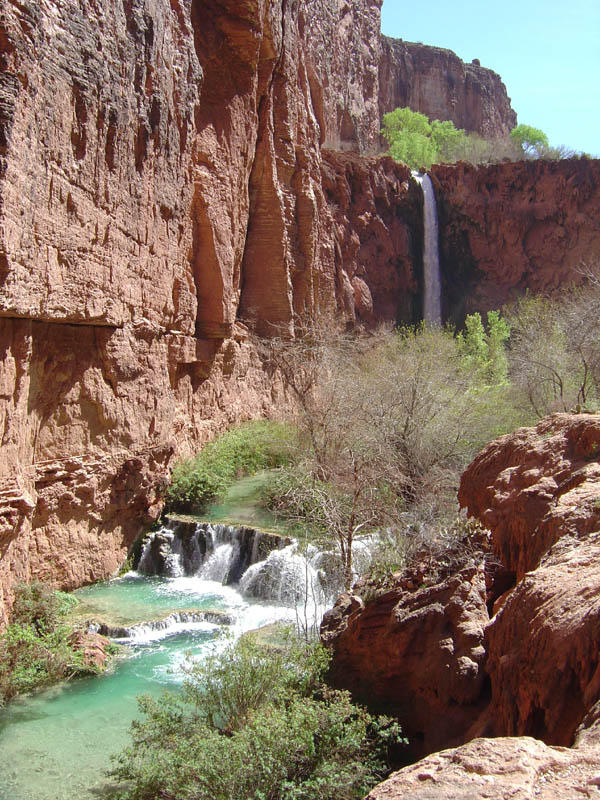
Writing is sometimes very hard work. I'll use this excuse and the excuse of being busy to present something old, an article I wrote in April last year, after a camping trip to Havasu Falls in the Havasupai reservation, near the Grand Canyon. I was reading the article recently, and there is a certain pleasure in rediscovering work you write, then set aside and forget - suddenly what you had written seems unfamiliar, its motivations and tensions belonging to an earlier time, but irrelevant now. The process sometimes provides startling insights about oneself; these insights that were unavailable during the process of writing become crystal clear at a later time.

The article is on my university website, which is like a bare cupboard - somebody once told me that when the website loads, the general impression is that an error message has come up. To make reading of this long article (1300 words) more colorful, I thought I'd provide a photograph, taken by Thomas, one of the three guys I camped with.

And here is the link to the article itself: http://www.public.asu.edu/~hbalasu/havasu.htm

Monday, October 10, 2005

My thoughts on Columbus Day

Columbus Day is quite a difficult day. When I started this post, I tried to make it light and easy, avoid altogether the tragic events – some of deliberate intent, some inadvertent – that followed in the centuries after Columbus’s landing. This is what I wrote:

“I promise not to be elegiac. Instead, I shall sing paeans to Columbus’s pioneering effort, the great adventure that he embarked on, which lead to the discovery of the New World. What valor! What doggedness! The glamour and gloss of that legend!

And the New World was full of strange exotic foods that completely changed cuisines in Old World. For we wouldn’t have otherwise had potatoes, tomatoes, chilies, vanilla, corn, and turkey; no marinara sauces, no fries. What luck to have stumbled on the sources to such culinary riches!”

I realized soon I could not proceed in this manner. I could not exalt Columbus and hide his avarice. I could not happily talk of the new food imports and ignore the vicious spread of diseases from the Old World that exterminated so many so comprehensively that there are no stories to tell. There are too many uncomfortable facts, of subjugation, genocide, swept under the rug of history, the rug that the victors chose to spread. (To call some worlds New and others Old: these can only be the categorizations of those who conquered; history, as they see it.)

Perhaps not writing anything at all – recourse to passivity, unquestioning acceptance – is the best way of acknowledging the almost total silence of many hundreds – even thousands possibly: how does one know? – of languages, ways of living, cultures that have ceased to exist. How else does one reconcile with this?

I sometimes think that this sense of tragedy is just a fashionable, romanticized feeling, easily dredged up for angst-filled insinuations. Have not other people in other places at other times suffered the same fate? Yes, but the memory of this most recent and massive dispossession and disappearance is still fresh. Perhaps it shall take a few more centuries, a millennium even, for the burden to lighten, for things to be viewed from a cold, impersonal distance.

Sunday, September 25, 2005

The Picador Book of Modern Indian Literature and Premchand's Shatranj ke Khiladi

The last time I checked on Amazon, no one had reviewed The Picador Book of Modern Indian Literature. But that may be because the book is a difficult read, because in its six hundred or so pages the editor Amit Chaudhri anthologizes all the major writing in India in the last century and a half. Amit Chaudhri’s effort is nothing short of astonishing; he must have read through hundreds of translations from the multitude of Indian languages to assemble such a wide-ranging anthology as this. The collection is more meticulous and well researched than Salman Rushdie’s Mirrorwork, which proclaims that the best Indian writing since independence has been in English. Certainly, a lot of good writing has been in English, but the vernacular was and still remains a powerful medium for creative expression.

(In May 1999, the literary critic Pankaj Mishra in an article for the New York Review of Books wrote that despite the success of Arundhati Roy’s The God of Small Things, which sold 100,00o copies, the market for Indian writing in English in India hasn’t really opened up (as opposed to the West where there seems to be a significant audience for Indian writing). For instance, Amit Chaudhri’s novel, Freedom Song sold a modest 4000 copies in India while literary novels in Malayalam or Marathi sell tens of thousands of copies. )

I was leafing through Chaudhri’s anthology, and in the section on Hindi I saw a short story by Premchand. The Chess Players was written in 1924 but is set in a much earlier time. I read the first two sentences and felt a stab of nostalgic yearning for the Hindi stories that I had read in high school. For years now I haven’t read even a page in Hindi and I have to labor through a paragraph when I see one. As I read more of the Premchand story, I wished I had a copy of it in Hindi with me, so I could be closer to the subtle rhythms of the language that Premchand must have used.

Mirza Sajjad Ali and Mir Raushan Ali are the chess players of the story, obsessed with the game. Indeed this is the story that Satyajit Ray used for his well-known Shatranj ke Khiladi. It is set in Lucknow of the mid nineteenth century when it was the principal city of the Awadh province, ruled by the Muslim king Wajid Ali Khan. The Lucknow that Premchand depicts in the story is in a sensual stupor, its residents far too busy in indulgent pursuits to be aware of the political ferment of the time.

Like others with their own preoccupations – reveling in opium induced ecstasy or betting on quail and partridge fights – Mirza Ali and Mir Ali too are absorbed in their long chess games every day. This goes on until domestic pestilences – such as Mirza Ali’s wife who disallows any chess games in the house – force them to escape one day to the desolate countryside where they play in an abandoned mosque. But that same day, the soldiers of the East India Company march through the countryside on their way to Lucknow. Curiously – and this is perhaps the central theme of the story: the extraordinary insouciance of the two players in face of all the tumult around them – the political maneuvering that will bring Lucknow under British control does not interest them, but the maneuvers on the chess board that shall affect no one do. So even as Wajid Ali Khan surrenders to the British army without so much as a whimper, the two chess players continue to fight a pitched battle. Such is the intensity of their game that they start a quarrel over their moves; they start to fight with their swords and slay each other.

The ending struck me as rather contrived and abrupt, out of step with the nuanced story, its irony, humor and well-thought out historical setting. In the movie, Ray presents a different, a more poignant climax: the two chess players do get to the point where they could have killed each other – in fact Mirza even fires a shot at Mir – but miraculously both survive uninjured. In the last few seconds of the movie, Mirza (played by Sanjeev Kumar) and Mir (played by Saeed Jaffrey) have expressions of deep disquiet, as the enormity of where the game of chess has led them slowly sinks in.

Wednesday, September 14, 2005

Of William Prescott and Aztec misnomers

When William Hickling Prescott, the historian who documented the rise and fall of the Spanish empire, died in 1859, he could not have known that four years later a fledging town in American Southwest, a region he had never visited, would be named after him. He might have been pleased by this commemoration of his historical acumen that his then extremely popular book “A History of the Conquest of Mexico” did much to advance. But had he known that not only had his book caused a town to be named after him, but that the impressive and then unexplained ruins of the southwest were given Aztec names based on the conclusions of his book, he might have been doubly pleased for having left an imprint by sheer virtue of his scholarly work.

And had he lived on, the same indispensable curiosity that had brought him this far might have egged him on to research the region further, perhaps even visit it, to see that while many Aztec influences might have been absorbed by the Native Americans of the southwest, their communities – quite diverse themselves – had their own distinct identities and cultural accomplishments, developed and sustained independently of the Aztec. But that, of course, was not to be; Prescott was destined to rest in his grave, and I’ll permit myself to imagine that his left eye that had been bizarrely blinded by a hard crust of bread – hurled at dinnertime by a Harvard classmate; apparently there had been a fracas that night in the Commons– still twitches with excitement as the many dimensions of the histories of Mexico and Peru and other Native American empires are unraveled.

Prescott’s work and the other articles that posited the Arizona origins of the Aztec engendered a slew of misnomers that exist to this day. The town of Aztec in New Mexico famous for its centuries-old ruins, also called Aztec – in fact the latter inspired the former – is one example. The Native Americans who once lived and built their houses and ceremonial structures there are today referred to as the “Anasazi” or “Pueblo” (these names, too, have their own stories). The Puebloans had nothing to do with the Aztec. Neither did the Sinagua whose cliff dwelling in the Central Highlands region of Arizona is called Montezuma Castle, after the Aztec king. (The view that people living in relatively close proximity had “nothing to do” with each other cannot be literally true. Ideas are sure to have diffused through the vast trade networks that existed then; ideas as profoundly transformational as the cultivation of corn. But certainly there is uniqueness in how a community shapes external influences.)

One is justified in asking: What’s in a name, after all? Should these mistakes be panned so much when history was and still is a work in progress? The issue is not so much with the errors themselves as with the notions that lie behind them. Kirk Peterson, a ranger at the Chaco Canyon National Historical Park (also in New Mexico, a 3-hour drive from Aztec) articulated this well: “There was a school of thought that the natives who lived here were not capable building these structures.” He was referring to the ruins of the massive houses constructed from the eighth to tenth centuries. “And so it was natural to look to the nearest empire that could have.”

In addition to its architectural feats, Chaco canyon is also known for its sophisticated solstice marker on Fajada Butte (unfortunately the butte is off limits for visitors). And then there is the Great North Road that is within half of degree of being exactly north. The woman at the Visitors Center at Aztec where we had stopped by to get some information before proceeding to Chaco told us of her own visits to Chaco. “These were no rock pounding Indians,” she said, obviously quite impressed with what she had seen. But implicit in her remark is a slight of another kind.

Tuesday, September 06, 2005

The Argumentative Indian, by Amartya Sen

In this collection of essays on Indian history, culture and identity the economist Amartya Sen attempts to illustrate the heterodoxy that has persisted in Indian traditions for last three thousand years, and the role that skepticism and reasoning have played in them. Sen repeatedly recalls the tolerant edicts of Asoka, and Akbar’s decidedly multicultural pursuits; he also quotes from classical texts to make his point. Even the Vedas, he writes, have verses that are deeply doubtful and skeptical their own explanation of the creation of the world:
“Who really knows? Who will here proclaim it? Whence was it produced? Whence is this creation? The gods came afterwards, with the creation of the universe. Who knows whence it has arisen?
When this creation has arisen – perhaps it has formed itself, or perhaps it did not – the one who looks down on it, in the highest heaven, only he knows – or perhaps he does not know.”
A good part of Sen’s motivation for his essays seems to stem the urge to correct “exoticist” and excessively spiritual perceptions of the history and religions of South Asia that exist in the West and that are also influential in the way the people of the Indian subcontinent view themselves. And Sen’s point also seems to be that the argumentative tradition needs to be better appreciated and effectively used to correct the sharp inequities – pertaining to class, caste, gender – prevalent today.

The essays are written in a tone that is “benignly professorial” – as Pankaj Mishra in his review of the book for the Outlook magazine describes it – but the academic solemnity of his writing seamlessly transforms itself, when the occasion demands, into something sharp and ironic. For instance, Sen notes in one of his well-researched articles on types of gender inequities (Women and Men) that in the 1970s the much-used Handbook for Human Nutrition Requirement, drafted by a high level expert committee from the World Health Organization (WHO) and Food and Agriculture Organization (FAO), chose to classify household work as a ‘sedentary activity’. Sen’s contempt at this classification is evident in his own assessment: “It was hard not to think that the lack of experience of household work on the part of the patrician members of that august committee might have had a role in the remarkable diagnosis that household work was ‘sedentary’.”

Monday, August 15, 2005

Of tarpaulin and other things

The apartment complex where my parents live flanks the Bangalore-Bellary road that is being widened in preparation for the new international airport. Bangalore, burgeoning with new development projects, seems to be splitting at its seams here: earthmovers raking up heaps of rubble on the roadsides; wage-laborers patiently striking heavy hammers to break existing concrete structures; and uprooted trunks and roots of what had once been massive trees, still caked with the red earth of the subterranean depths from which they had been disinterred.

On my many bus trips from Yelahanka – where my parents live – to central Bangalore, I noticed especially the frequent use of the sturdy, waterproof canvas sackcloth also known as tarpaulin. I’ve asked myself: why did I notice tarpaulin of all things? Why did other roadside ubiquities – dogs waiting patiently outside kebab stalls; tea shacks; corrugated tin, iron and plastic sheets; thatched roofs made of dried branches of coconut trees – not catch my attention as much? I’ve surmised that it has something to do with my love of the word tarpaulin, just the way it sounds. Or was it the pervasiveness of its use, not as a word, but actual, physical, practical use?

Patchwork of tarpaulin, blue, black, green and white! Sheets of tarpaulin, under which: pyramidal mounds of apples and pomegranates! Sacks of tarpaulin, for shoe-smiths to protect still-not-fixed, still-strapless leather slippers and sandals! Tents of tarpaulin, in the dark depths of which I saw a blackened stove and a few utensils!

Near the Hebbal bus stop is a cluster of just such tents as I’ve announced above with much exclamatory pomp. Most of those who live in these portable tents are artisans – maybe migrants from the villages and tribal districts of Karnataka’s interior – and flanking the road for a more than a thousand feet are their creations, for sale. I like their woodworked items – mostly faces, religious and otherwise, that they shaped from chunks of timber. I also had the fortune to see them at work, as they carved with ease on the cylindrical pieces of wood, a foot or so thick. They were putting to intelligent use the trunks of the many coconut trees that were being felled for road-widening efforts along the Bangalore-Bellary road. I couldn’t help but be struck by the sheer practicality of this.

Tuesday, August 02, 2005

Empires of the Word: A Language History of the World, by Nicholas Ostler

Last year, I learnt from a friend of Jared Diamond’s book Guns, Germs and Steel (GGS), which attempts to answer one of the unfathomable and persistent questions of our times: why is history the way it is; why are some communities or – in today’s context – some nations affluent and powerful, while others are not? Such questions usually elicit resigned shrugs, simplistic explanations, or get enmeshed in theories of the inherent superiority of the value systems and mental capacities of certain races – as those espoused in the controversial The Bell Curve. Jared Diamond suggests it was ancient environmental and geographical happenstance – the concentration in certain regions of Eurasia of certain nutritious and robust crops, and wild animals that lent themselves easily to domestication – that led to the present day dominance of Eurasian societies and their colonies. Given the depth of the question, critics have accused Diamond of being too deterministic, too dismissive of cultural influences and racial differences and therefore too politically correct (though in one review it was tartly stated that political correctness does not necessarily conflict with the correctness of his theories).

A few months ago I learnt of Nicholas Ostler’s book, Empires of the Word: A Language History of the World, whose sweep is as broad as that of GGS but in the realm of languages: why are some languages so successful while others evanescent; why do some languages, established for long periods of time, perish without a trace while others are resilient? From what I have so far read of this book, the answers are nowhere as clear as in GGS. The factors that decide of the fate of a language are many and depend on the particular language in question. Ostler quashes through convincing examples the belief that the dominance of language can be assured through conquest or political subjugation: the Mongols during their reign very much gave in to the languages and culture of the lands they conquered; Dutch has not been very successful in Indonesia though colonial rule there was as long as that of the British in India. There are plenty of other examples; throughout the book Ostler contrasts languages that followed opposite trajectories.

The chapter on Sanskrit (Charming like a Creeper: The Cultured Career of Sanskrit) is a great read, full of wonderful anecdotes. Ostler follows the language from its beginnings to its zenith when it was popular throughout Southeast, Central and East Asia traveling with its two principal disseminators Hinduism and Buddhism, to its decline during the second millennium after Muslim conquests, and its present limited but steady existence as a liturgical language. Indeed, when as a young child I had unerringly recited, from sheer rote learning, a thousand incomprehensible verses of the Vishnu Sahasranamam, I had been inadvertently sustaining Sanskrit’s liturgical function.

(In the chapter on Sanskrit, I also came across the technical expression for the unique pronunciation of certain alphabets that speakers of South Asian languages are known for and that is partly responsible for their distinctive accent. The sounds t, d, k are often spoken without aspiration with the tongue held against the roof of the mouth. These sounds are due to retroflex consonants, common in many South Asian languages)

Empires of the Word starts with the remarkable conversation between the Aztec king Montezuma and the Spanish conquistador Cortez. It is interesting to speculate on the difficulties of language that both Montezuma and Cortez must have undoubtedly faced. Montezuma spoke in Nahuatl, which was then translated into a particular dialect of Mayan by a Mexican noblewoman; a Spanish priest then translated the Mayan to Spanish. It was 1512, less than thirty years since Columbus’s pioneering effort, the so-called “discovery” of the New World, which would irrevocably set into motion the colonization of the Americas, and which brought about that most peculiar intersection of peoples of Europe and the Americas who had lived apart long enough to have endowed the former with guns, horses, metal implements and diseases, all of which proved cataclysmic for the latter. The conversation between Montezuma and Cortez is but one of the many - in Ostler’s words – “pioneer moments of fatal impact that have happened throughout human history” when “the pattern was set for the irruption of one language community into another”.

Ostler feels that for a language to be taken up by communities other than its own, it needs to have persuasive power. Motives for this persuasive power can be very different, as history has demonstrated: military domination, hopes of prosperity, cultural prestige, attendance at a boarding school among many others. English today has tremendous persuasive power – in India and in many other countries of the world, its persuasiveness is particularly rampant – but the lessons of history show that no language, however widespread and popular it might have been in its heyday, has escaped decline. The argument in favor of English, of course, is that its supremacy coincides with the emergence of a global interlinked culture and for this reason it seems quite impregnable. But the history of languages has always of been full of surprises and one would expect the same of the future.

Empires of the Word is extremely detailed but its great feature is the self-contained nature of its chapters; naturally, it is a good reference for all the major languages in human history. Ostler currently lives in Bath, England, and also manages the following website for endangered languages http://www.ogmios.org/home.htm.

Sunday, July 24, 2005

On alcove residences and Chaco Canyon


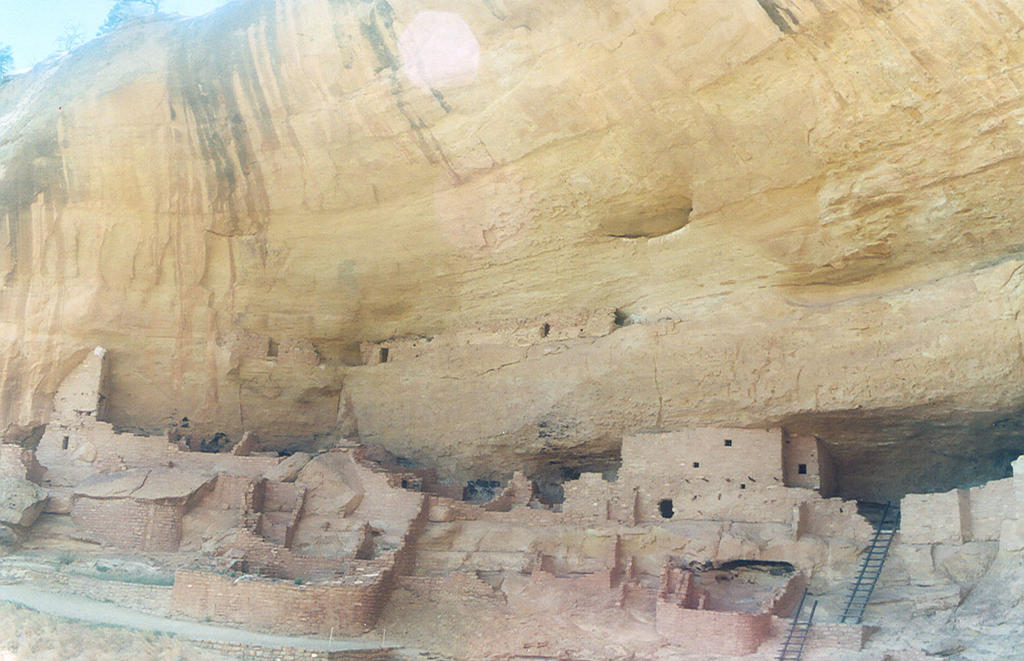
More than a millennium ago, Native American communities – those that are today referred to as the Anasazi or Pueblo – used a geological feature distinctive to the dry canyon country of the American Southwest to construct their houses. Though water was and still is a scarce commodity, run-offs from seasonal rainfalls and melted snow slowly permeate through the porous sandstone of canyon walls. Over hundreds of years and many seasons, the constant cycle of freeze and thaw causes exfoliation, or peeling off of the sandstone layer, leading to the formation of alcoves, located well above the base of the canyon. Usually, such high alcoves occur at the intersection of a sandstone layer and a solid impermeable layer of shale that eventually forms the base of the alcove.

I did not expect alcoves to be so big as to be the setting of an entire village until I saw a long-abandoned dwelling at the Navajo National Monument. It was a startling sight: a hundred or so box-like rooms, of the same color as that of canyon walls – as if the intent were to camouflage – and sloping precariously towards the edge. Since the alcove is gouged high in a canyon wall, it is accessed only by steep trails. The advantages of such a setting are immediately obvious: water seeping through sandstone meant the presence of an aquifer, though any supply of water from it could only have been meager; protection from the hot sun; and a natural vantage point from which to detect approaching danger.

There are many such abandoned alcove dwellings in the southwest, but the most famous ones are at Mesa Verde National Park in southern Colorado in the San Juan Mountains. The park was mentioned in some tour-book as the Disneyland of the Pueblo sites, and indeed, it seemed very much like a theme park when I visited it this summer: car doors slamming everywhere; large families; long lines of people waiting to reserve a spot for a ranger-guided tours of the alcove sites; and a crowded restaurant with a lunch buffet.

Chaco Canyon National Historical Park, by contrast, is a quiet spot in a remote part of northeastern New Mexico, accessed only by a dirt road with washboard bumps. Here, from the 8th to 10th centuries, the Puebloans constructed structures that are today called the Great Houses, massive complexes that were once four to five stories high, used possibly for ceremonial and religious purposes. The Great Houses are not alcove dwellings and represent a break from the past architecture of the Puebloans; they are indicative of the emergence of a stratified, hierarchical society, which might have been on of the reasons for its decline.

If you go to Chaco Canyon, do attend a 90-minute tour of park ranger Kirk Peterson, who will take you through Pueblo Bonito, one of the largest sites in the canyon. His tour touches on everything from the history of preservation of the site, to the ingenious construction techniques of the tenth century Chacoans, and why it might have been abandoned. Peterson readily acknowledges the shortcomings of attempting to understand an antiquated culture using such fields as anthropology or archaeology; his talk, therefore, is informed by a nuanced understanding of the worldviews of the present day Puebloan communities who consider themselves as descendents of Chacoans.

Friday, July 22, 2005

The Colorado Plateau

The Colorado plateau is a physiographic region in the southwestern United States that spans the four states of Arizona, Mexico, Colorado and Utah. The plateau is named after the Colorado river (the state itself has little of the plateau), which has, along with its tributaries, side-streams, run-offs and other forces of nature formed the canyons the region is famous for: Grand Canyon in Arizona, Zion and Bryce in Utah and hundreds of others, perhaps not as grand as these but just as beautiful. Why is the Colorado River such a great carver of canyons, while the Mississippi that runs longer is not? I overheard a ranger at the Grand Canyon National Park give a succinct answer: the Colorado has a sharp gradient owing to its descent from the Rockies, and also carries much grit – cutting power – in the form of rocks. The river runs into the elevated Colorado plateau that is brittle on account of its aridity, and cuts through it, chipping a little of the plateau every year. It has taken over five million years, a length of time too hard for us to imagine but that is not more than a blink of an eye in geological terms, for something of such magnificence as the Grand Canyon to form. There is, of course, much pooh-poohing of this theory – You’re telling me a river caused this? – and there should be, for even geologists do not concur on this topic, and theories do change over time, the newest ones overriding the existing ones.

Phoenix, Arizona

Phoenix received more rain this spring than it usually does - which is not much at all. For the most part, the skies were gloomy and the rain wasn’t much more than a drizzle. And yet, it seemed excessive for the desert. Bushes with flat, many-lobed leaves that I had never seen before grew lush in places where water had accumulated: near fences, edges of roads, and signboards of plazas. The open space behind my apartment, fenced off possibly for new construction, was thick these bushes, weeds and grasses. On days that the sun shone brightly, the yellow and white flowers they spawned were resplendent.

Even the little hill next to the university that usually has a barren, brown look had a tinge of green to it. The trail to the top is winding and steep in places and ends at a rocky outcrop, just next to an assemblage of steel that serves as some sort of a receiving or transmitting station. On late afternoons, somewhat breathless from the strain of the ascent, I liked to rest at the summit and enjoy the view: the great suburban sprawl; the gloomy amber street lights that seemed to flicker; the harried rush of cars, toy-like from where I saw them on the tortuous freeways; the glimmer of the lake and the lighted bridge that arched over it; the mountain ranges and their jagged peaks that stretched in every direction. Sometimes I lingered to watch the approach of planes, now specks in the distance, now perilously close, banking this way and that, portholes clearly visible, as they aligned themselves to the parallel strips of blue light along the runway a few miles away.

A football stadium straddles the hill and a smaller adjacent butte. I like to think of it as saucer-shaped spaceship that has somehow forcefully wedged itself in the little space that there is between the hill and the butte. On many fall weekends, the sudden explosion of fireworks follows the roar of many thousands of fans at the stadium. Once, while walking up the hill, I stopped dead in my tracks, entranced by the fireworks that shot through the sky and burst in succession into plumes of smoke that, for the few seconds before they thinned into nothingness, matched convincingly the forms and shapes of the clouds scattered in the darkening sky.

Fire and trails of smoke have always had something about them: from my childhood, I remember being drawn to smoke curling from incense sticks, the crackle of matches, the glob of fire on the oil-dipped wicker of brass lamps, and long minutes on terraces observing the widening contrails of jet planes that sailed inaccessibly in the sky.