Thursday, March 06, 2008

Let's commemorate the Potato!

Don’t you think the world should be paying tribute to the potato, that ubiquitous tuber, the essential ingredient into so many dishes, from masala dosas to beer-battered fries to its mashed form that is indispensable to Americans on Thanksgiving? Just yesterday I myself cooked and enjoyed potatoes for dinner with onions, garlic, turmeric and some red chili powder.

Indeed, the United Nations too has recognized the need to commemorate: 2008, it has declared, is the International Year of the Potato. This might sound comical, but if you look at the economic impact of the potato over the last five hundred years it’s quite appropriate. Which is why The Economist also has a series of articles in its latest issue acknowledging contributions. Consider this one, Spud we like:
Unlikely though it seems, the potato promoted economic development by underpinning the industrial revolution in England in the 19th century. It provided a cheap source of calories and was easy to cultivate, so it liberated workers from the land. Potatoes became popular in the north of England, as people there specialised in livestock farming and domestic industry, while farmers in the south (where the soil was more suitable) concentrated on wheat production. By a happy accident, this concentrated industrial activity in the regions where coal was readily available, and a potato-driven population boom provided ample workers for the new factories. Friedrich Engels even declared that the potato was the equal of iron for its “historically revolutionary role”.
And how can we forget what it did to Ireland in 1845, when a million died and a million others emigrated?

___

Delve deeper into history and we find that the potato wasn’t even available to Europe, Asia and Africa before the 16th century. Not only that, tomatoes, maize and chilies were not available either– yes chilies too were absent, believe it or not! The inescapable conclusion is that food must have been quite dull before the Spanish sailed to the Americas and brought back these culinary treasures. All these crops were first domesticated in Mexico, Central or South America a very long time ago. Potatoes were first domesticated in Peru 7000 years ago; the country now has 3500 edible varieties.

Here's the important lesson. There are many things today that we enjoy and take for granted. But if we understand their origins well, we learn that had it not been for trade and exchanges across cultures – the phenomenon we call globalization today, and which is much-maligned – we wouldn’t be enjoying them at all. And just because something comes from a different, faraway land does not mean that a community or culture or nation cannot add its own distinctness to that import. Did the Italians not combine pasta with tomato, a New World crop, to come up with something that is considered uniquely theirs?

Needless to say, this doesn’t apply only to food, vegetables and crops; there are parallels in a host of other areas. One only has to look.
__

Both pictures from The Economist. And an earlier post on another thing we take for granted: agriculture. And an even earlier post on how the supercontinent Pangaea broke into the continents of today, and how after 1492 the seams of Pangaea have been knitted again, not literally but through a massive exchange of crops, animals and people, now called the Columbian Exchange.

Monday, March 03, 2008

The Brothers Karamazov - a quick note

The last time I wrote about The Brothers Karamazov, I complained about the book being long-winded. I'd been reading Constance Garnett’s translation at the time. Thanks to Chandrahas' suggestion, I used the Pevear-Volokhonsky translation for the remaining two thirds of the book. And how the pages flew by! The Brothers Karamazov is now undoubtedly one of my all time favorites.

In the introduction, Richard Pevear claims to have kept Dostoevsky’s idiosyncrasies of prose intact so as to retain the humor. TBK may be considered a dark, tragic book, and sure it is that, but it is also exceptionally funny, so much that I burst out laughing in the most unexpected places, even when such serious matters as parricide were involved.

TBK is also, I feel, a spiritual book in many ways, and I’d like to retain the book’s intensity – its unrelenting questions about sin, conscience, loving and forgiving – as long as I can. I’ll try to write about my interpretation of the book’s themes in a longer post. For the moment, though, a couple of earlier posts on Dostoevsky: 1 and 2.

Thursday, February 28, 2008

Satire of the highest quality

in this recently begun but already enormously popular blog called Stuff White People Like. Just a glance at the posts there will tell you why the blog is generating so many hits. It exploits the stereotype, uses sweeping generalizations (what's interesting is that if the same approach were used in other cases, it would most definitely be considered offensive) and the deliberately staid tone of the writing takes care of the humor. For instance, here’s a hilarious excerpt from a piece about recycling:
Recycling is a part of a larger theme of stuff white people like: saving the earth without having to do that much.

Recycling is fantastic! You can still buy all the stuff you like (bottled water, beer, wine, organic iced tea, and cans of all varieties) and then when you’re done you just put it in a DIFFERENT bin than where you would throw your other garbage. And boom! Environment saved! Everyone feels great, it’s so easy!
Or, consider this piece about white people studying abroad:
In addition to accumulating sexual partners, binge drinking, drug use and learning, white people consider studying abroad to be one of the most important parts of a well rounded college education.

Study Abroad allows people to leave their current educational institution and spend a semester or a year in Europe or Australia. Though study abroad are offered to other places, these two are the overwhelming favorites.

By attending school in another country, white people are technically living in another country. This is important as it gives them the opportunity to insert that fact into any sentence they please. “When I used to live in [insert country], I would always ride the train to school. The people I’d see were inspiring.”

Khatami quote

Via Chandrahas, I learned of this wonderful quote by, no not some well known literary star, but from Mohammad Khatami, the former President of Iran. I don’t know much about Khatami or his political record – except that he seemed someone who promoted a conciliatory rather than a confrontational tone – but I like very much what he says below:
One goal of dialogue among cultures and civilizations is to recognize and to understand not only the cultures and civilizations of others, but those of one's own. We could know ourselves by taking a step away from ourselves and embarking on a journey away from self and homeland and eventually attaining a more profound appreciation of our true identity. It is only through immersion into another existential dimension that we could attain mediated and acquired knowledge of ourselves in addition to the immediate and direct knowledge of ourselves that we commonly possess. Through seeing others we attain a hitherto impossible knowledge of ourselves. [my italics]
Yes, there’s some rhetoric in the quote, but the last sentence captures the gist beautifully, and is spot on!

Thursday, February 14, 2008

The resettlement of refugee farmers after Partition: Notes from Ramachandra Guha's India after Gandhi

We all know that the partition of the Indian subcontinent in 1947 had terrible consequences. Tens of thousands of people died. Millions were displaced: Muslims left India for Pakistan, and Hindus and Sikhs left Pakistan for India. It was the greatest mass migration in history. But what is less understood is the manner in which the vast numbers of refugees were accommodated and settled into the newly divided regions. The greatest mass migration in history inevitably became the largest resettlement operation in the world.

How was this monumental task achieved? That question might take up many books, and perhaps many have already been written. But we get an exquisite glimpse of how it was done in the Indian side of the Punjab (East Punjab) in Refugees and the Republic a chapter in Ramachandra Guha’s sweeping post-independence historical narrative India after Gandhi. Indeed, the book’s great appeal lies in its ability to tell of scores of such forgotten stories, give quick but illuminating glimpses, while still not losing sight of the larger political narrative.

Punjab was one of the partitioned provinces; the eastern part found itself in India while the western in Pakistan. A large number of Muslims had left East Punjab for Pakistan. But there was an even greater influx of Hindus and Sikhs into the east from Pakistan. Most of these refugees were farmers. Together they had abandoned 2.7 million hectares of land in Western Punjab but across the border in India where they now had to make a living only 1.9 million hectares had been left behind by Muslim farmers who had fled the opposite way. Not only that, the new lands were also less fertile than the richer, abundantly irrigated soils they had been cultivating in the west.

The unenviable task of reallocating the reduced acreage of land fell upon the Indian government and its civil service workers. As a first step, they assigned each family of refugee farmers 4 hectares irrespective of its past holding; they also gave loans to buy seed and equipment. As families began to sustain themselves, applications were invited for them to claim more land, depending on what they had owned in West Punjab. Within a month, there were 500,000 claims! These claims were then “verified in open assemblies consisting of other migrants from the same village. As each claim was read out by a government official, the assembly approved, amended or rejected it.”

Refugees tended to exaggerate of course, but were deterred by the open assembly method; if a claim turned out to be false they were punished by a reduction in land. Nearly 7000 officials were needed to support this difficult and complicated process; these officials “came to constitute a kind of refugee city of their own.”

Sardar Tarlok Singh of the Indian civil service and a graduate of the London School of Economics led the rehabilitation operation. He used two interesting rules for allocating land, and this is where the innovation and pragmatism in the whole operation comes most clearly to light. Though claims had been filed, because of the reduced acreage, none of the refugees could be assigned as much land as they'd originally owned. Everybody’s claim had to be reduced by a certain percentage. Plus, there had to be some way of accounting for the differing fertility of land.

Sardar Tarlok Singh came up with two measures, the standard acre and the graded cut, which dealt with these issues, and this is how:
A standard acre was defined as that amount of land which could yield ten to eleven maunds of rice. (A maund is about 40 kilograms.) In the dry, unirrigated districts of the east, four physical acres were equivalent to one standard acre; but in the lush “canal colonies” [where irrigation was strong], one physical acre was about equal to one standard acre. The innovative concept of the standard acre took care of the variations in soil and climate across the province.

The idea of the graded cut, meanwhile, helped overcome the large discrepancy between the land left behind by the refugees and the land now available to them – a gap that was close to million acres. For the first ten acres of any claim, a cut of 25% was implemented – thus one got only 7.5 acres instead of ten. For higher claims the cuts were steeper: 30% between ten and 30 acres, and on upward, so that those having more than 500 acres were taxed at the rate of 95%.
With this rule, there clearly were losers, and the losers, of course, were those who had once owned huge tracts of land. Here’s an ironic example:
The biggest single loser was a woman named Vidyawati who had inherited land (and lost) her husband’s estate of 11,500 acres spread across thirty-five villages of the Gujranwala and Sialkot districts. In compensation she was allotted mere 835 acres in a single village of Karnal.
Standard acre and graded gut are simple rules, but their simplicity helped in solving a complex, very large-scale land allotment problem that involved thousands of people. By November 1949, about a year and a half since the operation began, Tarlok Singh had made 250000 allotments distributed equitably across the districts of East Punjab. Not only that, “neighbors and families were resettled together, although the recreation of entire village communities proved impossible.” The resettlements were so successful that “by 1950, a depopulated countryside was alive once again.”

The sheer scale of the effort is mind-boggling. Imagine the paperwork, the records that had to be kept and retrieved; imagine the disputes, the flared tempers, the jealousies; but imagine most of all the perseverance, the unflagging determination. It is upon such efforts – largely ignored yet involving the sweat and toil of thousands – that nations are built.

_____

Related notes:

1. Guha ends this section in the chapter poignantly. The resettlement, Guha says, may have been successful, but the general sense of loss could not be undone. The migrating Sikhs had left behind a beloved place of worship, Nankana Sahib, the birthplace of the founder of their faith, Guru Nanak. Muslims migrating from East Punjab too had left behind the town of Qadian, the center of the Ahmadiya sect of Islam; the Ahmadiya mosque was visible for miles around. Very few Muslims now lived in Qadian, which was full of Hindu and Sikh refugees. Guha quotes the editor of the Calcutta newspaper Statesman, who wrote that in both Qadian and Nankana Sahib there was “the conspicuous dearth of daily worshippers, the aching emptiness, the sense of waiting, of hope and…of faith fortified by humbling affliction.”

2. The picture shows a boy at a Delhi refugee camp in 1947. Here’s the source. The largest refugee camp, though, was at Kurukshetra, consisting of nearly 300,000 people. For their entertainment, film projectors were brought in and Disney specials featuring Mickey Mouse and Donald Duck were screened at night. It was, as one social worker described it, a “two-hour break from reality”.

Sunday, February 10, 2008

My adventures during a queuing study

Here’s my account of a class project I did back at Arizona State University. The class was about the mathematics of queues, but this light (and hopefully funny) account centers around my adventures while I did my project. There are a few technical terms here and there – Exponential distribution, Poisson arrivals, goodness of fit tests – but they shouldn’t hinder the flow of the piece.

___

In Spring 2003, I took a class on Queuing Theory as part of my PhD coursework at Arizona State University. One of the assignments towards the end of the term was to apply the queuing models we’d learned to a real situation. Expectedly, students headed to the nearest fast food chains, banks, traffic signals and congested elevators to diligently conduct their studies. A not-so-small number headed to their friends to just as diligently pilfer projects from prior years and repackage them as their own work.

I headed to the nearest Safeway grocery store. Why? Because I’ve been fascinated with American grocery stores from the time I first stepped into one. There is something in the size of these stores, the bright lighting, the glittering array of produce and processed food along aisles – vegetables that have so much sparkle as to seem unreal (strangely they do not taste as good as they look); monstrous bags of potato chips; boxes with muffins, their tops bursting with nuts and chocolate; an entire aisle for ice creams only – there is something in this abundance that leaves me agape. Such a cornucopia would have doubtless entered the dreams of Early Man resting in his cave next to his precious hunting tools; and doubtless, waking up the next day, he might have resolved to change the world around him to achieve that dream.

But to return to the particulars of my queuing project. The Friday before Easter, I sat outside the entrance of the Safeway store, next to the vending machine and bike stand, with a stopwatch, pen and piece of paper. I felt later that I might have been thought of as homeless, but this didn’t cross my mind then. I was too absorbed recording the arrival time of every customer into the store from 5 to 7 pm (A group such as a family or that arrived in the same car, I considered as a single customer.) I wanted to see whether the great claim made by mathematicians and queuing theorists about arrivals was true: the claim that the rate of arrivals, if they are sufficiently random and independent (as they are expected to be at a grocery store), follows a Poisson distribution; or conversely, the distribution of inter-arrival times is Exponential.
The plot of inter-arrival times did indeed look exponential. On average a customer arrived at the store every 15 seconds; the standard deviation was 16.25 seconds, quite high, but not unexpected given the distribution. The data cleared goodness of fit tests with flying colors. I was excited! A fundamental assumption in many queuing models is that inter-arrival times are exponentially distributed, and here I had empirical confirmation of this from data I had painstakingly collected.

But arrival data was only the first part of my project. I planned to explore whether there were enough cashiers in the store to sustain this arrival rate, and if queues were reasonable. Since I now had to collect data in the store, I approached the manager, Scott.

I had seen Scott on my weekly shopping visits. He was a tall man, with blonde hair and an erect and dignified bearing. He was usually dressed formally in a white shirt and striped tie. He looked grim - I'd never seen him smile - but was always attentive to his customers' needs. “Hi,” he often said sagely to them. “Are you finding everything you need? Can I help you with anything?”
___

I explained my project to Scott, and told him it could be useful to the store. He looked at me skeptically. A frown creased his forehead.

“You can’t ask customers any questions. That’s just not permitted.”

“Oh, no, it’s nothing like that. I won’t be asking anything, just recording data on how many come in to the store, at what time,” – I’d already done that with arrivals but I didn’t mention it – “and doing a queuing study that may yield benefits to the store. Maybe I’ll learn something that Safeway can implement.”

It wasn’t the strongest pitch. Scott was still unconvinced and the frown remained. But he agreed. So I began doing rounds at the store, trying to remain inconspicuous, getting a sense of what people did, the amount of time they spent in queues, and the time checkout cashiers took to service them.

I was intrigued particularly by the rack or shelf that extended in front of each of the checkout counters. They consisted of the latest magazines, chocolates and candy with colorful wrappings, and such odds and ends as batteries. Customers would choose a magazine and toss it into their cart as they waited, their curiosity no doubt piqued by George Clooney's most recent affair or the most recent adoption from Cambodia, Kazakhstan or Malawi by a high profile actress - all this brazenly announced in The National Enquirer or People. Kids, on the other hand, would insist on having candy. Since a significant number purchased something from the rack – it was a reflex for some – I wondered if queues were really so bad after all. Sure, queues shouldn’t be too long for that can be frustrating, but maybe it actually helps the store to lengthen queues just a wee bit and provide an extra magazine or candy rack.

I dealt with this in my project, though with the deadline approaching I could only scratch the surface. The details are too specific and convoluted to mention here, but I proposed a modified single server queuing model where queues are profitable, so long as they are not longer than the length of the rack (usually 4-5 people). I don’t think I did enough for the model to give any insights as far as Safeway was concerned, but I sure was excited with this seemingly perverse idea of increasing queue sizes.

The other analysis I did was standard, garden-variety stuff: Were there too few or too many cashiers? The answer was not simple. The store had a floating set of employees who would do other jobs in the store but when queues started building they would be called using the announcement system to open a new checkout counter. Thus lines never got out of control, and employees could be used flexibly to do other odd jobs at the store during periods of lull. I figured my fancy math models with their set of assumptions weren't really applicable. After all, what could I suggest about staffing from my short visits that Safeway employees and the ever grave Scott hadn’t already figured from years of experience? There do exist other situations where a fresh perspective can help spot obvious flaws or suggest improvements, but this didn’t seem like one. Besides, people working in settings such as Safeway have rudimentary but intuitive ideas they develop themselves, and which they adapt with the passage of time and with experience; they don’t need degrees in mathematics or operations research to develop this intuition.
____

Finally, to finish this rather long post, here's how my project related visits to Safeway came to an abrupt end. I was trying to collect cashier service times – I’d already collected enough but wanted some more. My modus operandi was to choose a cashier, retreat to the rear of the corresponding aisle and observe from there. I couldn’t retreat too far since I wouldn’t have a clear view and I couldn’t be too close either for fear of attracting attention. Whatever my little tricks, there must have been an inadvertent surreptitiousness to my actions, for my eyes met once with a curly haired cashier’s and lingered for a while. He picked up the phone; I thought it was to address some customer issue. But a minute later, I heard a familiar voice behind me.

“Hi,” the voice said sagely. “How are you doing?”

Scott was dressed as usual: plain white shirt and striped tie. He wasn’t happy. “You’re making people nervous,” he said.

“But I informed you already that I would be collecting data in the store – I was trying to do it covertly so as not to disturb!”

“Yes, but you have to tell me when you intend to come in so I can warn my employees and so they don’t get edgy about some stranger spying on them, stopwatch in hand.”

I saw his point. Scott was just being a good manager. I agreed to inform him in the future, but I never returned – mostly because I had enough data for my project, but also because I was worried about becoming notorious as an undercover data collector. What if harassed employees were to put up an enlarged mug of mine at various locations with the stopwatch cord serving as a noose and a bold red “BEWARE OF THIS MAN!” stamped diagonally across? Even worse, what if I were to be booted out of the store? How then would I buy the enticements along the aisles - bags of Lays, delectable Entenmanns pastries, desserts of Pepperidge Farms, things I had come to depend so much on?

So, you'll understand why I receded wisely, wrote up my project report, got a good grade, and continued to be an anonymous customer - one of the 'Poisson-arriving' masses!

Wednesday, February 06, 2008

Suketu Mehta on napping

There’s an long and interesting interview of Suketu Mehta, author of the famous non-fiction book on Mumbai, Maximum City, in the Believer magazine. The interview reveals a lot about his background and his struggle to become a writer. All that might seem very serious, but Mehta’s answers are often playful. In my view, he makes his most salient point in the beginning of the interview, when he talks about laziness as an asset, and more specifically about the regenerative effects of taking naps during the day.

I couldn’t agree more, given that I close my office door, not, as is assumed, for privacy and work, but for deep, immensely satisfying and refreshing 20-minute naps. There’s nothing more annoying that a jarring knock on the door that interrupts this sojourn of mine back into the world of dreams. Anyway, here’s Mehta:
You know, Bertrand Russell wrote an essay extolling sloth. I think [that’s] the difference between civilized and uncivilized society—societies where the afternoon nap is a regular feature. I nap every day, wherever I am. I have a big lunch, which I cook myself, and then I nap for at least an hour. It’s like having a second morning. The kind of stuff one writes after getting up from morning sleep and afternoon sleep is very different. When you get up from morning sleep, you’re writing straight from dreams. For me it’s much more wildly creative. But if I need to do detailed work—editing or paying my bills or writing a new scene for a nonfiction article in which facts are more important, then I write it after my afternoon nap. Someone should do a study on writers and their sleep habits and how that influences their work. Who wrote what sections of what book after sleeping at what time?
Interview link via Amitava's blog. I like Believer interviews; here's my post on a different Believer interview, The necessary vanity of a writer, from last year.

Thursday, January 31, 2008

Quick notes on Willa Cather's O Pioneers!

Willa Cather’s first novel, O Pioneers! is full of priceless gems. Cather displays a remarkable ability for direct, concise sketches that last only a few lines but tell us volumes about her characters. She shows the same skill in her descriptions of the natural world of late nineteenth century Nebraska, where she grew up. Cather belonged to a community of Swedish immigrants who struggled to farm and eke out a living in the seemingly stark, unforgiving prairie. The experience informs many of her stories and novels.

O Pioneers!, too, is set in Nebraska, and tells the story of the determined, intelligent, hard-working and fair Alexandra Bergson, who defies all odds and prejudices of her time to establish a successful farm business. We learn about Alexandra's personality from the moment Cather introduces her on the second page:
“[Alexandra] was a tall, strong girl, and she walked rapidly and resolutely, as if she knew exactly where she was going and what she was going to do next. She wore a man’s long ulster (not as if it were an affliction, but as if it were very comfortable and belonged to her; carried it like a young soldier), and a round, plush cap, tied down with a thick veil. She had a serious, thoughtful face, and her clear deep blue eyes were fixed intently on the distance, without seeming to see anything…”
That resoluteness, that confidence in Alexandra is her hallmark and it stays throughout the novel. Alexandra is the inspiring heart and soul of the book.
___

I won't formally review O Pioneers! Instead, I shall give an example – one among many – of how Cather’s prose moved me.

Marie is Alexandra’s neighbor. She is a beautiful and young. When she was only sixteen, she fell for a handsome young man and married him. She later finds him to be dour and jealous but is resigned to her fate. As her affection for her husband fades, Marie realizes that she is in love with Emil, Alexandra’s brother, whom she has known and played with as a child. Emil loves Marie too. They meet whenever they can, and chat excitedly as childhood friends will. But both are slowly becoming aware that the playfulness and joy of each others’ company has suddenly in adolescence transformed itself into a different kind of longing. It is a longing they cannot pursue for it brings only pain.

Frustrated, Emil leaves to Mexico City to work. He writes regularly to Alexandra from there; and Alexandra always shares these letters with Marie. What does Marie feel about these letters? Cather tells us in this poignant piece of prose:
Marie knew perfectly well that Emil’s letters were written more for her than for Alexandra. They were not the sort of letters that a young man writes to his sister. They were both more personal and more painstaking: full of descriptions of the gay life in the old Mexican capital in the days when the strong hand of Porfirio Diaz was still strong. He told about bull-fights and cock-fights, churches and fiestas, the flower-markets and the fountains, the music and dancing, the people of all nations he met in the Italian restaurants on San Francisco Street. In short, they were the kind of letters a young man writes to a woman when he wishes himself and his life to seem interesting to her, when he wishes to enlist her imagination on her behalf.
So true! Great literature is full of these moments: moments that we have known and experienced in our lives, but have never been able articulate successfully. And when someone expresses it beautifully, as Cather does above, we feel a intimate connection with the characters; we feel it is a marvel that someone from a different time and place could share the exact same subtlety.

_____

And finally, to end, here are some great quotes from the novel:

1. “Of all the bewildering things about a new country, the absence of human landmarks is one of the most depressing and disheartening.”

2. “A pioneer should have imagination, should be able to enjoy the idea of things more than things themselves.”

3. “The history of every country begins in the heart of a man or a woman.”

4. “There is a good deal of the child left in people who have had to grow up too soon.”

5. “There are only two or tree human stories and they go on repeating themselves as if they had never happened before; like larks in this country they have been singing the same five notes for thousands of years.”

The Willa Cather picture, taken in 1936, is from here. Here's a link to my post about the landscape of the Great Plains. And here's a post on Willa Cather from The Middle Stage.

Monday, January 28, 2008

Parag Khanna's The Second World

Parag Khanna writes in this long but engrossing essay in the New York Times of the new multi-polar world order that is taking shape. The article summarizes the principal thesis of his upcoming book. What Khanna states comes as no big surprise. But his conclusions are based on his travels to what he terms 45 crucial “second world” countries: countries that are on their way up, but that still carry with them significant problems with regard to poverty, development and oppressive regimes. Ukraine, Brazil, Turkey, Malaysia, Vietnam, Iran and Libya are some examples.

Khanna argues that it is in these countries that key shifts in global currents can be noticed. His approach is to analyze them with respect to the influences of the three major power blocs: the waning US bloc, which seems to lost its capacity for engagement; the emerging European Union, which is slowly accommodating many countries at its periphery, and which many are willing to be part of; and the East Asian Chinese bloc, already in the middle of a tremendous expansion aided by a enterprising diaspora, and whose quest for energy and mineral resources is propelling it to far-flung places – consider for instance its engagement in Africa.

Interestingly, Khanna does not think India is anywhere close to being a global player like China or the EU, though it still wields influence. Check one of the questions in this interview to see why he feels so.

I very much look forward to the book, which is out in March. The geopolitical shifts about to happen in this century are fascinating and they will impact all of us. So I do hope the book is readable and gives a good glimpse of what is to come.

As a sample, here are Khanna’s analyses about China's growing influence, and Turkey’s strategic efforts at development:
The East Asian Community is but one example of how China is also too busy restoring its place as the world’s “Middle Kingdom” to be distracted by the Middle Eastern disturbances that so preoccupy the United States. In America’s own hemisphere, from Canada to Cuba to Chávez’s Venezuela, China is cutting massive resource and investment deals. Across the globe, it is deploying tens of thousands of its own engineers, aid workers, dam-builders and covert military personnel. In Africa, China is not only securing energy supplies; it is also making major strategic investments in the financial sector. The whole world is abetting China’s spectacular rise as evidenced by the ballooning share of trade in its gross domestic product — and China is exporting weapons at a rate reminiscent of the Soviet Union during the cold war, pinning America down while filling whatever power vacuums it can find. Every country in the world currently considered a rogue state by the U.S. now enjoys a diplomatic, economic or strategic lifeline from China, Iran being the most prominent example

[...]

Turkey, too, is a totemic second-world prize advancing through crucial moments of geopolitical truth… Roads are the pathways to power, as I learned driving across Turkey in a beat-up Volkswagen a couple of summers ago. Turkey’s master engineers have been boring tunnels, erecting bridges and flattening roads across the country’s massive eastern realm, allowing it to assert itself over the Arab and Persian worlds both militarily and economically as Turkish merchants look as much East as West. Already joint Euro-Turkish projects have led to the opening of the Baku-Tbilisi-Ceyhan pipeline, with a matching rail line and highway planned to buttress European influence all the way to Turkey’s fraternal friend Azerbaijan on the oil-rich Caspian Sea.
I learned of the book and the article through a post by Ethan Zukcerman. And here's Nitin Pai's insightful take on the book at The Acorn. Nitin's point - and I think it's very plausible - is that Khanna has deliberately couched his thesis as a wake-up call for the US.

Friday, January 25, 2008

Binyavanga Wainaina on the Kenyan situation

The Kenyan writer Binyavanga Wainaina, famous most for his scathing essay How to write about Africa, provides an intelligent assessment of the uncertain political situation in Kenya. (You'll need Quicktime player to watch this. If you don't have it, here's a New York Times article on the same subject by Binyavanga.)

Paz and Naipaul quotes on monotheism

Here's Octavio Paz - whom I quoted extensively in this post - again from In Light of India, this time with some thoughts on monotheism:
Monotheism has been the great unifier of peoples, languages, races, and cultures. It has also been a great divider of people and the source of endless and terrible intolerance. The relative disaster of Islam in India - it tried to convert millions, but the majority remained faithful to their old beliefs and gods - is proof of the double face of monotheism: when it does not unite, it tears apart.
And this reminds me of Naipaul's view:
The two great revealed religions, Islam and Christianity, have altered the world forever, and we all, whatever our faith, walk in their light. Over and above their theology, these religions gave the world social ideas – brotherhood, charity, the feeling of man for man – which we now all take for granted. They are the basis of our political ideas and our ideas of morality. Those ideas didn't exist before. It may be that these two revealed religions have done their work and have little more to offer.
I am sure Sam Harris would disagree with Naipaul, especially with the morality bit.

Wednesday, January 16, 2008

From hunter-gatherers to farmers - Quick thoughts on an Economist article

Agriculture is so pervasive and necessary in sustaining populations that it can seem a natural accompaniment to humankind, something that has been there since time immemorial. The notion is so strongly rooted that we tend to forget that agriculture - which, in essence, is the domestication of wild plants and animals for human benefit - was one of the great innovations in history: our ancestors gradually perfected it by constantly experimenting with the natural world. And they did this only some 10,000-12,000 years ago. That's fairly recent if we consider that for countless millennia before the advent of agriculture, as far back as 85,000 years ago, we were all hunter-gatherers.

The agrarian lifestyle is a radical shift from that of a hunter-gatherer because food production is much more efficient. As a consequence, farmers can dedicate themselves to producing food while others can carve their own niches: warriors can spend more time fighting and training; builders can ponder longer over architectural nuances; artists can mull over their masterpieces; and priests can go about invoking gods. Specialization of this sort does not run deep in hunter-gatherer societies.

With agriculture, in other words, come the trappings of a complex, organized society.

Was this shift good for us? Population densities increased; wars and weaponry got more sophisticated; increased interaction with domesticated animals meant that diseases could more easily jump from cattle to humans; the natural environment around us was altered to suit our purposes; and – for those of us conscious of egalitarianism – there was certainly more inequality. While all these aspects have broader dimensions to them, they are generally used to highlight the negative aspects of an agrarian society.


But this recent article in The Economist poses an excellent counterpoint: Was it really a peaceful Eden when we were hunter-gatherers? Did we really live in harmony with our environment as is often claimed? The hunter-gatherer societies of today - !Kung of the Kalahari, the Inuit of Arctic, the aborigines in Australia – are constantly involved in tribal conflicts with high death rates. This might be an effect of modernity, but then perhaps not – Steven Pinker thinks not in his well articulated TED lecture.

And it appears that hunter-gatherers wreaked much havoc on the environment as well. Sample this from the Economist article:
Returning to hunter-gatherers, Mr LeBlanc argues (in his book “Constant Battles”) that all was not well in ecological terms, either. Homo sapiens wrought havoc on many ecosystems as Homo erectus had not. There is no longer much doubt that people were the cause of the extinction of the megafauna in North America 11,000 years ago and Australia 30,000 years before that. The mammoths and giant kangaroos never stood a chance against co-ordinated ambush with stone-tipped spears and relentless pursuit by endurance runners.

This was also true in Eurasia. The earliest of the great cave painters, working at Chauvet in southern France, 32,000 years ago, was obsessed with rhinoceroses. A later artist, working at Lascaux 15,000 years later, depicted mostly bison, bulls and horses—rhinoceroses must have been driven close to extinction by then.
So maybe the time before agriculture should not be seen as an Eden-like continuum. Rather it should be seen as a time when we were faced repeatedly with ecological crises of our own making – just as one seems to loom upon us now – and when we innovated ceaselessly to get ourselves out of these crises. I’ll leave readers with these two closing paragraphs from the article, which provide a great perspective on human history over the last 80,000 odd years:
Incessant innovation is a characteristic of human beings. Agriculture, the domestication of animals and plants, must be seen in the context of this progressive change. It was just another step: hunter-gatherers may have been using fire to encourage the growth of root plants in southern Africa 80,000 years ago. At 15,000 years ago people first domesticated another species—the wolf (though it was probably the wolves that took the initiative). After 12,000 years ago came crops. The internet and the mobile phone were in some vague sense almost predestined 50,000 years ago to appear eventually.

There is a modern moral in this story. We have been creating ecological crises for ourselves and our habitats for tens of thousands of years. We have been solving them, too. Pessimists will point out that each solution only brings us face to face with the next crisis, optimists that no crisis has proved insoluble yet. Just as we rebounded from the extinction of the megafauna and became even more numerous by eating first rabbits then grass seeds, so in the early 20th century we faced starvation for lack of fertiliser when the population was a billion people, but can now look forward with confidence to feeding 10 billion on less land using synthetic nitrogen, genetically high-yield crops and tractors. When we eventually reverse the build-up in carbon dioxide, there will be another issue waiting for us.


The first picture shows one of the many brilliant paintings in the caves of Lascaux. The paintings are about 16000 years old.
The second picture is from the Economist and credited to the Bridgeman Art Library. In the article the picture appears with this interesting caption: "Another fine environmental mess we've got ourselves into."

Sunday, January 06, 2008

Quotes from The Brothers Karamazov

The image to the left is of the first page of the first edition of the novel; I stole it from here.

I am about halfway through the dense, tedious and long-winded The Brothers Karamazov - Dostoevsky's last novel (Constance Garnett’s translation). Though reading it hasn't been easy given Dostoevsky's style - which essentially consists of long, digressive and sometimes vague conversations between characters - there still are some splendid themes and quotes in the novel. Here are a few. The first two are by the novel's narrator, while the rest are by Dmitri and Ivan, two of the three Karamazov brothers .

1.“As a general rule, people, even the wicked, are much more naïve and simple-hearted than we suppose. And we ourselves are, too.”

2. “There is a silent and long-suffering sorrow to be met with among the [Russian] peasantry. It withdraws into itself and is still. But there is grief that breaks out, and from that minute it bursts into tears and finds vent in wailing...But there is no lighter a grief than the silent. Lamentations comfort only by lacerating the heart still more. Such grief does not desire consolation. It feeds on the sense of its hopelessness. Lamentations spring only from the constant craving to re-open the wound.”

3. Dmitri Karamazov, the eldest of the three brothers says in the novel: “Man is broad, too broad. I’d have him narrower.”

4. Ivan Karamazov, the most learned and intellectual of the brothers, makes this excellent point on how we often tend to express things stupidly because stupidity is sometimes more truthful and direct:

“Russian conversations…are always carried on inconceivably stupidly…the stupider one is the closer one is to reality. The stupider one is, the clearer one is. Stupidity is brief and artless, while intelligence wriggles and hides itself. Intelligence is a knave, but stupidity is honest and straightforward.”

5. Ivan Karamazov again - from the famous chapter The Grand Inquisitor, which has the toughest prose I’ve plodded through in recent times - on how the Roman Catholic Church is about capturing God’s word, and allowing God to have no say at all. The Catholic Church, in short, reigns supreme and is the authority on all matters practical and divine. Dostoevsky was critical of Catholicism.
“One may say it is the most fundamental feature of Roman Catholicism, in my opinion at least. ‘All has been given by Thee [God] to the Pope,’ they say, ‘and all, therefore, is still in the Pope’s hands, and there is no need for Thee to come now at all. Thou must not meddle for the time being, at least.’”

6. And Ivan yet again: this time commenting on how beasts are unfairly accused of depravities that are very uniquely human:

“People talk sometimes of bestial cruelty, but that’s a great injustice and insult to the beasts; a beast can never be so cruel as man, so artistically cruel.”

________

Two other of my Dostoevsky posts are here and here.

Friday, January 04, 2008

A strange tree

It’s not a cactus, and it isn’t a regular tree either. What is it then? It’s the very special looking Joshua tree! Here's a description from an information board at the wonderfully rugged national park in California that is named after the tree:
Explorers, naturalists, and writers have described the tree as a strange, grotesque, peculiar, bristly, stiff, ungraceful, repulsive, bizarre, endlessly varying and spine-studded and spiteful looking. How would you describe it?

Both pictures from my Christmas trip last year to the Joshua Tree National Park.

And this is a good time to wish all readers of Thirty letters in my name a very happy new year!

Monday, December 31, 2007

The Americas before Columbus, and the Old World: Some thoughts on history

Ever since I began reading about Native American history a few years ago, I’ve been intrigued by this question: Why did the highly original Pre-Columbian empires of Mexico, Central and South America – the Aztecs and the Incas – perish so abruptly and spectacularly under European conquests, while the ancient traditions, beliefs, books and languages of the Indian subcontinent, even while suffering destructive invasions through the ages, manage to adapt and survive so successfully to the present day? Why, in short, was history so different in these places?

The answer isn't simple. It would take a pretty hefty book to explain, and even then we won’t be able to do justice. But in this short post, let’s look at a couple of key factors – geography and connectedness – that played a pivotal role.

The cultures of the Indian subcontinent have never existed in isolation but have always been part of vast trade networks – if not directly, then by association. The networks spanned such diverse regions as the Middle East, Europe, North Africa (and parts of East Africa), Central, East, and Southeast Asia. Indeed these regions together formed the largest such landmass in the ancient world that was easily navigable by land and sea even though means of transportation weren’t sophisticated. It was a slow process that sometimes took many centuries but cultures belonging to this landmass – the Old World, in the Western historian’s parlance – began to reap the benefits of innovations from far-flung places.

Wheat and barley, for instance, were wild crops native to the Middle East and were first domesticated there about ten thousand years ago, but soon they spread to distant parts Europe and Asia, transformed agriculture and led to increases in population. Most domesticated animals of today – including horses and cows– were also Middle Eastern wild natives before they were tamed there, traded across regions and eventually went on to provide labor that was much needed in agriculture. (Jared Diamond has argued in Guns Germs and Steel that the Fertile Crescent region of the Middle East had a head start in agriculture because it was endowed with such easily "domesticable" - my own word - wild crops and animals that other regions of the world lacked. Diamond argues that this is the reason the Middle East produced very early a significant number of organized societies.)

Exchanges were not restricted to crops and animals: philosophy, architecture (think of the Greco-Buddhist architectural tradition), and religious ideas also diffused easily. Europeans learned the use of gunpowder through the Arabs, who got it from the Chinese; the monotheisms of the Middle East reached the frontiers of Europe, Asia and North Africa; Chinese scholars visited India and took back Buddhist ideas. The method of representing numbers using the decimal system, which we all use today, was an Indian innovation; it reached Italian merchants via the treatises of an Uzbek mathematician, Khwarizmi, resident in Baghdad, and eventually replaced the cumbersome Roman numeral system.

Ancient Indian societies, thus, were as enriched by assimilations as others were by them. Contrast this with what went on in the Americas. There too, we find complex societies, two sets in particular: the Mesoamerican ones based in Mexico and Central America including such societies as the Olmec, Mayan and Aztec; and the Peruvian ones, of whom the Incas are the most famous. These were great civilizations too: the Mayans came up with their own writing system, and independently developed the idea of zero; the Incas built some remarkable suspension rope bridges on precarious landscapes; the 14th century Aztec city of Tenochtitlan (today Mexico City) was one of the grandest of the world at its time, with pyramids, causeways, aqueducts and botanical gardens. In the first paragraph of this post, I used the term “highly original” to describe these cultures. That was not an arbitrary choice. The Mesoamerican and Peruvian societies were indeed highly original; they did it all without influences from other parts of the world.

But what were these cultures of the Americas missing? Because of their geographical isolation, they were unaware of the great innovations and weaponry of the Old World. Even more critically they were missing immunity to such diseases as measles and smallpox, diseases of the Old World that had jumped from domesticated animals such as cows, pigs, and horses to humans (in the same way that avian influenza is on the verge of making the transition from birds to us today). The Americas before Columbus had no such mammals to rely on for domestication, and hence did not develop the same set of diseases.* (The actual explanation is, of course, a lot more complex, but we'll have to do with this for the sake of brevity.)

So when Columbus sailed to the Americas in 1492, ending millennia of isolation, the shock – of devastating new diseases especially and superior military technology – was numbing: Native American societies simply crumbled. Millions of Native Americans throughout the continent perished from diseases they had never before known; nearly a fifth of humanity might have been lost this way. And the clash between the Aztecs of Mexico and the conquering Spanish in the early 1500s was probably one of the truly tremendous collisions in history. Because of their geographical solitude and the debilitation that disease brought, the Aztecs, and the Incas shortly after, were destined to lose.

It is true: history often rests on such quirks, and the effects can be devastating.

_____

Jared Diamond synthesized these ideas (which other anthropologists and historians have known for a while) in his superb book Guns Germs and Steel. But let me present the viewpoint of someone more literary and contemplative and who by virtue of his background and travels is uniquely positioned to comment on contrasts in ancient Mexican and Indian history: the Nobel-prize winning Mexican poet, Octavio Paz, who has also written some sterling historical essays.

Paz’s knowledge and grasp of Pre-Columbian cultures that comprise his heritage is exceptional. But he is equally adept at interpreting the Spanish and Catholic half of Mexico, which were undeniably more influential in the country's inception. And while serving six years as the Mexican ambassador to India (and earlier as an attaché), Paz seems to have gained a thorough knowledge of Indian history as well. It is no surprise then that we find a rich synthesis of all these different threads in his book In Light of India. I'll close this post with the following paragraphs from the book which summarize beautifully what I’ve been trying to convey:
…the Mesoamerican [or Pre-Columbian Mexican] cultures were born and grew in total isolation until the sixteenth century. India, in contrast, was always in communication with other peoples and cultures of the Old World: first with Mesopotamia, and later with the Persians, Greeks, Kuchans, Romans, Chinese, Afghans, Mongols. The thought, religion and art of India were adopted by many Asian peoples; in turn, the Indians absorbed and transformed the ideas and creations of other cultures. The Mexican cultures did not experience anything like the penetration of Buddhism into Ceylon, China, Korea, Japan and Southeast Asia, or the influence of Greek and Roman sculpture on Indian art, or the mutual borrowings among Christianity, Buddhism and Zoroastrianism. The Mexican cultures lived in immense historical solitude; they never knew the essential and common experience of the Old World: the presence of the Other, the intrusion of strange civilizations with their gods, technical skills, visions of this world and next.
Mesoamerica lacked contact with foreign peoples, ideas and institutions. It moved without changing a perpetual return to the point of departure. All civilizations – including China and Japan – have been the result of intersections and clashes with foreign cultures. All, except the pre-Hispanic civilizations of America. The ancient Mexicans saw the Spanish as supernatural beings who had come from another world because they did not have mental categories in which to place them. They lacked the experience and concepts that marked the people of other civilizations.
______


* Mammals like horses that could potentially have been domesticated did exist in the Americas, but they appear to have perished just around the time that the Native Americans first arrived there via the land bridge that used to connect Alaska with the eastern end of Russia. The reasons for this extinction are still being debated, but it appears that the newly arrived settlers hunted them extensively.

The first picture is of the Aztec God, Quetzalcoatl.

Other related posts: Knitting together seams of Pangaea, Chris and thoughts on Native American History; and some short notes on a couple of excellent books on history I read early this year: The Oregon Trail and 1491: New Revelations of the Americas before Columbus.

Wednesday, December 19, 2007

The Ota Benga story

In the late 19th and early 20th centuries, it was quite common in North America and Europe to display recently “discovered” tribal groups at fairs as scientific and anthropological curiosities, and have them beat drums or perform traditional dances. The people chosen for such purposes were typically Native Americans from North America (Geronimo of the Apaches was a famous draw) and - even more exotic and different-looking - people of certain groups from the African interior.

In 1906, the tradition appears to have reached its zenith, when Ota Benga (in picture), a pygmy from the Belgian Congo, found himself sharing a cage with an orangutan at the Bronx Zoo as part of a tableaux intended to illustrate the stages of evolution. Ota Benga’s filed teeth – a tradition of cosmetic dentistry followed by his people – were mistaken as a sign of cannibalism. To further this false impression, zookeepers scattered bones in the cage. On some days, nearly 40,000 visitors are estimated to have visited the zoo to see Benga.

And the New York Times published a poem on Benga, which went like this:

From his native land of darkness
To the country of the free,

In the interest of science
And of broad humanity.

The outrage we feel today about this scarcely believable story from just over a century ago is an indication of just how much sensibilities have changed. But to me the key issue is not what happened to Ota Benga; rather, it is this: What is it that most of us do not condemn today and are complicit with that will in 2107 seem utterly outrageous?

Update: See Amit Varma's excellent response to the question in his weekly Mint column here.

___

On a related note, James T Campbell, author of Middle Passages: African-American Journeys to Africa – a work of narrative non-fiction and also the book where I first read about Ota Benga – has this to say about how early scientific thinking actually accentuated ideas of race. The end of the 18th century, Campbell writes, coincided with
the birth of race, the idea still prevalent today, that the human species is divided by nature into a small number of distinct groups or races, each identifiable through phenotypic signatures (chiefly skin color and hair texture) and each endowed with distinct capacities and traits. The roots of this perdurable (and deeply misleading) notion are not easily disentangled. Clearly, they reach far back in time, to the earliest European encounters with sub-Saharan Africans in the middle of the fifteenth century. Yet they also reflect a series of specifically eighteenth century intellectual and cultural developments, most notably the rise of natural science, which was fast displacing religion as the primary idiom for describing human nature and variety. In an era in which all the world’s flora and fauna was being sorted into an elaborate classificatory scheme, it was perhaps inevitable that human beings too would be sorted and classified. Whatever the precise sources, the end result was a recognizably modern conception of biological race, complete with an insistence of the innate, ineradicable inferiority of people of African descent. In the nineteenth century, this belief would become the standard justification for slavery, and it remains the institution’s most enduring legacy.

Thursday, December 13, 2007

Guha on NRI worship

In an essay in Outlook that is just as hilarious as it is satirical, Ramachandra Guha takes a swipe at Non-Resident Indians who expect to get worshiped in India - and who do get the adulation they crave for.

The funniest part is early in the article and is about writers of Indian origin: Guha compares the trinity of Salman Rushdie, Amartya Sen and VS Naipaul to Hindu holy trinity of Brahma, Vishnu and Shiva:
"Analagous to Brahma, Vishnu, and Siva, we have Salman the Creator, Amartya the Preserver, and Sir Vidia the Destroyer. Just as Brahma gave birth to the world, Rushdie gave birth, through his magnificent novel Midnight's Children, to an innovative and globally influential school of Indian writing in English. Like the god he resembles he appears to have done little since—but, for that first and fundamental act of creation, we worship him still.

Vishnu the Preserver is supposed to have had 10 avatars. His successor probably exceeds him in this regard. Sometimes he comes to us as a Bangladeshi (by virtue of the fact that he was born in Dhaka), at other times as a Bengali, at still other times as a Global Indian. Other roles he has assumed include economist, philosopher, sociologist, historian, and seer. Like the god he resembles he comes to cheer us, to console us, to chastise us.

Siva could set the world ablaze with a mere blink of the eyelids. His modern successor can destroy a reputation by a word or two said (or unsaid). As with Siva, we fear Sir Vidia, we propitiate him, and we worship him. Who knows, if we are diligent and devoted enough, he may grant us some favours in this world (or the next)."
Read the full article! The excellent illustration above is by Sandeep Adhwaryu.

And this is a good time to put up a link to my review of Ramachandra Guha's India after Gandhi, easily one of my favorite books of the year.

Saturday, December 08, 2007

China in Africa

One of the biggest current affairs dynamics of recent times has been China’s burgeoning presence and interest in Africa. Chinese migrants to Africa total about 750000, and these include shopkeepers, business executives, construction workers, and even – surprise – farmers. China needs energy and mineral resources to maintain its spectacular economic growth, and Africa has plenty to offer. Africa also has plenty to gain in return: it gets massive and much needed infrastructure projects from the Chinese, a number of which are currently in progress. One expensive Chinese gift to Africa, worth $150 million, will be a swanky conference center for the African Union in Addis Ababa.

But what are the nuances that go with China’s engagement in the continent? China does not carry – at least not yet – the baggage of an exploitative colonial past, an accompaniment, for better or worse, to any modern day Western initiative in Africa. China also claims not to interfere in the politics of the countries it is involved with. In fact, if you look at this graph, its largest investments are in Sudan, whose government has a terrible record in the Darfur conflict. And because China deliberately looks the other way and is so powerful in Sudan, it has come under intense pressure from activists to alter its dubious stance and put pressure on the Sudanese government.


There's no doubt that African economies are benefiting from Chinese investments. But there are murmurs of protest as well – and this is only to be expected in what is a clearly complex and still unfolding engagement between two regions with very different historical experiences and differently positioned on the ladder to development. In Zambia cheap Chinese manufactured textile goods (in some cases made from cheaply procured Zambian exports) have flooded the market, affecting local Zambian industry adversely. A recent blast in a Chinese owned explosives factory in the town of Chambishi – the worst industrial accident in Zambia’s history – has further fueled resentment. The blast killed nearly 50 people, most of them young men and women in their twenties. Though the causes of the blast are not yet understood, one Zambian employee who lost family members in the accident told the New York Times that he'd had concerns about how Chinese managers ran the factory. According to him, they emphasized productivity but were careless about the safety of the employees.

In other cases – Angola for example – construction workers from China making a living in Africa stay in strictly utilitarian, low-cost, barrack-like settlements, segregated from where the locals live. Cooks brought from China make the food for these workers. And work keeps them so busy that they don’t get to explore the places they are helping rejuvenate. I am not sure how useful such separation will be – a lack of interaction can only increase resentment, and development projects can only be beneficial in the long run if skills are exchanged and pooled. But it would be simplistic to assume that there's no give and take and reaching out going on. In Ethiopian road construction projects some of it does seem to be happening as this article suggests: the supervisor interviewed in it is part of a small group from the China Road and Bridge Corporation, and works closely with Ethiopian engineers and designers despite language difficulties.


The big question is: where will the Chinese African courtship lead the two regions, say 30-40 years from now? I suspect there won’t be a clear answer then either: Africa is way too diverse for there to be any uniformity in results. And the answer is also tied to China’s rise, endlessly trumpeted in the media (along with the parallel rise of India) as the biggest event of this century.
__

Both the BBC and New York Times have recently had special features and articles focusing on China in Africa. (This piece is based almost entirely on what I've read in these articles and some from allafrica.com - unfortunately, I'll have to rely on them until I actually travel and learn more. Hopefully that will happen in the next few years.) The BBC, true to its style, keeps its articles short and crisp (see 1, 2, 3 and 4) while the NYTimes ones are more elaborate (see 1 and 2). And there are photo features as well with notes on the side; I’ve often found them interesting and informative. Here are a couple: Chinese Businesses in Africa (the pictures are mostly from Malawi); and the rather naughtily titled China’s African road gangs. I pilfered the second picture from the latter feature, while the first picture is from this NYtimes article, and shows Chinese goods on display in a street in Lusaka, Zambia.

Friday, November 30, 2007

Some pictures

I was going through my pictures from a couple of my trips this year, and came across a few that I thought would be nice to post. So here they are:

South Dakota

Road curving through the Badlands National Park.

Church somewhere in southern South Dakota.


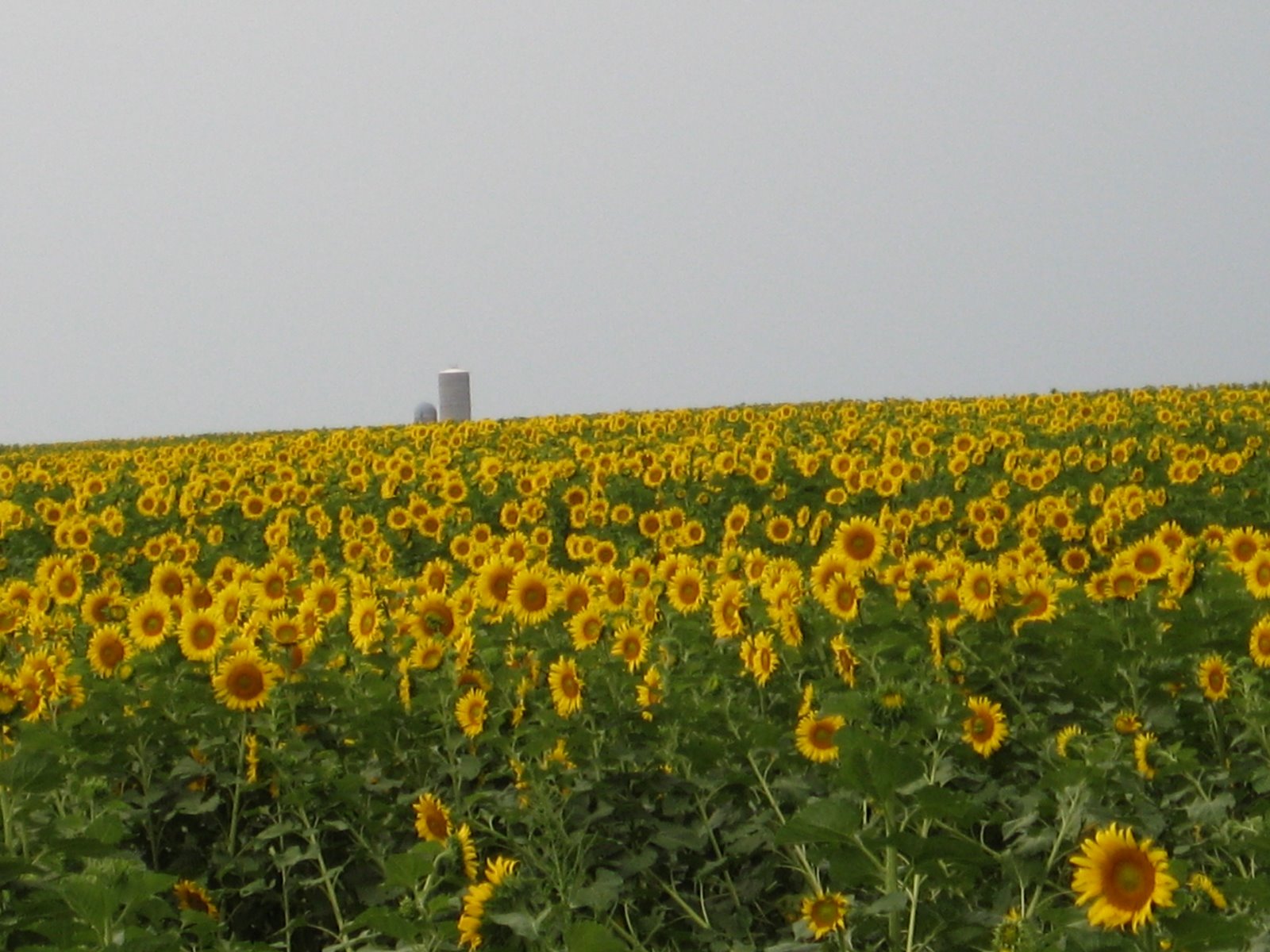
One sees innumerable cornfields while driving through the Great Plains, but there are fields of sunflowers too. The building in the distance is a silo.


Hampi (see more here)

Relief just outside the Virupaksha temple complex.

Examples of Islamic architecture in Hampi.

Saturday, November 24, 2007

Tardiness, and a new blog

Apologies for not having been to post much this month – certain other activities (including traveling, binge dining and lazing around) have taken over. Should be back soon enough, I think, though I've made such promises in the past only to break them.

In the meantime, here’s another blog that I recently started: Out of Kilter. It’s actually related to my profession, operations research, which earns me a living and which is often described rather glibly and abstractly as The Science of Better (click to see a summary of what operations research means and entails). I’ll be posting some personal notes and opinions on some unconventional aspects of operations research in Out of Kilter. My introductory post is here – where you’ll find why the blog is named that way - while my first post on relationships that maximize HIV transmissions is here.

In the future, I'll post snippets from Out of Kilter in this space, just to add some variety, to go with posts on history, travel and literature that are the staple of this blog. Which reminds me: I just organized some selected posts over the last two years from some of these categories on my sidebar, so do take a look.

Thursday, November 15, 2007

Nollywood, and exceprts from William Easterly's book

Ever wondered which movie industry is the most vibrant after Bollywood and Hollywood? It’s Nollywood apparently, and here’s the story:
In 1992, Nigerian moviemaker Ken Nnebue released a film called Living in Bondage, a melodrama about a man who joins a secret sect that promises him great wealth if he sacrifices his wife. The film’s dialogue is in Igbo, with subtitles in English. Rather than showing the movie in theaters, which many Nigerians could not have afforded, Nnebue released the film directly to video. This was born the Nigerian movie industry called Nollywood, sometimes called the third most vibrant movie industry in the world after Hollywood and Bollywood. Shooting with a very low budget and a tight schedule, Nigerian moviemakers churn out thousands of titles affordable to poor Africans. The industry reaches the African mass market by emphasizing local cultures and themes most relevant to Africans. People in Nigeria video stores often pass up the latest Hollywood release in favor of one of them from Nollywood.
That’s from William Easterly’s The White Man’s Burden: Why the West’s efforts to aid the Rest have done so much ill and so little good. Easterly is a development economist at the New York University. His point in the book is that transformations in poor countries will happen through the efforts, small and large, of homegrown entrepreneurs – Ken Nnebue of Nollywood is one example – and not through the ineffective aid efforts of institutions such as the G8 or the World Bank. Easterly is also critical of Jeffrey Sachs, whose argument is the exact opposite: that West has not been providing enough aid. Easterly is particularly miffed at the grand-sounding title of Sachs’ latest book The End of Poverty: The Economic Possibilities of Our Time.

But to return now to another excerpt. In this - one of my favorites in the book - Easterly illustrates how a local entrepreneur's perseverance despite immense adversities has helped increase access to cell phones (their usage has grown spectacularly in Africa) and hence improve businesses:
Entrepreneur Alieu Conteh started building a cellular network in the Democratic Republic of the Congo (formerly Zaire) when it was still in the midst of its civil war in the 1990s. He couldn’t get foreign manufacturers to ship cellular towers into the country with rebel soldiers around, so he got local men to weld scrap metal into a makeshift tower. Demand exploded for Conteh’s phones, and in 2001 he formed a joint venture with the South African firm Vodacom. One illiterate fisherwoman who lives in the Congo without electricity relies on her cell phone to sell her fish. She can’t put the fish in a freezer, so she keeps them alive on a line in the river until customers call to place an order. Vodacom Congo now has 1.1 million subscribers and is adding more than a thousand a day.